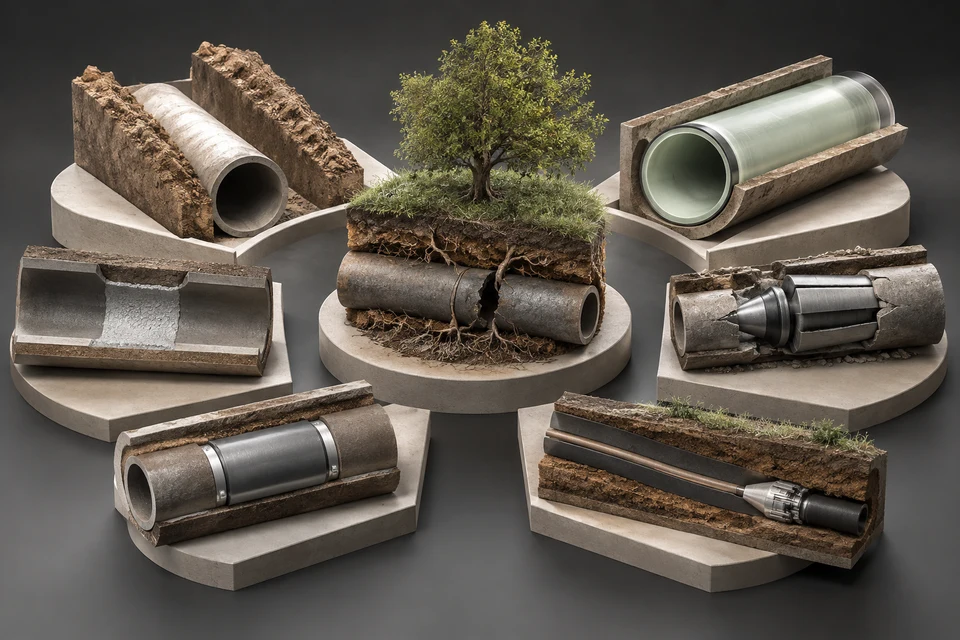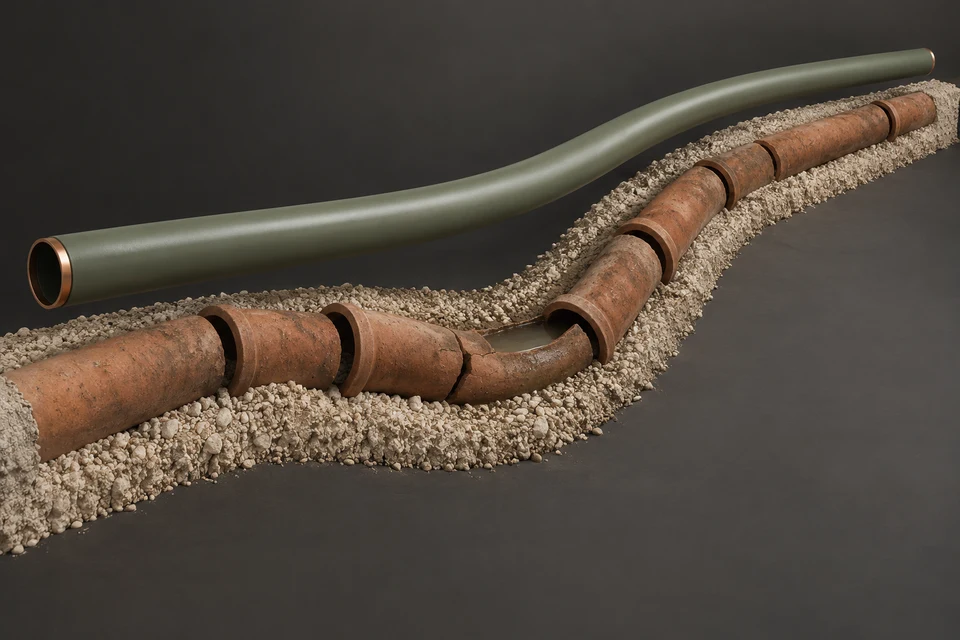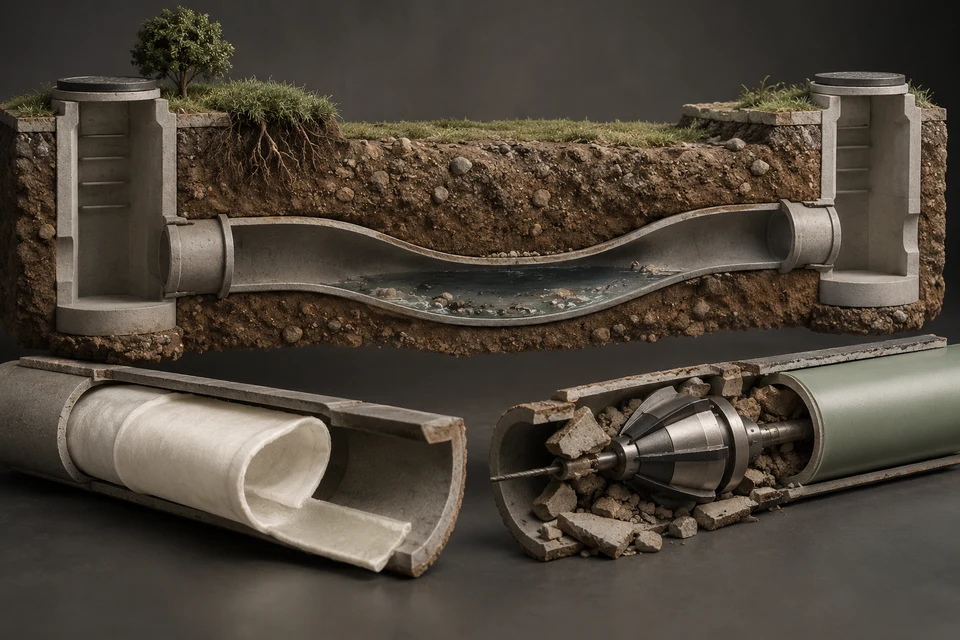
No. Trenchless methods cannot fix a belly. A CIPP liner cures against the old pipe and copies its dip exactly, and pipe bursting pulls new pipe along the old path, sag included. Correcting a belly means excavating the sagging section, rebuilding the bed beneath it and re-laying the pipe to grade. The rest of the line can often still be lined.
- A belly is a grade problem, and only excavation changes grade.
- Lining a sagging line gives you a new pipe with the same low spot.
- Judge a belly by how deep the water stands, how long the low section is, and whether solids collect there.
- The common fix is a spot excavation at the sag combined with lining or leaving the sound remainder.
- Find out why the pipe sank before re-laying it, or the new section may sink too.
01 /What is a belly in a sewer line?
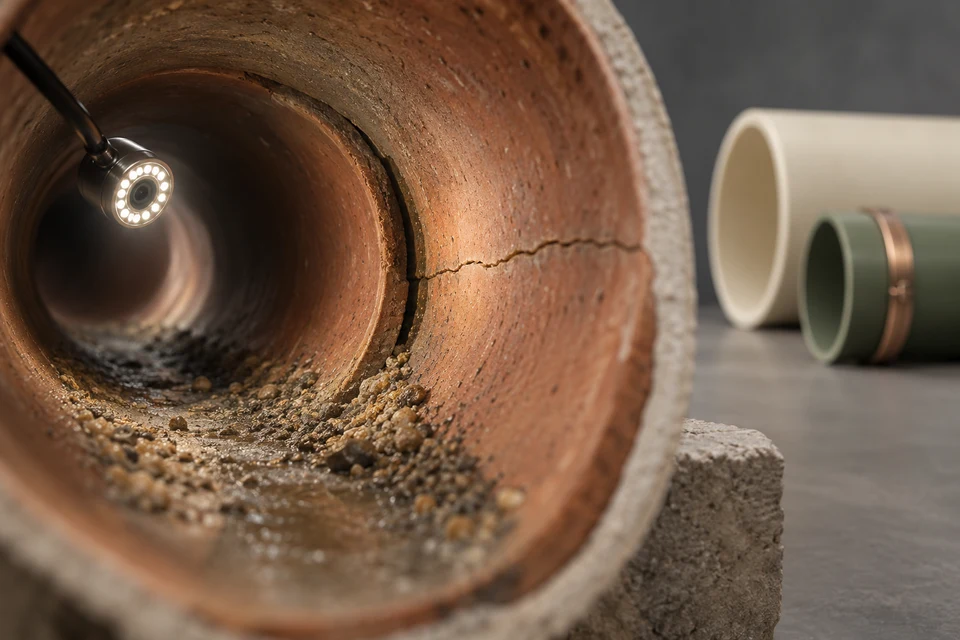
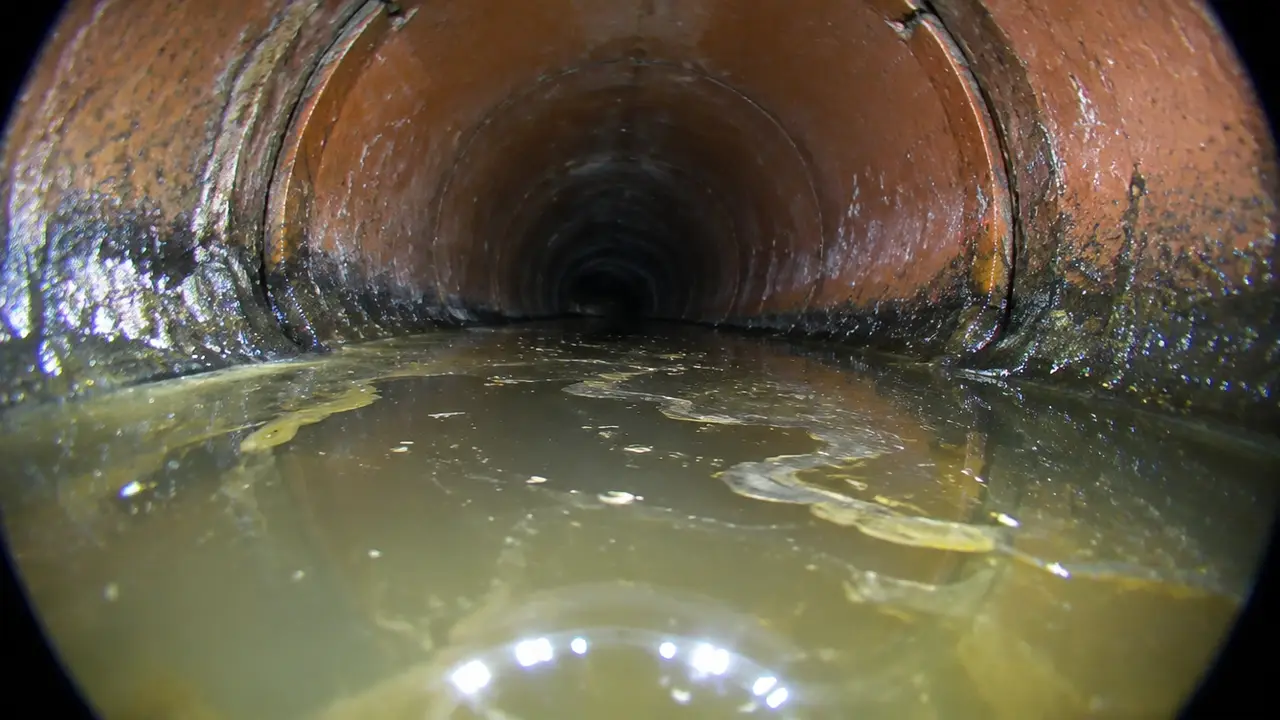
A belly, also called a sag, is a section of pipe that has settled below its designed slope, so water and solids collect there instead of draining. On camera it shows as a stretch where the water line rises across the pipe, sometimes submerging the camera lens, then falls away again downstream.
A building sewer depends on gravity. Canadian plumbing codes set a minimum slope for building drains and sewers, commonly expressed as a ratio such as 1 in 50 or 1 in 100 depending on pipe size, and the local inspector enforces the figure that applies. Where a pipe loses that slope, flow slows, paper and solids drop out, and the pool becomes a place where blockages start.
02 /Why can't lining or bursting fix a sag?
Both trenchless methods take their direction from the old pipe. A liner is pressed against the host wall and cured there, so its invert follows the host's invert millimetre for millimetre. A bursting head is guided by the old pipe it is breaking, so the new pipe arrives in the same channel, dip and all.
You may hear that a stiff HDPE pipe pulled under tension can bridge a very short, shallow dip. Treat that as a possibility to discuss, not a fix to count on. If the camera shows a sag that matters, plan for excavation at that point. This is why the Repair or Replace? Decision Engine returns 'Replace the sagging section' whenever a sag is present, and why the Replacement Method Selector rates both lining and bursting 'Not suitable' for a sagging line.
03 /How serious is the belly on your camera footage?
There is no single code threshold that says when a residential belly must be fixed. Judge it by four things you can see on the video: how deep the standing water is relative to the pipe, how long the low section is, whether solids and paper are sitting in it, and whether it lines up with your history of blockages.
| What the footage shows | What it suggests | Typical response |
|---|---|---|
| A thin film of water over a short length | Minor settlement; drains slowly but completely | Note it, keep the video, recheck if symptoms appear |
| Water across a good part of the pipe height for a metre or two | A true belly that slows flow | Monitor with regular cleaning; plan repair if blockages recur |
| Water reaching the top of the pipe or submerging the lens | Deep sag; solids likely to settle | Plan to excavate and re-lay that section |
| Debris, paper or grease sitting in the pooled water | The sag is actively trapping solids | Repair is usually justified |
| A belly next to cracks, offsets or separated joints | The pipe may still be moving | Repair and investigate the cause |
Two practical tips. First, ask the inspector to run water from an upstream fixture during the recording, which shows whether the pool drains or just rises and falls. Second, note the distance of the low point on the counter and have it marked on the surface with a locator, along with its depth. Without that, no one can price the dig.
04 /Why did the pipe sink in the first place?
Pipes sag because the ground beneath them moved or was never properly prepared. Knowing which cause applies matters, because re-laying a pipe on the same poor foundation invites the same result.
- Poor original bedding: the pipe was laid on uneven or soft trench bottom with little granular support.
- Loose backfill settling: uncompacted fill beneath or beside the pipe consolidated over time.
- Washout from a leak: water escaping through a cracked pipe or open joint carried fine soil away, leaving a void that the pipe dropped into.
- Soft or wet soils: organic soil, saturated silt or disturbed ground that could not carry the load.
- Later digging nearby: another utility trench or a foundation excavation disturbed the ground next to the lateral.
- Freeze and thaw: in shallow sections, frost can lift and drop the pipe repeatedly, loosening its support.
Shallow bellies deserve particular attention in Canada. Standing water in a section of lateral with little cover can freeze in a hard cold snap, especially under a driveway cleared of insulating snow.
05 /How is a sagging section re-laid?
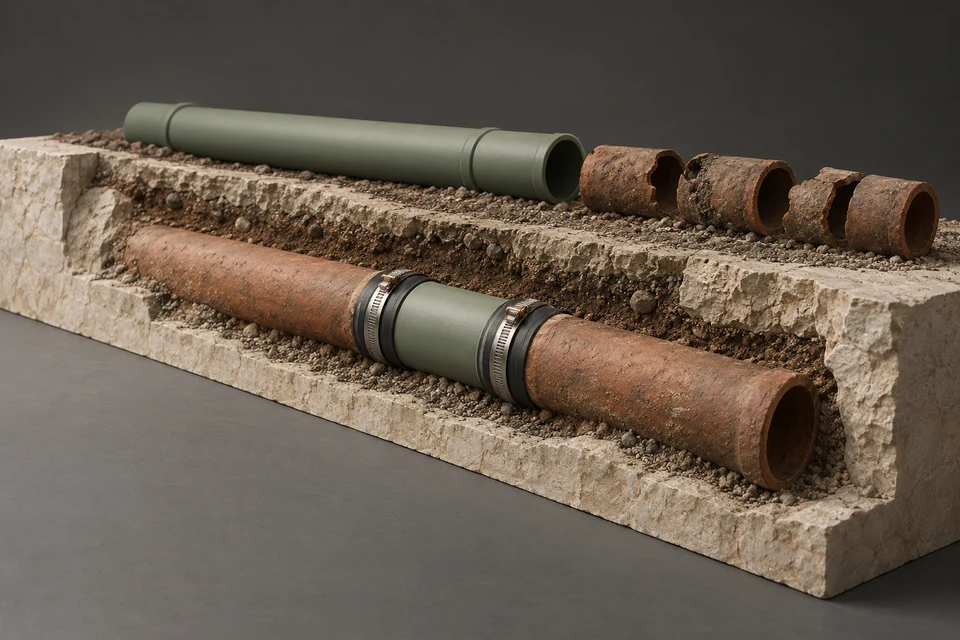
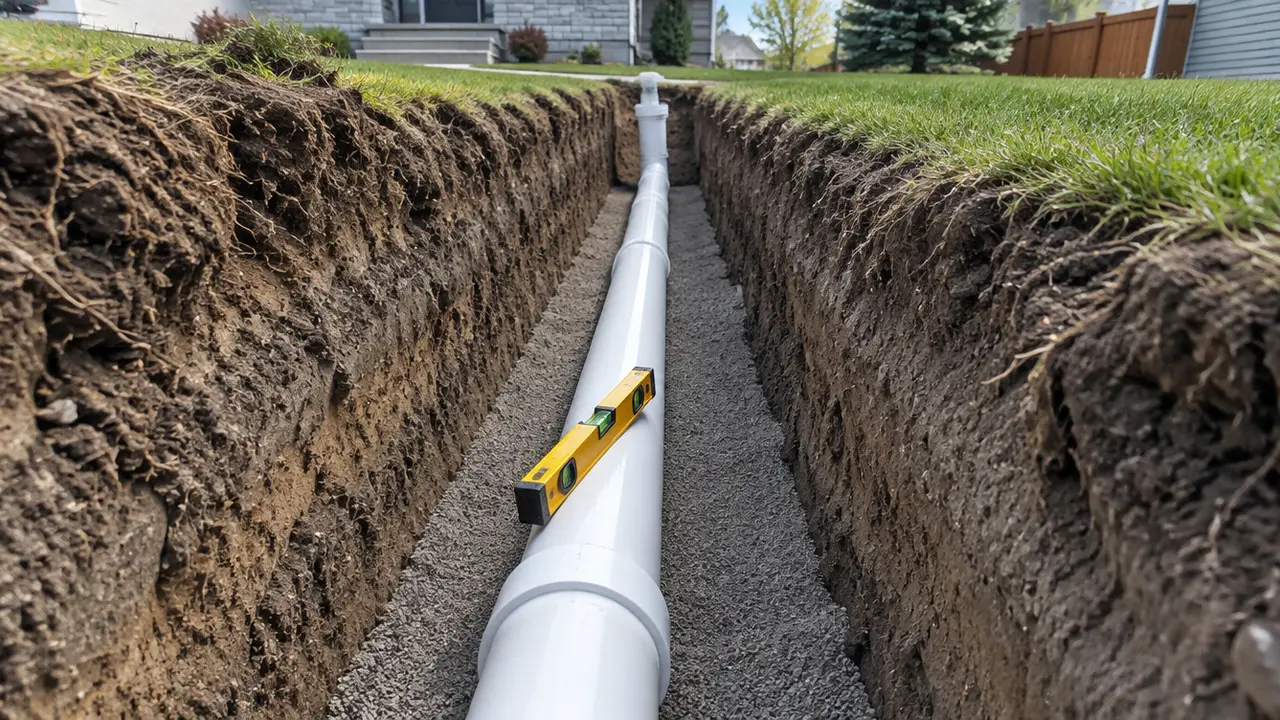
The sagging section is excavated, the pipe removed, the ground beneath rebuilt, and new pipe laid to a checked grade, then tied into the old pipe or a new liner at each end. On a typical residential lateral, the dig covers the length of the belly plus enough room at each end to make sound connections.
- Locate and expose
The low point is located from the surface, utilities are marked, and the pipe is exposed with enough length on each side to reach sound pipe.
- Remove soft ground
Soft, wet or organic material under the old pipe is dug out and replaced with compacted granular material so the new section has a firm base.
- Set the grade
The new pipe is bedded and checked with a level or laser so it falls continuously in the direction of flow, matching the pipe at both ends.
- Connect
The new section is joined to the existing pipe with approved couplings suited to both materials, such as shielded transition couplings between clay or cast iron and PVC.
- Inspect, then backfill in lifts
Where a permit applies, the inspector sees the work before cover. Backfill goes in compacted layers so the surface does not settle over the next season.
06 /What are the options if the whole line sags or the belly is long?
If the belly covers most of the line, or there are several, an open-cut replacement of the whole run is usually the cleanest answer, because it rebuilds grade from end to end. That is the second half of rule 2 in the decision engine: replace all of it when the sag extent is 'throughout'.
| Situation | Common fix | Why |
|---|---|---|
| One short belly, rest of line sound and modern | Spot excavation at the belly only | Fixes the grade without disturbing sound pipe |
| One belly in an old clay or cast iron line with joint problems | Excavate the belly, then line the remaining run | Grade fixed by digging, joints sealed by lining |
| Several bellies along the run | Open-cut replacement | Grade must be rebuilt from end to end |
| Belly under a structure you cannot dig through | New route by open cut or guided boring | Bypasses the problem section |
| Minor belly with no blockage history | Monitor and clean as needed | The cost of digging may outweigh the benefit |
A combined approach is often the best value: excavate only where the grade is wrong and let trenchless methods handle the rest. Ask contractors to price it that way alongside a full open-cut option, so you can compare like with like. For method trade-offs, see sewer replacement methods compared.
07 /Can you live with a belly?
Sometimes. A shallow belly in a sound plastic pipe that has never caused a blockage can reasonably be left alone and watched. What you are managing is the risk of solids building up in the low spot, so the strategy is to keep them from accumulating and to recheck the line.
- Keep wipes, grease and paper towels out of the drains entirely.
- Consider periodic jetting if solids have been seen collecting in the sag.
- Recheck with a camera after any slow-drain episode, and before selling.
- Keep the original video so a later inspection can show whether the sag has deepened.
If you are unsure whether your belly is the 'live with it' kind or the 'dig it' kind, run your findings through the decision engine and then have a contractor review the footage. When you are ready, request quotes that price the belly repair on its own and as part of a full solution.
FAQQuestions people ask
Can trenchless sewer repair fix a belly?
No. Lining copies the old pipe's shape, and bursting follows its path. A belly has to be excavated and re-laid on a proper bed and grade. Trenchless methods can still renew the rest of the line.
Is a belly in a sewer line a big deal?
It depends on depth, length and whether solids collect in it. A shallow film of water may be tolerable. A deep sag that traps debris or coincides with repeated blockages usually needs repair.
How is a sewer belly fixed?
By excavating the sagging section, removing soft ground beneath it, placing compacted granular bedding, and laying new pipe to a checked slope before backfilling in compacted layers.
Will hydro jetting fix a sewer belly?
No. Jetting can clear solids that collect in the sag, which helps manage it, but it cannot change the pipe's slope. The low spot remains and will collect material again.
Can a new sewer line develop a belly?
Yes, if it was laid on poor bedding or loose backfill, or if nearby ground is later disturbed. Good bedding, compacted haunches and backfill placed in lifts are what prevent it.
NETWORKGo deeper across the HAUSE Sewer network
Common sewer defects, explained by what they do to the pipe
Common sewer defects explained: roots, cracks, fractures, offset and separated joints, sags, deposits, holes and collapse, with severity and usual next steps.
SewerJetting.caJetting before trenchless lining: why the prep cleaning decides the result
Why jetting before trenchless lining matters: root removal, descaling cast iron, cleaning to a bare wall, camera checks and what rushed CIPP prep causes.
SewerCleaners.caFats, oils and grease: how FOG builds up in sewer lines and how to stop it
How fats, oils and grease (FOG) build up in sewer lines, why hot water and soap fail, how sewer cleaners remove grease, and kitchen habits that prevent it.