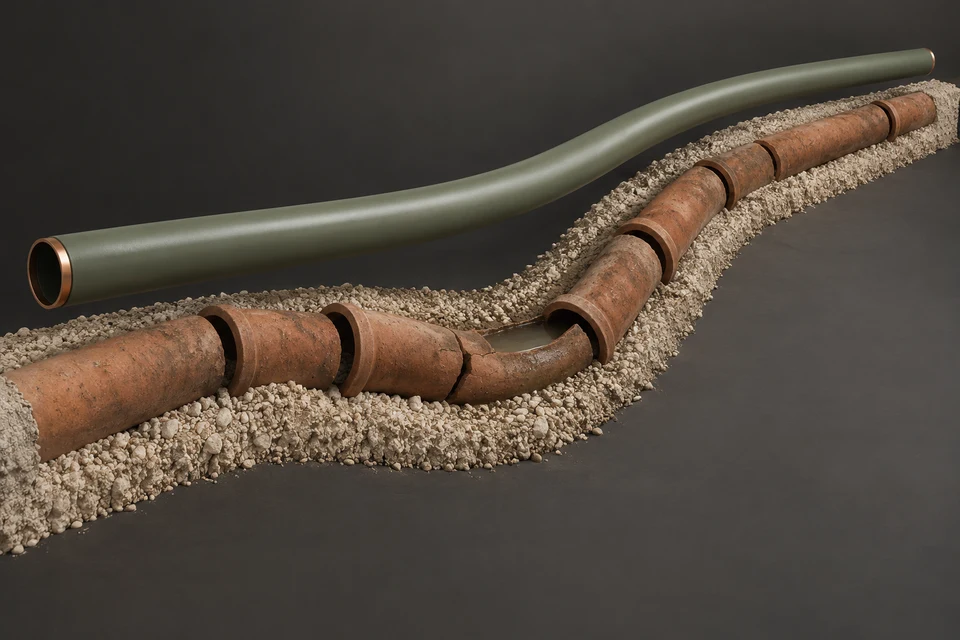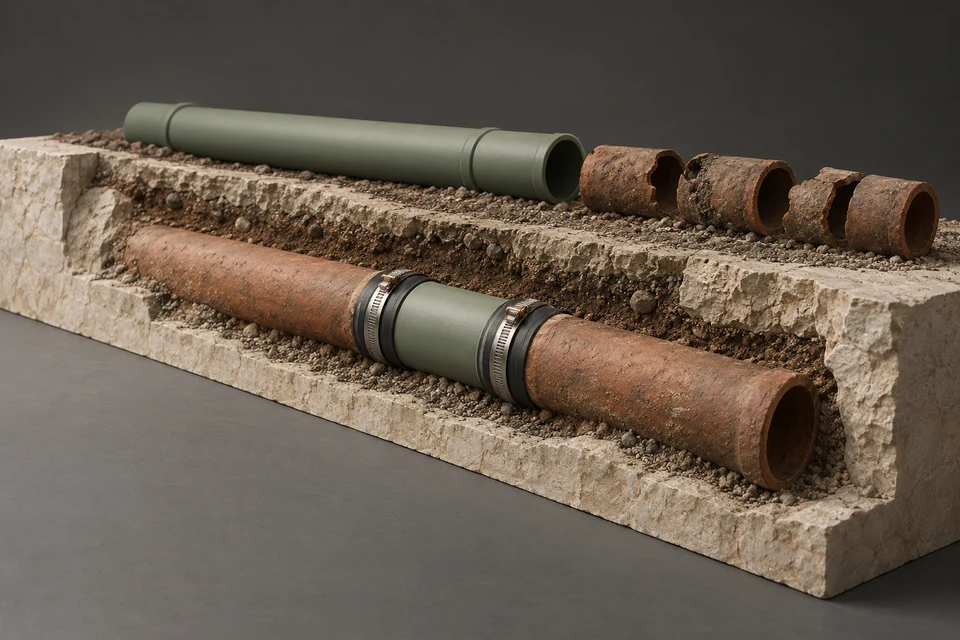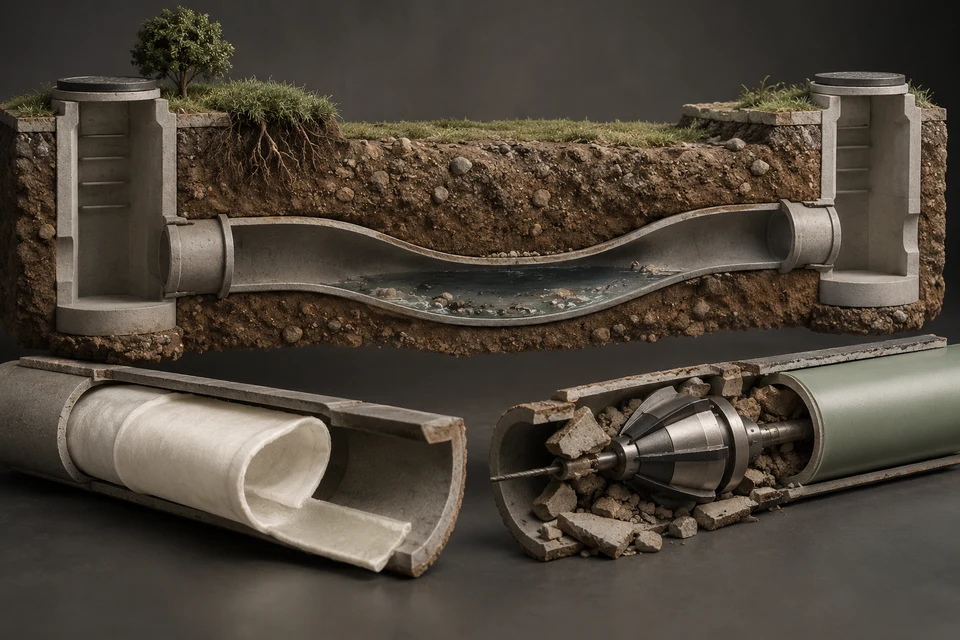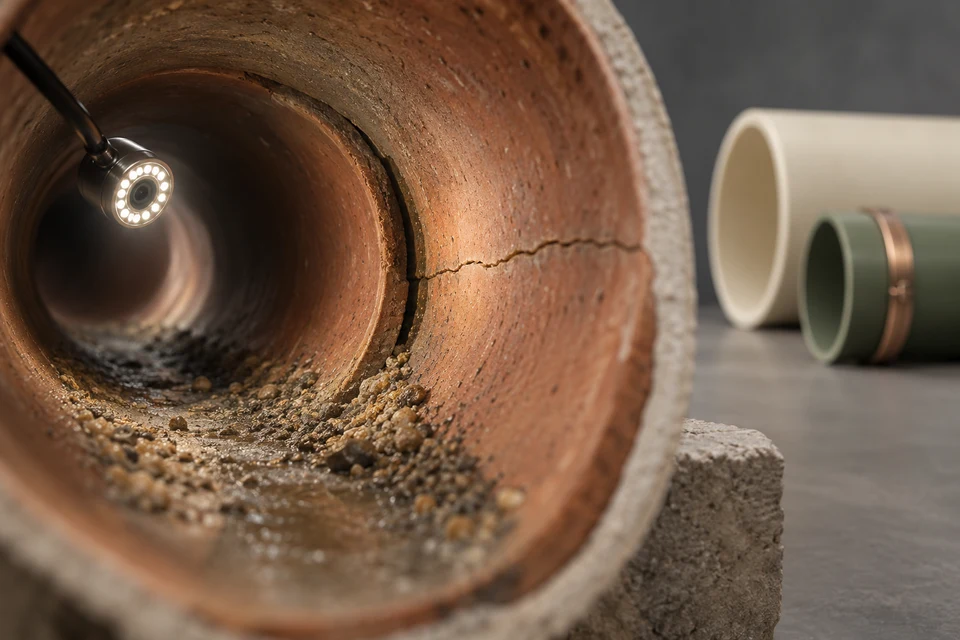
The Repair or Replace? Decision Engine turns camera findings into a verdict: replace, replace the sagging section, spot repair, descale then reline, reline, maintain, or get a second opinion when nothing fits. It weighs material, age, camera findings, extent, recent backups and your plans, applies seven rules in order with the first match winning, and explains its reasons and what to ask a contractor.
- The engine applies seven rules in a fixed order; the first rule that matches decides the verdict.
- Structural failures such as collapse, deformation and sags are checked first because they rule out repair methods that cannot handle them.
- Two modifiers add notes: one for selling within two years and one for lines aged 70 or more.
- The result is a starting point for a conversation with a contractor, not a diagnosis or a quote.
- Method choice comes next: take the verdict to the Replacement Method Selector.
Repair or Replace? Decision Engine

01 /What does the decision engine ask?
It asks six questions, all answerable from a camera inspection report and what you know about the house. The more precisely the report describes the findings and their extent, the more useful the verdict.
| Input | Choices | Why it matters |
|---|---|---|
| Material | Clay, cast iron, bituminous fibre, concrete, ABS-PVC, unknown | Each material fails differently; fibre pipe deforms and cannot be repaired |
| Age | Under 25, 25 to 50, 50 to 70, 70+ years | Sets how much life the untouched pipe has left |
| Camera findings (tick all that apply) | Roots at joints, cracks, fractures, offset joints, sag or belly, collapse or broken, heavy scale or corrosion, deformed pipe | Decides which repair methods are even possible |
| Extent | One spot, a few spots, throughout | Separates spot repair from full-length renewal |
| Backups in the last 2 years | 0, 1, 2+ | Shows whether maintenance is keeping up |
| Plans | Staying 10+ years, or selling within 2 years | Changes what you should document and when |
If the material is not stated in the report, choose 'unknown'. If the report lists a finding you do not see here, pick the closest structural equivalent and note it for the contractor conversation.
02 /What rules does it apply?
The engine checks seven rules in order, and the first one that matches decides the verdict. The order matters: the most serious conditions come first because they eliminate options that later rules would otherwise suggest.
- Collapse or broken pipe, bituminous fibre pipe, or deformed pipe throughout → Replace, by open cut or bursting. A liner cannot be installed through a collapse, and it would copy a deformed shape.
- Sag or belly present → Replace the sagging section, or all of it if the extent is 'throughout'. Lining follows the bad grade, so it cannot fix a sag.
- Extent 'one spot' and no heavy scale → Spot repair, by excavation or a sectional liner.
- Heavy scale on cast iron with extent 'throughout' → Descale then reline, or Replace if the age is 70+.
- Only roots at joints, at 'a few spots', with 0 or 1 backups → Maintain: root cutting plus a camera every 1 to 2 years, and consider relining. With 2+ backups → Reline.
- Any other findings at a few spots or throughout on clay, concrete or cast iron → Reline (CIPP).
- No findings → Maintain.
If your inputs match none of the seven rules, for example structural findings in a plastic line at a few spots, the engine does not force a verdict. It returns Get a second opinion and suggests asking two contractors to explain their method against the footage.
Each rule encodes a piece of engineering. Rule 1 exists because lining needs a round, continuous host; a collapsed or flattened pipe is not one. Rule 2 exists because every trenchless method follows the old grade, so a belly can only be corrected by digging, as can trenchless fix a belly explains. Rule 3 reflects the principle that a single defect in otherwise sound pipe rarely justifies renewing the whole line, but it excludes heavy scale because scale is a whole-pipe condition. Rule 4 recognises that cast iron heavily scaled throughout can often be descaled and lined, while very old cast iron may have too little wall left to be worth it.
03 /Why does roots-only get its own rule?
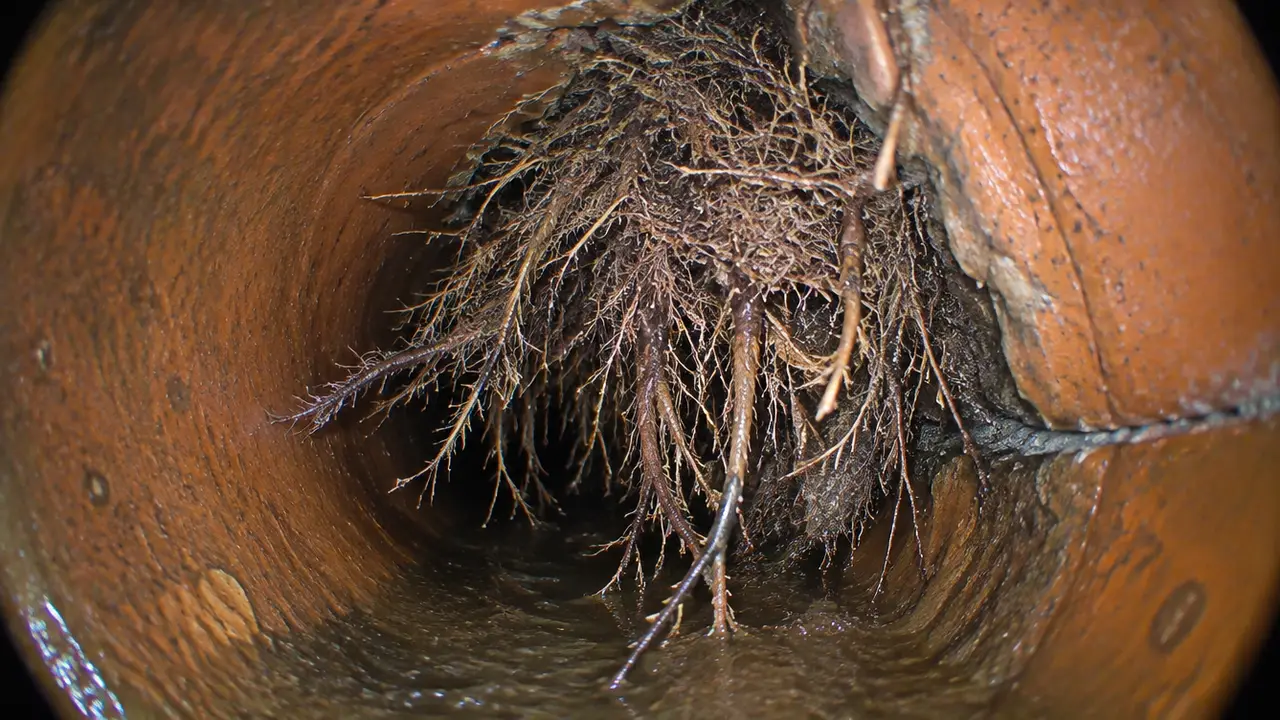
Because roots at a few joints are a maintenance problem before they are a structural one. Cutting roots and checking the line on a schedule can keep a clay line working for years, and that is cheaper than relining in the short run. The backup count is the tie-breaker: if the line has backed up twice or more in two years despite that maintenance, the treadmill has stopped working and relining is the better answer.
Rule 6 then catches the rest of the older-material cases: cracks, fractures, offsets and similar findings at more than one spot in clay, concrete or cast iron. For those, a full-length cured-in-place liner seals every joint and crack in one installation, provided rules 1 and 2 have already confirmed the pipe is round and on grade. CIPP lining explained covers what that involves.
04 /What do the modifiers add?
Two situations add a note to whatever verdict the rules produce. They do not change the verdict itself.
| Condition | Note added | Why |
|---|---|---|
| Plans: selling within 2 years | Selling soon: document the condition and get written quotes; a buyer’s inspector will likely scope it | A recorded video and written quotes let you control the conversation instead of reacting to a buyer's report |
| Age: 70+ | At over 70 years, remaining life is limited even where the pipe has not yet failed | Very old lines are often close to their next failure, so full-length options deserve a price alongside any repair |
05 /What does the result show?
The result gives you three things: the verdict, the reasons behind it, and what to ask the contractor. The reasons explain in plain language why the rule that fired applies to what you entered, so you can check the logic against your report. The question is there so the first conversation with a contractor is about your footage, not a sales script.
| Verdict | Ask the contractor |
|---|---|
| Replace (collapse, fibre or deformed pipe) | Open cut or pipe bursting: which suits my depth and surface? |
| Replace the sagging section, or Replace if the sag runs throughout | How long is the sag, and can the rest of the line be lined instead? |
| Spot repair | Dig repair or sectional liner, and will you camera the whole line afterwards? |
| Descale, then reline, or Replace for 70+ cast iron | How thick is the remaining wall where the scale was worst? |
| Maintain or Reline (roots only) | Which joints are the roots entering, and what would lining them cost? |
| Reline (CIPP) | Liner thickness and length, how connections will be reinstated, and the warranty |
| Maintain (no findings) or Get a second opinion | No set question; keep the video and recheck on a schedule, or have two contractors explain their method |
Modifier notes appear under the reasons, and every result closes with a reminder that these are general decision rules and that the footage, and a contractor who has seen it, make the final call.
06 /Worked examples
| Inputs | Rule that fires | Verdict |
|---|---|---|
| Clay, 50–70 years, roots at joints, a few spots, 0 backups, staying | Rule 5 | Maintain: cutting plus a camera every 1–2 years; consider relining |
| Same line, but 2+ backups | Rule 5 | Reline |
| Clay, 50–70 years, cracks and offset joints, throughout | Rule 6 | Reline (CIPP) |
| Cast iron, 70+ years, heavy scale, throughout | Rule 4 | Replace, with the age 70+ note |
| Cast iron, 50–70 years, heavy scale, throughout | Rule 4 | Descale then reline |
| Clay, 25–50 years, sag, a few spots | Rule 2 | Replace the sagging section |
| ABS-PVC, under 25 years, offset joint, one spot | Rule 3 | Spot repair |
| Bituminous fibre, any findings | Rule 1 | Replace |
Notice that a sag wins over everything except collapse, fibre pipe and deformation. A line with cracks throughout and one sag gets 'replace the sagging section' first, because whatever is done to the rest, the belly needs digging. In practice, that often means excavating the sag and relining the remainder.
07 /What does the engine not know?
It knows only what you enter. Several things that matter to the final decision are outside its view, and you should bring them to the contractor conversation separately.
- Ownership: it does not know where your property line is or whether a defect is on the municipal side. Confirm with your municipality before paying for work near the boundary.
- Depth, surface and access: these decide the method and the price, not the verdict. The Replacement Method Selector handles them.
- Cost: the engine gives no prices. Planning ranges are in repair vs reline vs replace cost.
- Mixed lines: many lines change material along their length. Run each section separately if the report treats them separately.
- Plastic lines with structural defects: the rules are built around the failure modes of older materials. Cracks or offsets in PVC or ABS usually point to installation or ground problems that need a contractor's reading of the footage.
- Footage quality: a report that missed part of the line cannot produce a reliable verdict for the part it missed.
08 /How should you use the verdict?
- Check the reasons against the report
If a reason does not match what the report says, recheck your inputs.
- Choose the method
Take the verdict to the Replacement Method Selector with your depth, surface, access, bends and connections.
- Ask the listed questions
Put them to at least two contractors, using the same video.
- Compare like with like
Ask for prices on the verdict and on the next option up or down, such as spot repair and full relining.
- Request quotes
When you are ready, request quotes with the verdict, the reasons and your footage attached.
For the thresholds behind these rules, read when to replace a sewer line and spot repair vs full replacement.
FAQQuestions people ask
Is the decision engine's verdict a diagnosis?
No. It applies general rules to the inputs you enter. A qualified contractor reviewing the actual footage, the depth and the site makes the diagnosis.
Why does a sag override most other findings?
Because no trenchless method can correct grade. Whatever is done to the rest of the line, a belly needs excavation, so the engine flags it before considering lining.
Why is bituminous fibre pipe always a replace verdict?
Fibre pipe softens and deforms under soil load along its length. A liner would copy the deformed shape, and repairs leave deforming pipe on either side, so replacement is the lasting answer.
What does 'maintain' mean?
Keep the line clear with root cutting or cleaning as needed and a camera check every one to two years, comparing videos over time. For roots-only lines, consider relining if backups start to recur.
Does the engine give prices?
No. It returns a verdict, reasons and a question for the contractor, but no dollar figures. Planning ranges are on the repair vs reline vs replace cost page, and only a scoped written quote is a price.
What if my result says 'Get a second opinion'?
Your combination of findings did not match any of the seven rules, which often happens with defects in plastic pipe or mixed lines. Send the same footage to two contractors and ask each to explain their recommended method against it.
NETWORKGo deeper across the HAUSE Sewer network
Jet or auger? A decision tool for your blocked line
Jet or auger decision tool: enter blockage type, pipe material, camera findings, pipe size and access to see whether to jet, auger or camera first.
SewerCleaners.caHow to hire a sewer cleaner: the checklist, the questions and the paperwork
How to hire a sewer cleaner in Canada: questions to ask, insurance and WCB coverage in Alberta, a written scope template, red flags, and how to compare quotes.
PipeCleaning.caPipe Method Matcher: which cleaning methods suit your pipe
Pipe Method Matcher: enter your house era, pipe material and symptom to see which pipe cleaning methods are recommended, safe with conditions, or avoid.