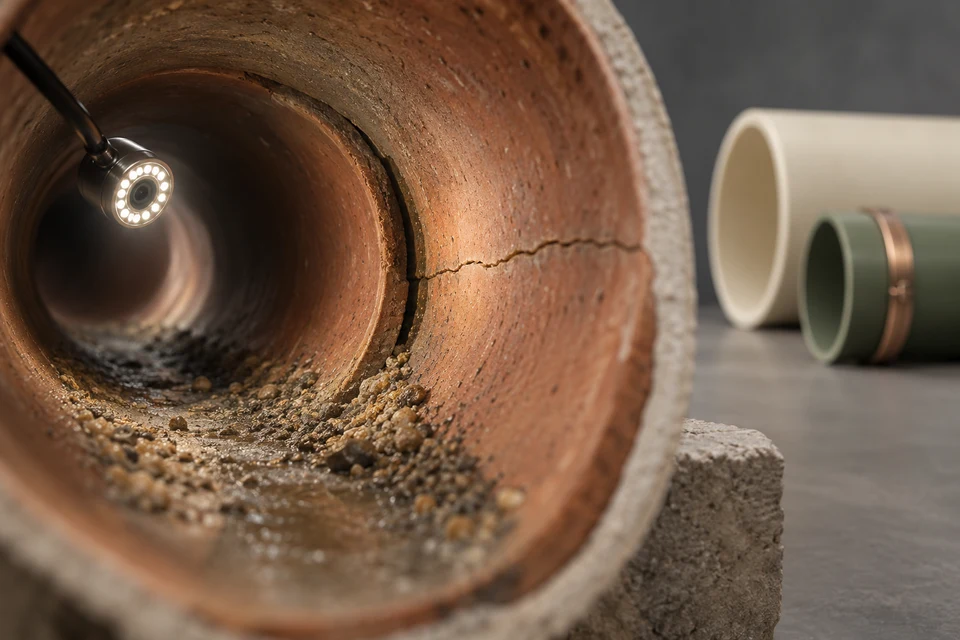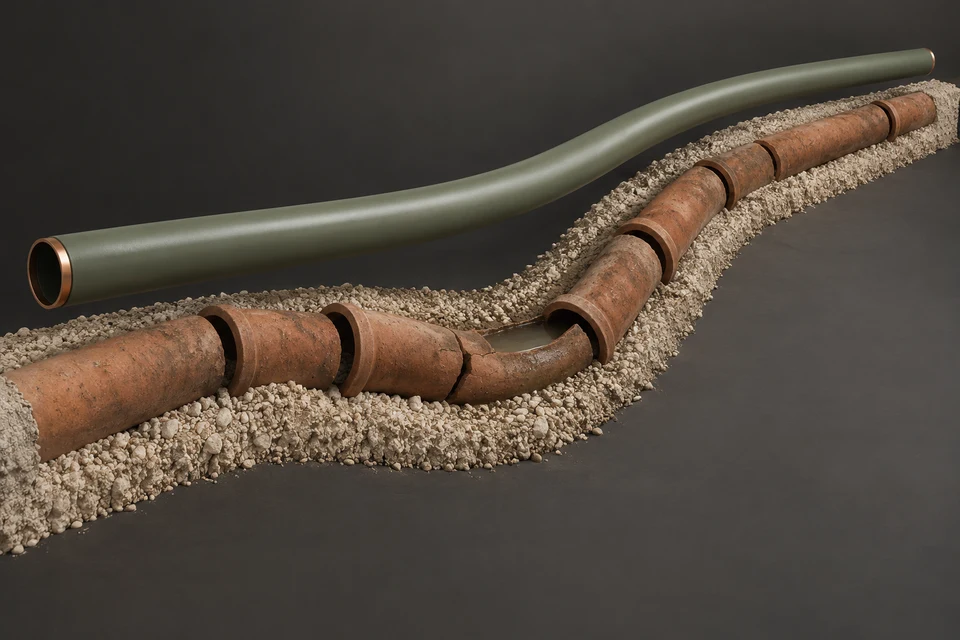
Replace a sewer line when recorded camera footage shows damage that repair cannot reliably fix: a collapse, deformed or bituminous fibre pipe, fractures or holes repeating along the run, a belly that holds water, or cast iron corroded throughout. Age alone is not a reason. Structural defects at many joints plus recurring backups usually are.
- Symptoms prove that something is wrong; only recorded camera footage shows whether the pipe itself has failed.
- Replacement is justified by the extent and type of damage, not by the age of the house.
- A pipe that can no longer serve as a host for a liner, such as a collapsed or badly deformed one, has to be replaced or burst.
- When cleaning is needed more than once a year to keep the line flowing, the maintenance treadmill is costing you the price of a permanent fix.
- The best time to replace is before something expensive is built on top of the line.
01 /How do you know a sewer line needs replacing rather than repair?
You know from recorded camera footage, read against three questions: how much of the line is damaged, whether the damage is structural, and whether the old pipe is still sound enough to hold a liner. Backups, gurgling and slow drains tell you the line is in trouble. They do not tell you whether a single joint, a single root mass or 20 metres of pipe is responsible.
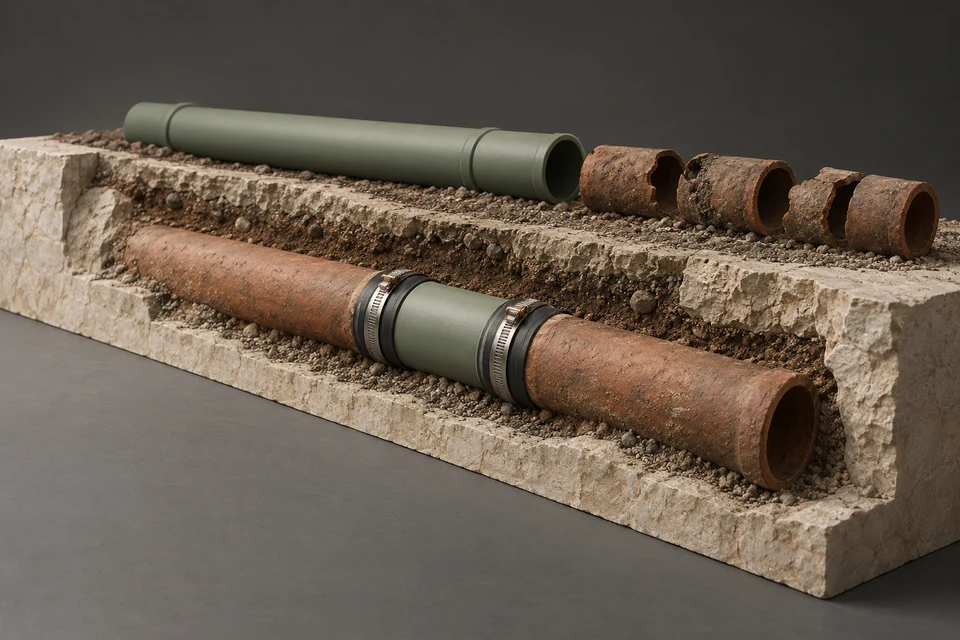
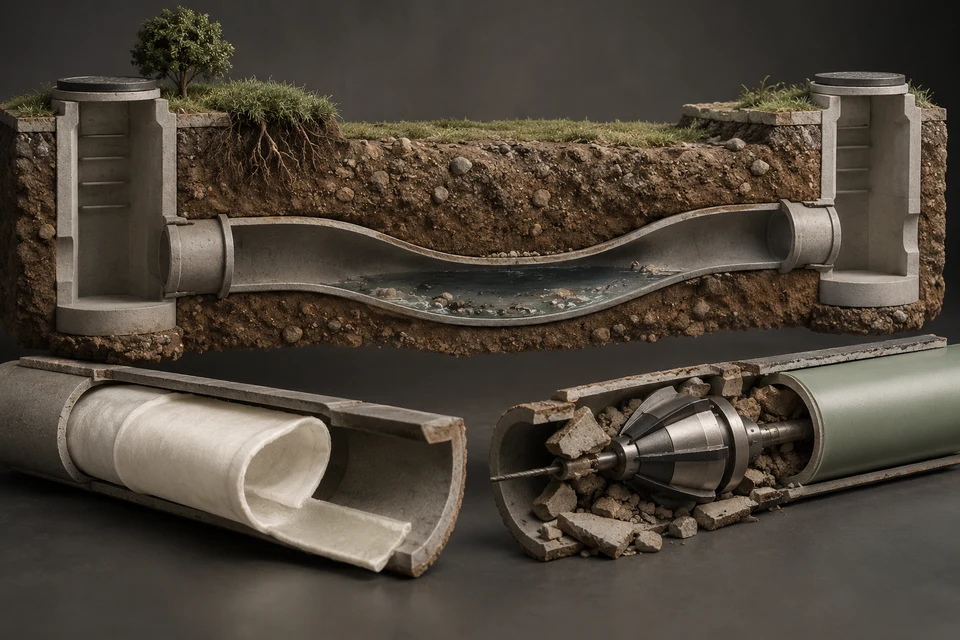
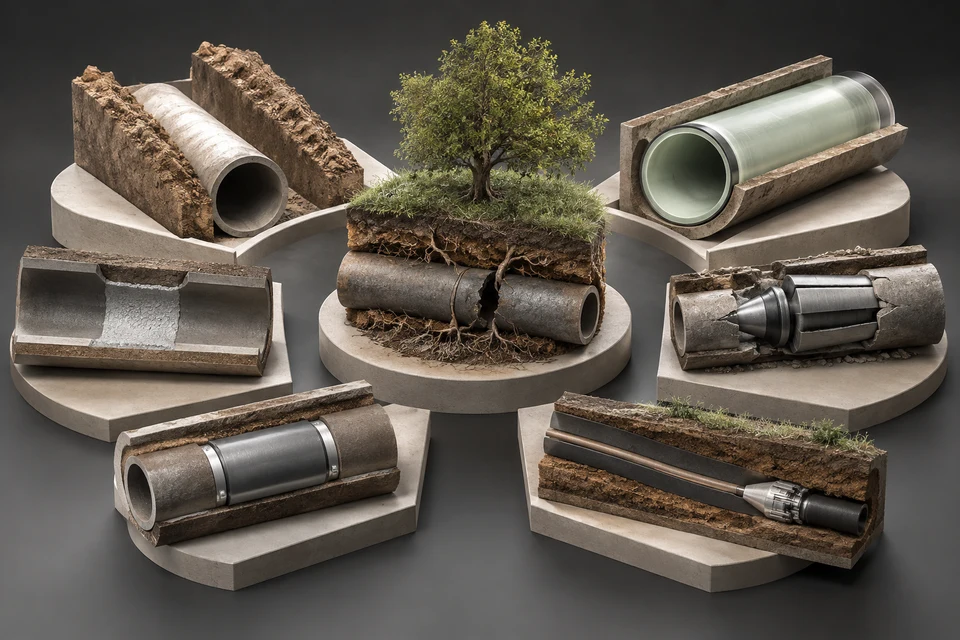
Replacement means one of three things in practice. The old pipe is dug out and a new one is laid in a trench (open cut). The old pipe is broken outward while a new pipe is pulled in behind it (pipe bursting). Or the old pipe is left in place and a new structural pipe is formed inside it (full-length cured-in-place lining, often called relining). All three give you a new pipe from end to end. A spot repair or a short sectional liner fixes one location and leaves the rest of the original line in service.
| Question | Points toward repair | Points toward replacement or full relining |
|---|---|---|
| How much of the line is damaged? | One location, or two well-separated defects | Defects repeat at many joints or along most of the run |
| Is the damage structural? | Roots, grease or scale in otherwise sound pipe | Fractures, holes, deformation, collapse, lost grade |
| Can the old pipe host a liner? | Round, continuous, on grade | Collapsed, crushed, badly deformed, or sagging |
If you answer the first question 'many places' and the second 'structural', you are in replacement territory. The third question decides whether that replacement can be done from inside the old pipe or needs a new path, which is why the method question comes after the diagnosis, never before it.
02 /Which camera findings point to replacement?
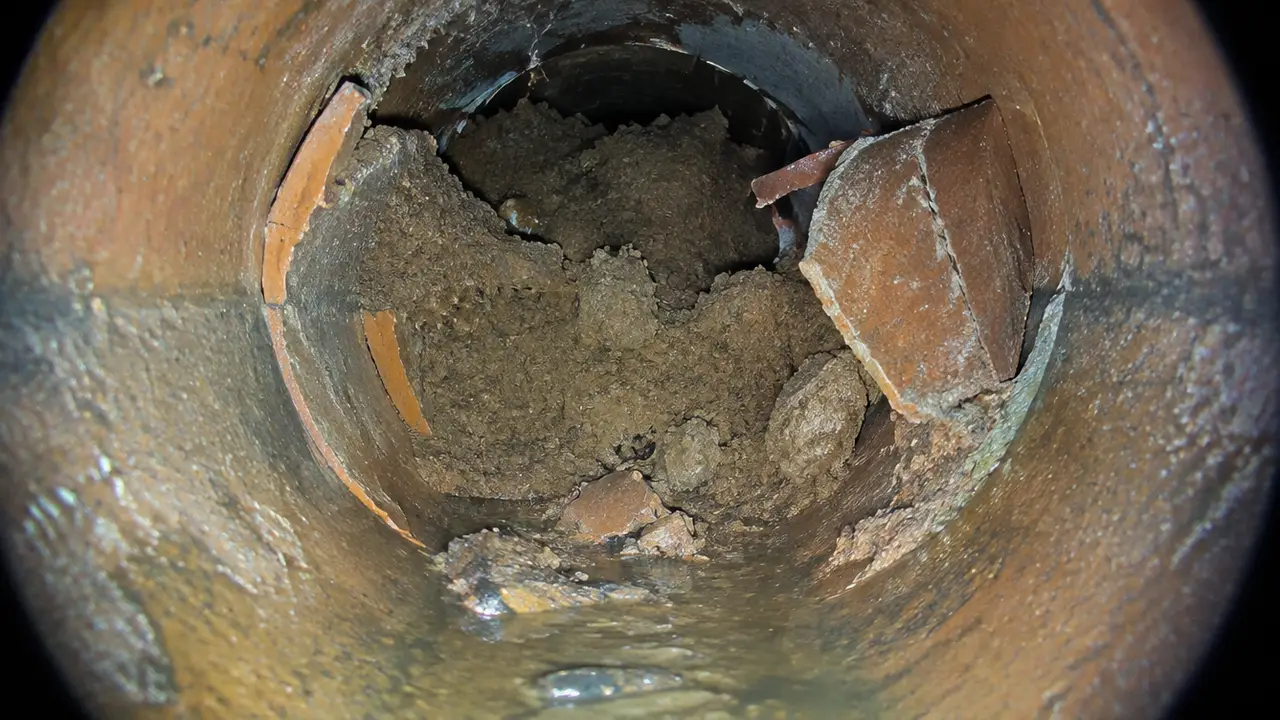
Collapse, holes, deformation and a belly that holds water are the findings that most often end the conversation about repair. Each describes a pipe that has lost either its shape, its wall or its grade, and a pipe without those three things cannot be patched back into service for long.
| Finding on video | What it means for the pipe | Usual response |
|---|---|---|
| Collapse or missing pipe wall | Soil is where the pipe should be; flow is partly or fully blocked | Replace that section by digging or bursting; a liner cannot be installed through a collapse |
| Holes or broken pieces at several points | The wall has failed in more than one place | Replace or burst the run |
| Deformed (oval or flattened) pipe | The pipe is yielding to soil load; typical of bituminous fibre | Replace; a liner would copy the deformed shape |
| Belly holding water across a long stretch | The pipe has settled below its design grade | Replace the sagging section and re-lay it on grade |
| Longitudinal or multiple fractures | Cracking has progressed beyond hairline | Full relining if the pipe is still round; otherwise replace |
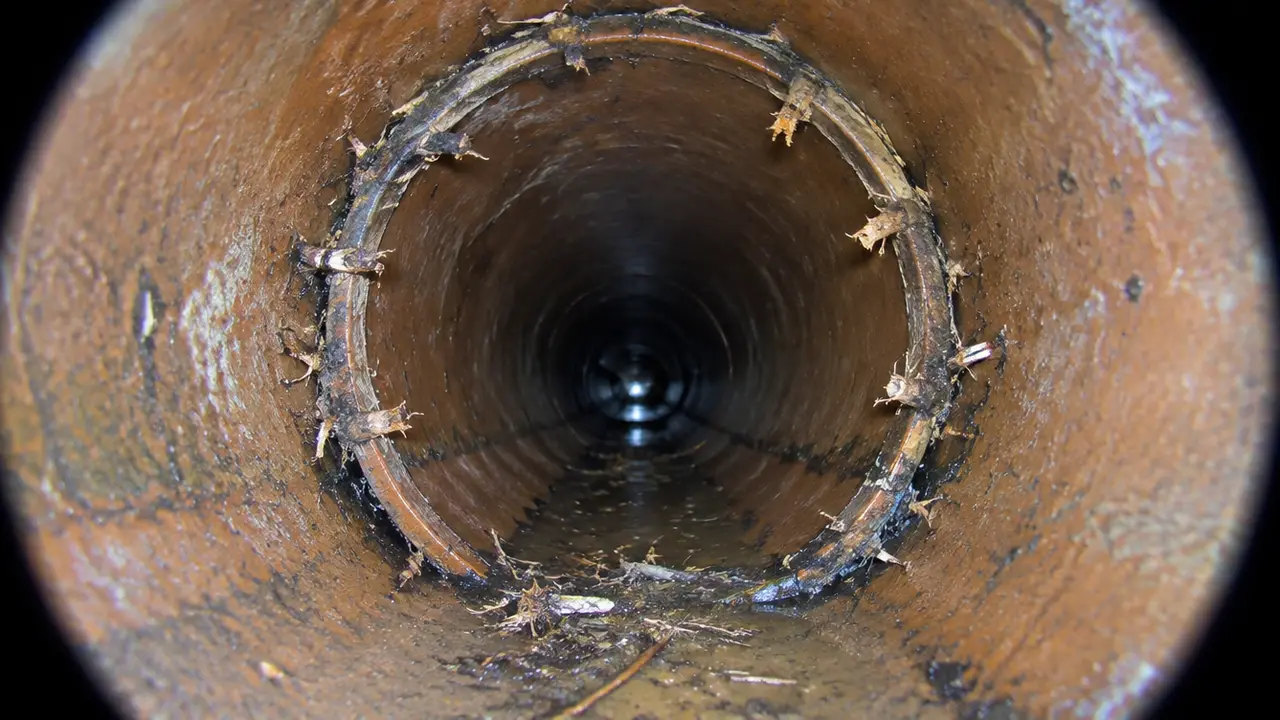
| Roots at most joints of a clay line | Joints are open along the run | Reline, or replace if the line also has grade or shape problems |
| Heavy tuberculation with through-wall corrosion in cast iron | The wall is thinning from the inside | Descale then reline, or replace very old lines |
| One offset or separated joint | Local movement at a single joint | Spot repair by digging or a sectional liner |
| Hairline crack at one location | Minor defect in otherwise sound pipe | Monitor or spot repair |
Two findings deserve extra caution. The first is a camera that stops. If the head cannot pass a point, you do not yet know what lies beyond it, so any replacement quote that covers the unseen section is priced on a guess. The second is soil or gravel visible through a joint or a hole. That means the ground around the pipe is washing into it, which leaves voids that can settle later under driveways and walks.
If you already have a report and want to sort your findings the same way, the Repair or Replace? Decision Engine applies these rules in order and returns a verdict with its reasons.
03 /Do symptoms alone justify replacing a sewer line?
No. Symptoms justify clearing the line and running a camera, not replacement. The same backup can come from a wad of wipes in a sound PVC pipe or from a collapsed clay joint, and the difference between those two fixes is the difference between a service call and a replacement.
- A lowest-fixture backup (floor drain, basement shower or toilet) says the blockage is downstream of every branch, which usually means the building drain or lateral.
- Backups that return within weeks of clearing point to a physical defect that keeps catching debris: roots at a joint, an offset lip, or a belly.
- Gurgling toilets when a washer drains show air being pushed through a partly restricted line.
- A soft or sunken strip in the lawn along the sewer route can mean water and soil are moving around a broken pipe.
- Sewage odour outdoors near the line may indicate a break, though vents and cleanout caps are more common causes.
Use symptoms to decide how quickly to act. Use footage to decide what to do. If a contractor recommends replacement without first showing you a recorded video with distances, ask for the video before discussing price.
04 /Does the age of the pipe matter?
Age matters as a clue to the material and its known failure modes, not as a countdown. A 70-year-old cast iron line in dry, stable soil can still be serviceable, while a 40-year-old bituminous fibre line can already be deformed. What age tells you is which weaknesses to look for on camera. How those weaknesses steer the method for each old material is covered in replacing cast iron, clay and Orangeburg sewer pipe.
| Material | Typical era in Canadian houses | Weak point to check on camera |
|---|---|---|
| Vitrified clay | Early 1900s to the 1970s | Joints: roots, offsets and separations; the clay body itself resists corrosion |
| Cast iron | Common through the 1960s, especially inside houses | Internal scale, corrosion along the bottom, cracks and holes |
| Bituminous fibre (Orangeburg) | Roughly the 1940s to the 1970s in some areas | Blistering, flattening and deformation under soil load |
| Concrete | Mostly older municipal and some private lines | Surface loss from sewer gas corrosion and joint problems |
| ABS and PVC | From about the 1970s onward | Joint installation faults, bedding problems, bellies, or damage from later digging |
The widely used convention is to treat a line of 70 or more years as having limited remaining life even when the video looks acceptable. That does not force replacement. It means that when a repair is on the table, you should price a full relining or replacement alongside it, because the next defect may be only a few metres away. How long sewer pipes last covers the materials one by one.
05 /When is the maintenance treadmill a reason to replace?
When a line needs cutting or jetting more than about once a year to stay open, or has backed up twice or more in two years despite cleaning, maintenance has stopped being cheaper than a permanent fix. Roots grow back into the same open joints, and each cleaning also carries a small risk of damaging an already weak pipe.
A useful exercise is to add up what the last three years of service calls, cleanups and insurance deductibles actually cost, then project that forward ten years. Compare that figure with the price of relining or replacing the line. The arithmetic and planning ranges are laid out in repair vs reline vs replace cost, and SewerQuotes.com publishes detailed pricing for each method.
A line that has to be rescued every spring is telling you the joints are open, and joints do not close themselves.
One caution. If the backups are caused by grease, wipes or a failed backwater valve rather than by the pipe, replacement will not stop them. The camera footage has to show a structural cause before the treadmill argument holds.
06 /Are there good reasons to replace a line before it fails?
Yes. The cheapest time to replace a marginal line is before you build something over it or finish the space it runs under. Once the new work is in, every future repair has to remove and rebuild it.
- Before finishing a basement, if the building drain under the slab is cast iron or clay. Cutting new flooring and tile later costs far more than cutting bare concrete now.
- Before pouring a new driveway, patio or retaining wall over the lateral route.
- Before planting large trees near an old clay or concrete line. See SewerRoots.ca for species and distances.
- Before adding a secondary suite or extra bathrooms, when the existing line is undersized, sagging or marginal.
- When the municipality is rebuilding the main on your street, since the street is already open and the connection may be renewed. Ask your municipality whether owners can coordinate private-side work.
- Before listing a house, if you already know the line is failing and would rather control the fix than negotiate it.
These are planning triggers, not emergencies. They give you time to get a proper camera inspection, compare methods and schedule the work in a good season.
07 /When is replacement the wrong answer?
Replacement is the wrong answer when the defect is isolated, when the pipe is modern and sound, or when the problem is inside the pipe rather than in it. Recommending a full replacement for any of these is either over-caution or a sales tactic.
- A single offset, crack or root intrusion in an otherwise sound line is a spot repair. See spot repair vs full replacement.
- A PVC or ABS line with a blockage usually needs cleaning and a camera run, not a new pipe, unless the footage shows a belly or crushed section.
- Grease and scale buildup in sound pipe needs cleaning and changed habits.
- A shallow belly holding a thin film of water may be tolerable; judge it by depth, length and whether solids collect. Can trenchless fix a belly explains the options.
- A defect on the municipal side of the property line may be the municipality's to fix. Confirm ownership before you pay.
When the recommendation and the footage do not match, get a second opinion from a different company using the same video. Many contractors will review an existing recording for a modest fee, and it can save you from paying for the wrong job.
08 /How to reach a decision in five steps
- Clear the line and record it
Have the line cleared if it is blocked, then run a camera with a distance counter from a cleanout. Ask for the unedited video and a written observation list.
- Locate the problem spots
Have the contractor mark the surface above each major defect with a sonde locator and note the depth. This decides whether a dig, a liner or a burst is practical.
- Sort the findings
Separate structural defects from maintenance defects, then count how many locations are involved. Run them through the decision engine.
- Match methods to the site
Enter depth, surface, access and bends in the Replacement Method Selector to see which methods fit your line.
- Get quotes on the same scope
Send the same video and written scope to at least two contractors. When you are ready, request quotes through our form.
FAQQuestions people ask
How do I know if my sewer line needs to be replaced?
A recorded camera inspection that shows collapse, deformation, holes or fractures along much of the line, a belly holding water, or roots at most joints of an old clay line is the usual evidence. Symptoms alone only show that something is wrong.
How often should a sewer line be replaced?
There is no schedule. Lines are replaced when they fail or when their condition makes failure likely. A well-installed PVC line may never need replacing in your ownership, while bituminous fibre lines are often replaced within a few decades.
Can a sewer line be repaired instead of replaced?
Often, yes. Isolated defects in otherwise sound pipe can be fixed with an excavated spot repair or a sectional liner. Widespread structural damage is when full relining or replacement makes more sense.
Why would a contractor recommend replacing my whole sewer line?
Usually because the camera showed defects at many locations, the material is known to fail, or the pipe cannot host a liner. Ask to see the footage and the defect list. If the recommendation does not match the video, get a second opinion.
Is it worth replacing a sewer line before selling a house?
It can be, if you already know the line is failing. A buyer's inspector is likely to scope it, and controlling the fix yourself avoids a rushed negotiation. At minimum, document the condition and get quotes you can share.
Should an old clay sewer line be replaced even if it is working?
Not automatically. If a camera shows sound pipe with tight joints, it can stay in service. Replacement or relining becomes worth considering before new construction over the line, or once roots return to many joints.
NETWORKGo deeper across the HAUSE Sewer network
How long cast iron drain pipes last, and when to repair, line or replace
How long do cast iron drain pipes last? Why they rust and crack, how to judge remaining life, and when a repair sleeve, lining or replacement is right.
SewerInspector.caCommon sewer defects, explained by what they do to the pipe
Common sewer defects explained: roots, cracks, fractures, offset and separated joints, sags, deposits, holes and collapse, with severity and usual next steps.
SewerRoots.caSewer root removal cost in Canada: cutting, chemicals and permanent fixes
Sewer root removal cost in Canada for 2026: planning ranges for cable cutting, jetting, camera, lining, bursting and replacement, plus cycle-versus-fix math.