Choose a sewer replacement contractor who shows you recorded footage before recommending anything, explains why their method suits your defects, owns or directly controls the equipment for that method, holds the trade certification, insurance and workers' compensation coverage your province requires, and puts scope, pipe specification, restoration and warranty in writing. Then stay involved at the key moments of the job.
- The best contractor for your line is one whose preferred method actually fits your defects, not the one with the most advertising.
- Ask who does each part of the job; many companies subcontract excavation or lining.
- Verify the trade certificate, the business licence where applicable, liability insurance and a workers' compensation clearance yourself.
- Test the recommendation: a good contractor can explain why the alternatives do not suit your line.
- Be present, or send someone, for the open-trench inspection and the final video.
01 /Who actually does sewer line replacement?
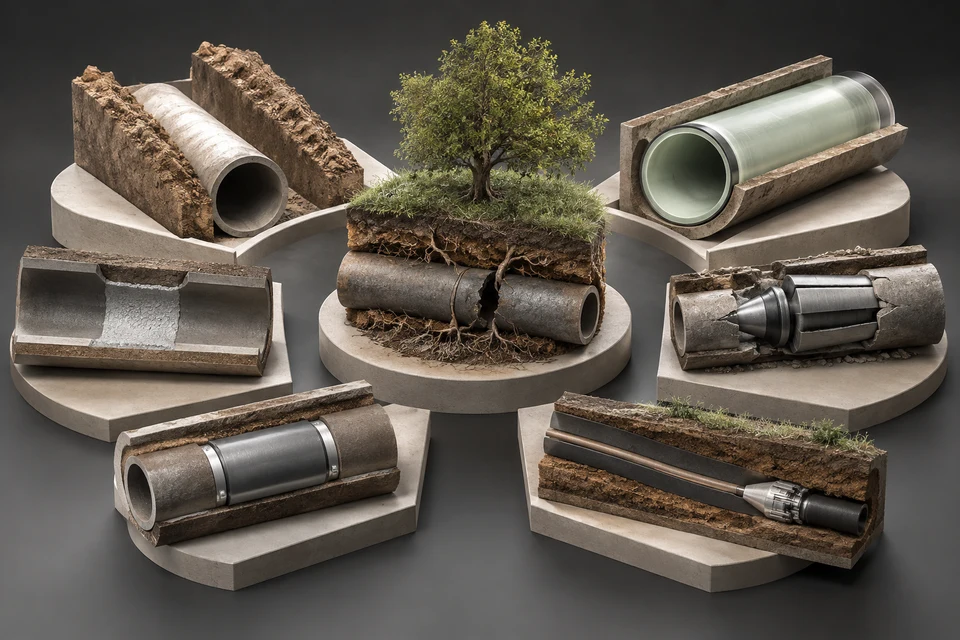
Sewer replacement is done by several kinds of business, and knowing which kind you are talking to explains a lot about the method they recommend. A company that owns lining equipment will tend to see lining solutions; an excavation contractor will tend to see trenches. Neither is wrong, but you need to know the lens.
| Type | Typically does | Ask about |
|---|---|---|
| Drain cleaning and plumbing companies | Diagnosis, cleaning, spot repairs; some do full replacement | Who does the excavation or lining, and whether it is subcontracted |
| Plumbing contractors with excavation crews | Open-cut laterals, under-slab drains, connections | Trench protection, grade control, restoration standard |
| Trenchless specialists | CIPP lining, sectional liners, sometimes bursting | Liner system, training, reinstatement equipment |
| Excavation and underground utility contractors | Deep or long laterals, work at the main, road cuts | Plumbing certification for the pipe work and permits |
| General renovators | Occasionally, as part of a larger job | Who the plumbing and excavation subtrades are |
Large drain franchises and local plumbing firms can both do good replacement work. Many drain cleaning companies replace sewer lines themselves, while others pass the excavation or lining to a partner. Either model can work, as long as you know who is responsible for what and whose warranty applies.
02 /What credentials should you verify?
Verify the credentials yourself rather than relying on a logo on a truck. Most can be checked with a phone call or an online lookup, and a legitimate contractor will provide the documents without fuss.
- Trade certification: plumbing is a certified trade in Canada, and in many provinces only certified plumbers or registered apprentices may do regulated plumbing work. Ask for the certificate of the person doing or supervising the pipe work.
- Business licence: some municipalities require contractors to hold a local business licence. Check with the municipality.
- Liability insurance: ask for a certificate of insurance naming the policy limits, and check that it is current.
- Workers' compensation clearance: a clearance letter from the provincial workers' compensation board shows the company's account is in good standing, which protects you if a worker is hurt on your property.
- Trenchless system training: for lining or bursting, ask which system is used and whether the crew is trained on it by the manufacturer or supplier.
- Permits: ask who pulls the permit. A contractor reluctant to pull one is telling you something.
03 /How do you test a replacement recommendation?
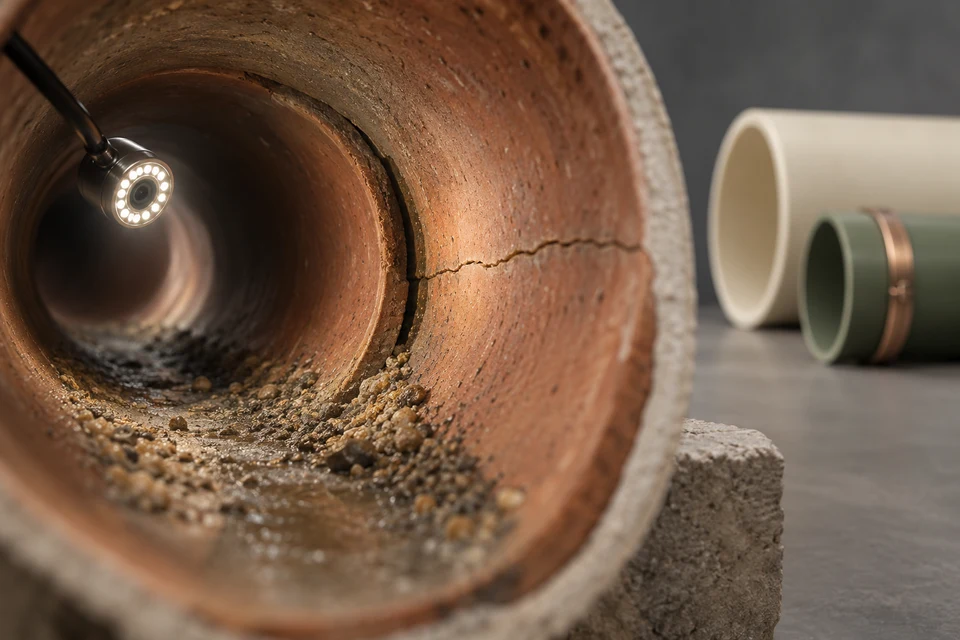
Ask the contractor to walk you through the video and connect each part of the recommendation to something you can see. A sound recommendation survives questions; a sales pitch changes shape under them.
- Which defects drive the recommendation? Ask for them by distance on the counter.
- Why not a spot repair? If there is one main defect, why is the whole line being replaced?
- Why this method? For lining: is the pipe round and on grade? For bursting: are there bends or connections? For open cut: what makes trenchless unsuitable?
- Where does the scope start and end? Foundation to property line, or to the main? Is the connection included?
- What happens if something unexpected is found? Rock, water, an unmarked utility, a second defect beyond the camera's reach.
- What proof will I get? A recorded video of the finished line from the same access point.
Compare the answers with what the decision engine and the Replacement Method Selector suggest for your findings. If a contractor's recommendation sharply disagrees with both, ask them to explain the difference. There may be a good reason, and a good contractor will be able to give it.
04 /What are the warning signs?
The warning signs cluster around missing evidence, missing paperwork and pressure. Any one of them is a reason to slow down; two or three are a reason to get another opinion.
| Warning sign | Why it matters | Response |
|---|---|---|
| Replacement recommended without recorded footage | No evidence behind the scope | Ask for the unedited video before discussing price |
| Video not shared, or only still images | You cannot get a second opinion | Insist on a copy as a condition of any quote |
| Same-day discount or pressure to sign now | Urgency replaces evidence | Unless sewage is actively backing up, take time to compare |
| 'Permit not needed' or 'we'll skip the permit' | No inspection, possible code issues at sale | Confirm permit requirements with the municipality |
| Only one method ever offered | The method may suit the company, not your pipe | Ask why alternatives do not fit |
| Large cash deposit before scheduling | Exposure if the job does not happen | Tie payments to milestones |
| Vague scope: 'replace sewer line' | Nothing to hold them to | Ask for start and end points, length, pipe, restoration |
For comparing written quotes line by line and spotting pricing tactics, SewerQuotes.com has a quote comparison method and worksheet.
05 /What should the contract say?
The contract should describe the job precisely enough that a stranger could tell whether it was done. If the line belongs to a condominium corporation or is shared with a neighbour, settle who signs first; see condos, shared laterals and rentals. If a clause would not help you settle a disagreement, it is too vague.
- Method, start and end points, length and depth, with a sketch.
- Pipe material, size and rating; bedding material; couplings; cleanouts; tracer wire if wanted.
- Who applies for permits and books inspections, and who arranges public and private locates.
- Restoration: what surfaces, to what standard, by whom and when, including winter arrangements.
- How extras are priced: rock, water, extra length, unmarked obstructions.
- Payment schedule tied to milestones, with the final payment after the finished-line video.
- Warranty terms in writing, including what is excluded and whether they transfer to a buyer.
Sewer replacement warranties and final checks covers the warranty clauses in detail.
06 /How do you supervise the job without getting in the way?
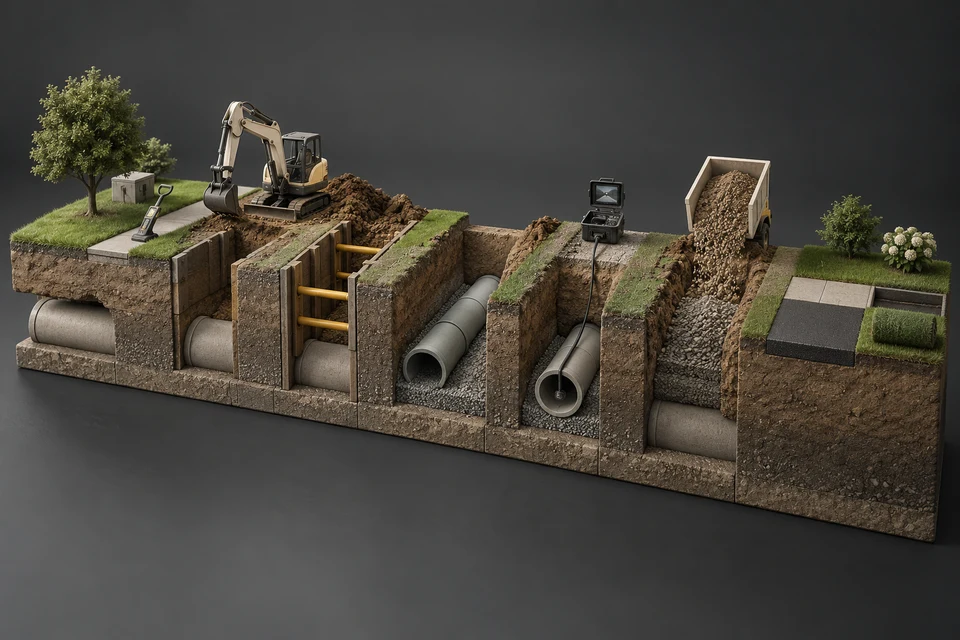
Be present, or have someone you trust present, at four moments: the start, when the pipe is laid and exposed, at inspection, and at the final video. The rest of the time, let the crew work and keep the site clear.
- Start of day one
Walk the site with the lead hand: locate marks, where equipment will travel, what must be protected, where the spoil will go.
- Open trench
Check the pipe markings against the contract, look at the bedding and couplings, and photograph everything with measurements from the house.
- Inspection
Note the inspector's result and any corrections. Do not allow backfill before it passes, where an inspection applies.
- Final video and walkthrough
Watch the finished-line video, walk the restoration, and list any items still to be completed before the last payment.
Keep one running note of what was agreed on site, with dates. If the crew proposes a change, such as a different route or extra length, ask for it in writing with the price before they proceed.
07 /Which installation mistakes should you watch for?
Most failures of new sewer lines trace back to a handful of installation shortcuts, and nearly all of them are visible while the trench is open or on the finished-line video. Knowing what they look like lets you ask the right question at the right moment, instead of discovering the problem at the first backup.
| Mistake | How it shows up later | When to catch it |
|---|---|---|
| Pipe laid on clods, rocks or blocking instead of continuous bedding | A sag or a cracked section within a few seasons | Open trench, before inspection |
| Unshielded rubber couplings at old-to-new transitions | An offset joint that catches solids and roots | Open trench; final video shows a lip at the coupling |
| Backfill dumped in one lift | A sunken trench line or cracked driveway strip | During backfill; ask how compaction is done |
| Branch connections not reopened after lining | A fixture or floor drain that suddenly drains slowly | Final video should show every branch open and trimmed |
| Grade set by eye instead of measured | Standing water visible on the final video | Ask to see the laser or level reading before cover |
| No cleanout added | Every future camera run or cleaning costs more | Scope stage; write cleanouts into the contract |
None of these needs expertise to spot once you know to look. For old-pipe transitions specifically, see replacing cast iron, clay and Orangeburg sewer pipe; for what the inspector checks before the trench closes, see permits and inspections.
08 /How many quotes should you get?
Two or three, all priced from the same recorded video and the same written scope. More than three rarely adds information and costs everyone time. If the quotes propose different methods, that is useful: it tells you where the judgement calls are, and it gives you specific questions to ask each contractor.
When you are ready, request quotes through our form with your footage and scope attached. HAUSE Sewer is an information and quote-request network, not a contractor, so the choice and the contract remain between you and the company you hire.
FAQQuestions people ask
How do I find the best sewer line replacement company near me?
Look for evidence rather than ads: a company that shares recorded footage, explains its method in terms of your defects, provides certification, insurance and workers' compensation documents, and puts scope, restoration and warranty in writing.
Do drain cleaning companies replace sewer lines?
Many do, either with their own excavation or lining crews or through partners. Ask who will perform each part of the job and whose warranty covers it.
What is the difference between a trenchless contractor and a plumber?
A trenchless specialist focuses on lining or bursting equipment and methods. A plumbing contractor may do open-cut replacement, connections and indoor work. Many jobs involve both, and the pipe work itself is regulated plumbing.
Should I pay a deposit for sewer replacement?
A modest deposit tied to scheduling is common. Keep larger payments tied to milestones, and hold the final payment until the finished-line video and restoration are complete.
Is it worth getting a second opinion on a sewer replacement quote?
Yes, for any large recommendation. Send the same unedited video to another contractor and ask for their assessment. It costs little compared with replacing the wrong length of pipe.
NETWORKGo deeper across the HAUSE Sewer network
What drain cleaning is, and what a pipe cleaning service actually does
What is drain cleaning? What a pipe cleaning service does on a visit, whether it counts as plumbing, who can do it, and how to choose a service near you.
SewerCleaners.caHow to hire a sewer cleaner: the checklist, the questions and the paperwork
How to hire a sewer cleaner in Canada: questions to ask, insurance and WCB coverage in Alberta, a written scope template, red flags, and how to compare quotes.
SewerQuotes.comSewer camera inspection cost, and what the fee should include
Sewer camera inspection cost in Canada for 2026: standalone, pre-purchase and add-on scope prices in CAD, what a proper report includes and when the fee is wasted.