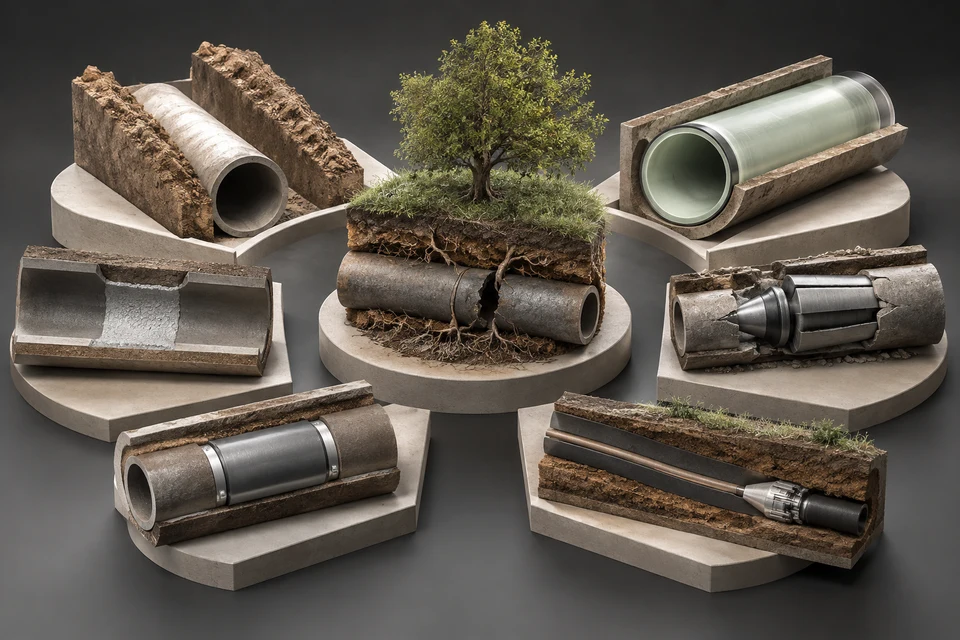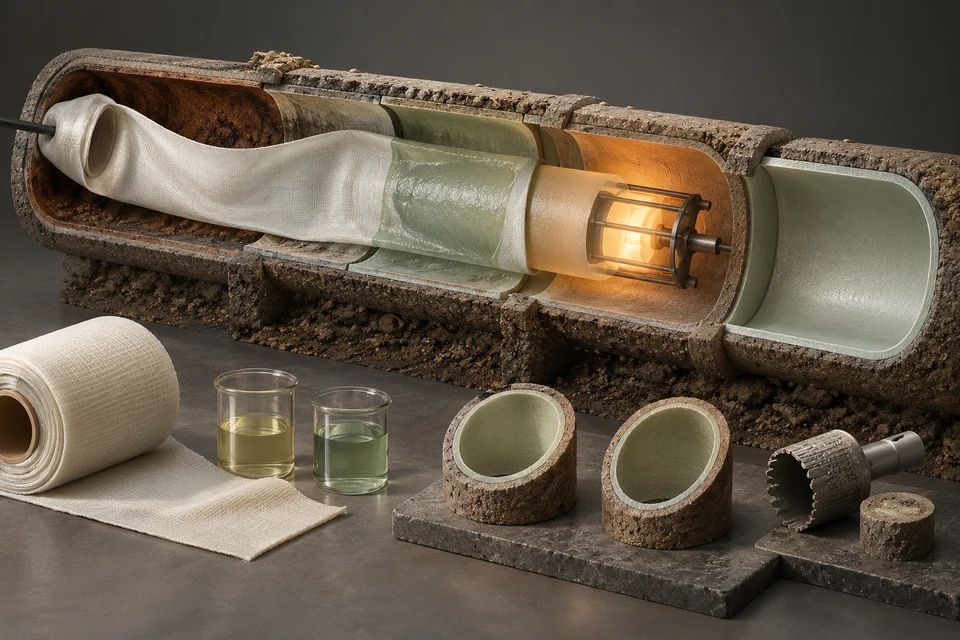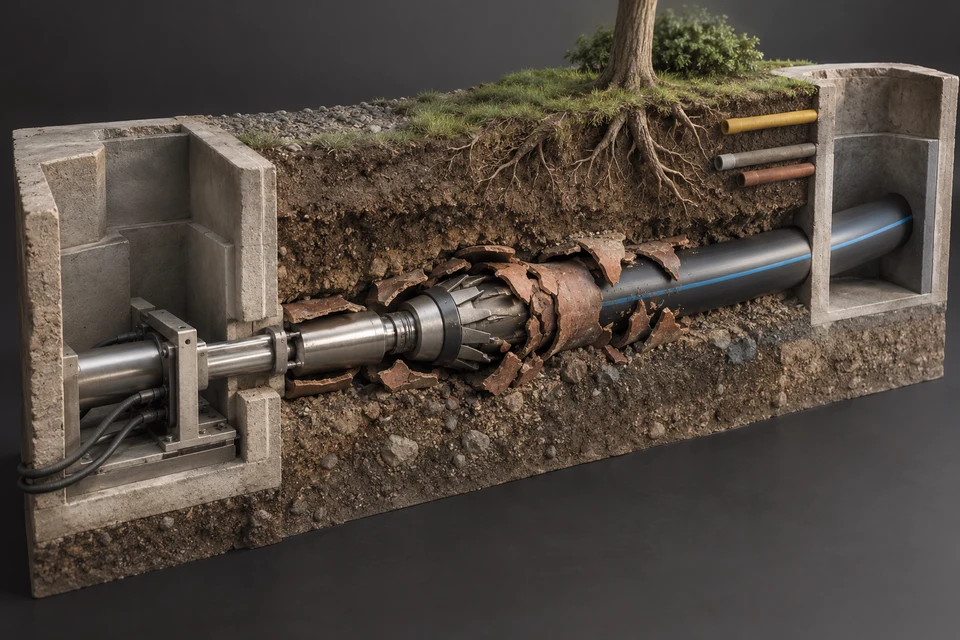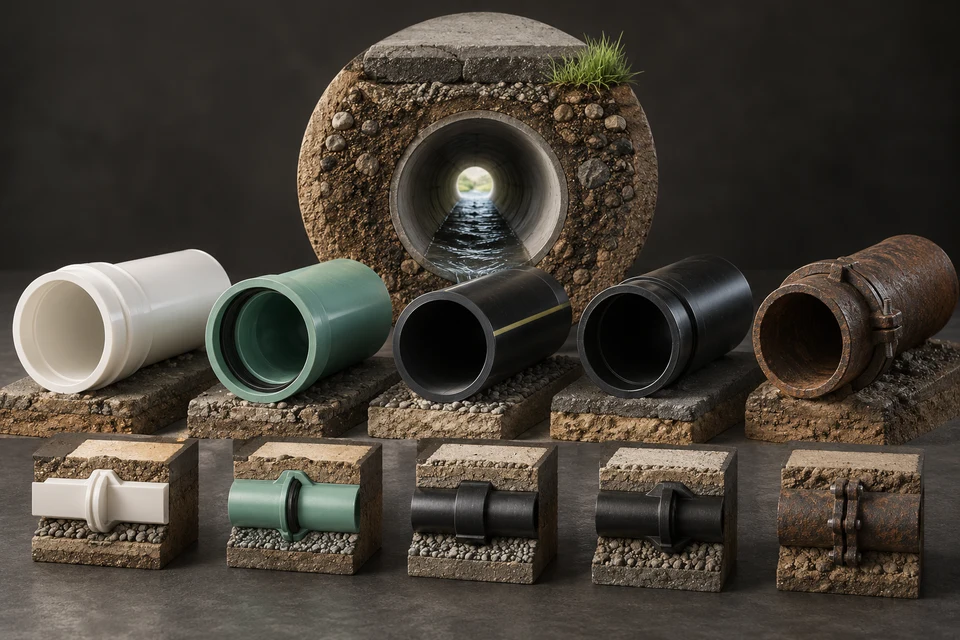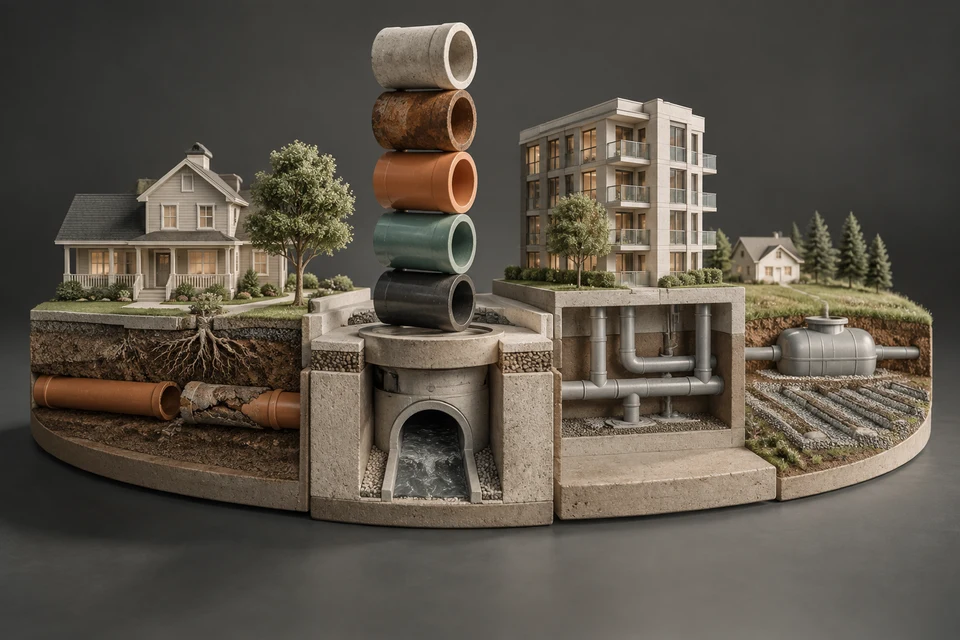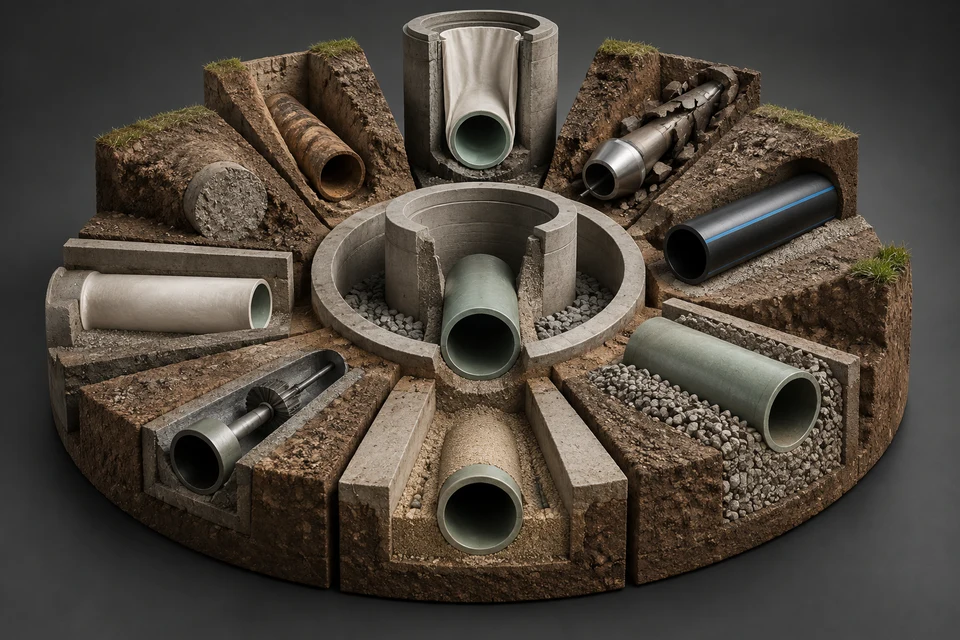
This glossary defines the terms that appear in sewer replacement quotes, camera reports and contracts in Canada, from open-cut trenching and bedding to cured-in-place lining, pipe bursting, pipe ratings such as SDR and DR, and the paperwork that closes a job. You can read any entry without the others.
- Most replacement vocabulary falls into four groups: the parts of the line, the methods, the pipe specifications and the site work.
- Terms such as grade, bedding and haunching describe what keeps a new pipe working, not just what it is made of.
- If a quote uses a term not listed here, ask the contractor to define it in writing.
01 /How to use this glossary
Replacement quotes are written in trade shorthand. Before you compare two quotes, look up any term you are not sure of, because two contractors can use different words for the same thing, or the same word for different things. Where a term connects to a longer explanation on this site, the related guides go deeper: sewer replacement methods compared, CIPP lining explained, pipe bursting explained and best pipe for sewer replacement.
A–ZTerms
- Abandonment
- Taking an old sewer line permanently out of service while leaving it in the ground. A properly abandoned line is disconnected as the municipality requires, capped or plugged at both ends, sometimes filled with grout, and recorded.
- ABS
- Acrylonitrile butadiene styrene, a black plastic drain-waste-vent pipe joined by solvent welding. Common inside Canadian houses and under basement slabs; whether it is accepted for a buried lateral depends on local rules.
- Access pit
- A small excavation that gives a crew entry to a pipe for trenchless work, a connection or a repair. Bursting needs one at each end; lining may need one where no usable cleanout exists.
- Annular space
- The gap between an old host pipe and a new pipe or liner inside it. In slip lining it is filled with grout; with CIPP the liner is pressed against the host so the gap is minimal.
- As-built
- A record of what was actually installed: the route, depths, pipe material, fittings, cleanouts and any abandoned sections, usually a measured sketch with photos. It is the map for every future repair.
- Backfill
- Material placed back into a trench over the pipe after installation and inspection. Good practice places it in compacted layers so the surface does not settle over the following seasons.
- Backwater valve
- A valve on the building drain that lets sewage flow out but closes when sewage tries to flow back from the main. A slab or lateral replacement is often the easiest time to install one.
- Bare land condominium
- A condominium or strata in which owners hold lots rather than units in a building. Roads and in-ground services such as sanitary lines are often common property maintained by the corporation, with easements to reach pipes under individual lots.
- Bedding
- The layer of granular material placed under a new pipe in the trench. It gives the pipe even support along its length and is the main defence against future sags.
- Belly (sag)
- A section of pipe that has settled below its designed slope and holds water and solids. Trenchless methods follow a belly; only excavation and re-laying corrects it.
- Bituminous fibre pipe (Orangeburg)
- Mid-century sewer pipe made of wood or paper fibre bound with coal tar pitch. It softens and deforms under soil load and is generally replaced rather than repaired or lined.
- Building drain
- The lowest horizontal drain inside a building, usually under the basement floor, collecting the stacks and fixtures before the pipe leaves the foundation.
- Building sewer
- The pipe from the outside of the foundation to the municipal sewer or a private system. In everyday use it is the same thing as the private part of the lateral.
- Bursting head (expander)
- The cone-shaped tool pulled through an old pipe during pipe bursting. Its nose follows the old pipe and its expander breaks the pipe outward, making room for the new pipe behind it.
- Butt fusion
- A method of joining HDPE pipe by heating the squared ends and pressing them together, forming a continuous joint as strong as the pipe. Used to build the pipe string for bursting.
- Calibration tube
- An inflatable bladder or tube used in some lining systems to press the liner against the host wall while the resin cures. It is removed or left in place depending on the system.
- CIPP (cured-in-place pipe)
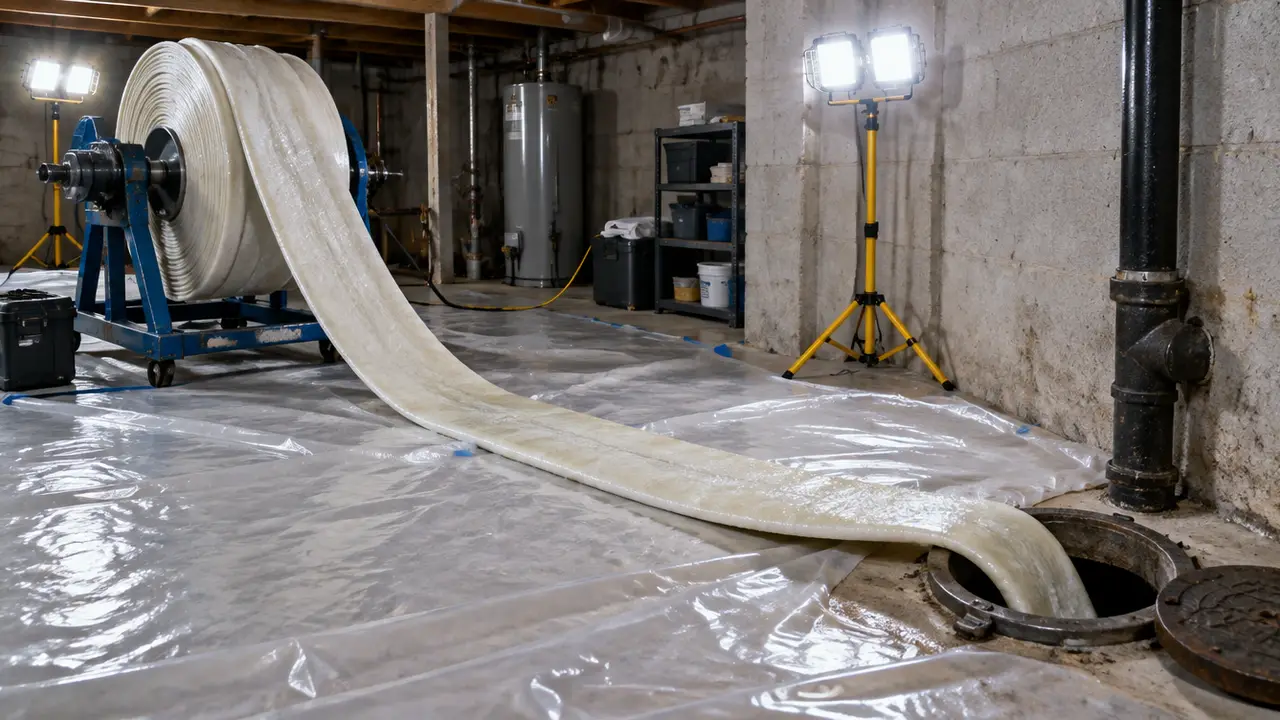
- A lining method in which a resin-saturated fabric tube is installed inside an old pipe and hardened there, forming a new jointless pipe within the host.
- Cleanout
- A capped access fitting on a drain or sewer through which cameras, cables, jetters and liners can enter. Adding one near the foundation is a common part of a replacement.
- Common elements
- In a condominium, the parts of the property owned in common rather than by one unit owner. Drain lines serving more than one unit and the building sewer are usually common elements, so the corporation decides on their repair or replacement.
- Compaction in lifts
- Placing backfill in layers of limited thickness and compacting each one before adding the next. It prevents the trench from settling and supports a new pipe evenly.
- Connection liner
- A short liner that seals the junction between a lateral and the municipal main from inside the main, sometimes with a brim against the main wall. Usually needs municipal involvement.
- Deflection
- The small change in shape a flexible plastic pipe undergoes under soil load. Designed deflection is normal; excessive deflection signals poor bedding or backfill.
- Descaling
- Mechanically removing corrosion scale and tubercles from the inside of cast iron pipe, typically with chain knockers or abrasive cutters, to recover the bore before inspection or lining.
- Dimension ratio (DR)
- For HDPE and some other pipe, the outside diameter divided by the wall thickness. A lower DR means a thicker, stiffer pipe.
- End seal
- A seal at the end of a liner that stops groundwater and roots travelling along the gap between the liner and the old pipe. Missing end seals are a common source of later problems.
- Epoxy resin
- A two-part thermosetting resin widely used in residential lateral lining. It bonds well to host pipe and has low odour, but is sensitive to correct mixing and cure temperature.
- Fully deteriorated design
- A liner design that assumes the old pipe provides no structural support, so the liner is made thick enough to carry soil and surface loads on its own.
- Grade
- The slope of a gravity sewer, expressed as a ratio or percentage of fall per unit of length. Codes set minimum slopes; a sewer that loses grade develops a belly.
- Guided boring (pilot tube)
- A trenchless method that installs new pipe along a new path with close control of line and grade, by pushing a steerable pilot along an optically checked line before enlarging the bore.
- Haunching
- Placing and compacting bedding material under the lower sides of a pipe, between the trench bottom and the pipe's widest point. Plastic pipe depends on this side support.
- HDPE
- High-density polyethylene, a tough, flexible plastic pipe joined by butt fusion into continuous lengths. The standard replacement pipe for pipe bursting.
- Heave
- Upward movement of the ground surface caused by soil being pushed outward during pipe bursting. The risk rises when lines are shallow or when the pipe is upsized.
- Horizontal directional drilling (HDD)
- A steerable drilling method that pulls back new pipe along a bored path. Well suited to pressure pipes; less common for gravity sewers because of the need for steady grade.
- Host pipe
- The existing pipe that a liner is installed inside. Its shape, continuity and grade determine whether lining is possible and how the liner will perform.
- Inlet baffle (inlet tee)
- The fitting inside a septic tank where the house sewer enters. It turns incoming flow downward so it does not stir up the scum layer or short-circuit to the outlet, and it must be left intact when a new line is connected.
- Inversion
- Installing a liner by turning it inside out into the host pipe with air or water pressure, so the resin-coated face presses against the old pipe wall.
- Invert
- The inside bottom of a pipe, where the flow runs. Grades and depths are normally measured to the invert.
- Lateral
- The pipe carrying sewage from a building to the municipal main. It usually has a private portion and, in many Canadian cities, a municipal portion beyond the property line.
- Launch and receiving pits
- The two excavations used in pipe bursting: the launch pit where the new pipe enters the ground, and the receiving pit where the puller or winch draws the head through.
- Locate
- Marking the position of buried utilities before digging. Public locates are requested through the provincial one-call service; private lines on your property need a private locate.
- Offset joint
- A joint where two pipe lengths have shifted out of line, leaving a step inside the pipe that catches debris and may let soil or roots in.
- Open cut
- Replacing a pipe by excavating a trench along its route, removing the old pipe and laying new pipe on prepared bedding. The only method that can correct grade along the whole line.
- Ovality
- How far a pipe has deformed from round. Significant ovality, common in bituminous fibre pipe, rules out lining because the liner would copy the deformed shape.
- Partially deteriorated design
- A liner design that assumes the old pipe still carries soil loads, so the liner mainly resists groundwater pressure and seals the wall. It allows a thinner liner.
- Permit holder
- The person or company named on a plumbing permit, who books inspections and answers for the work. Normally the contractor doing the job; an owner-occupier can hold a homeowner permit only for work done personally.
- Pipe bursting
- A trenchless replacement method that breaks the old pipe outward with a pulled head while drawing a new pipe, usually HDPE, into the same path.
- Pipe splitting
- A variant of bursting for ductile pipe such as PVC or steel, in which blades or rollers slit the old pipe before an expander spreads it apart.
- Point repair (spot repair)
- A repair to a single location on a line, either by excavating and replacing a short section or by installing a sectional liner from inside.
- Pull-in-place
- Installing a liner by winching it into position inside the host pipe and then inflating it against the wall, rather than inverting it.
- PVC sewer pipe
- Polyvinyl chloride pipe made for gravity sewers, typically with gasketed bell-and-spigot joints and rated by SDR. The common choice for open-cut laterals in Canada.
- Reinstatement
- Reopening a branch connection that a liner has covered, done from inside with a remote-controlled cutter guided by camera and recorded distances.
- Relining
- Common name for full-length lining of a sewer with a structural liner, usually CIPP, so that the old pipe becomes the host for a new jointless pipe.
- Right-of-way permit
- Municipal permission to dig in a boulevard, sidewalk or road, separate from the plumbing permit. It may carry conditions for traffic control, restoration standards and who does the work on municipal land.
- SDR (standard dimension ratio)
- The ratio of a pipe's outside diameter to its wall thickness. SDR 35 is a common residential sewer rating; SDR 28 and SDR 26 have thicker, stiffer walls.
- Sectional liner
- A short cured-in-place sleeve installed over a single defect using an inflatable packer. It avoids digging but cannot correct sags or crushed pipe.
- Service line coverage
- An optional home insurance endorsement that extends coverage to buried lines on the property, including the sewer lateral. It can pay toward excavating and repairing a failed line up to a per-incident limit, but only for failures after it was added.
- Sewer backup coverage
- An optional home insurance endorsement that pays for damage when sewage or water comes up through drains and fixtures. It covers cleanup and damaged finishes and contents, not repair of the pipe that caused the backup.
- A single building sewer that serves two or more houses before reaching the main. Responsibility for the shared section depends on registered easements, agreements between owners or municipal policy.
- Shielded coupling
- A rubber coupling wrapped in a stainless steel shear band, used to join pipes of different materials or outside diameters while resisting misalignment.
- Shoring and trench boxes
- Systems that support trench walls against collapse. Provincial safety rules require sloping, benching, shoring or a trench box beyond set depths.
- Slip lining
- Pulling a smaller solid pipe into an old one and grouting the gap. Common in large municipal pipes; rarely used on house laterals because it costs too much diameter.
- Sonde
- A battery-powered beacon carried inside the pipe, often built into the camera head, whose signal a handheld receiver on the surface picks up to mark where the pipe runs and how deep it is.
- Tracer wire
- A wire laid along non-metallic pipe so the pipe can be found later with a standard locator. Often brought up at a cleanout for easy connection.
- Transite (asbestos-cement pipe)
- Pipe made of cement reinforced with asbestos fibres, used for some mid-century sewers and water lines. It must be identified and handled under asbestos procedures if cut or removed.
- Transition coupling
- A coupling that joins pipes of different materials or outside diameters, such as new PVC to old clay or cast iron. Shielded types are preferred underground because their steel band holds the pipes in line.
- Tree protection zone
- The area around a tree where digging, storage and equipment are restricted during construction. Its size and the trees it applies to are set by municipal bylaw, and work inside it may need a permit.
- Upsizing
- Replacing a pipe with a larger-diameter one, most practical by pipe bursting or open cut. Lining slightly reduces diameter instead.
- Wet-out
- Saturating a liner's fabric tube with mixed resin before installation, so that the resin is distributed evenly with no dry areas.
FAQQuestions people ask
What is the difference between a building drain and a building sewer?
The building drain is the lowest drain inside the house, usually under the basement floor. The building sewer starts outside the foundation and runs to the municipal sewer or a private system.
What does SDR 35 mean on sewer pipe?
The pipe's outside diameter is 35 times its wall thickness. It is a common rating for residential PVC sewer pipe; lower SDR numbers mean thicker walls.
What is reinstatement in sewer lining?
Reopening each branch connection that the liner covered, using a robotic cutter inside the new liner. Each one should appear fully open on the finished video.
What is the difference between relining and replacing a sewer?
Relining forms a new pipe inside the old one and leaves the old pipe in place as a host. Replacing removes or destroys the old pipe and installs a new one.