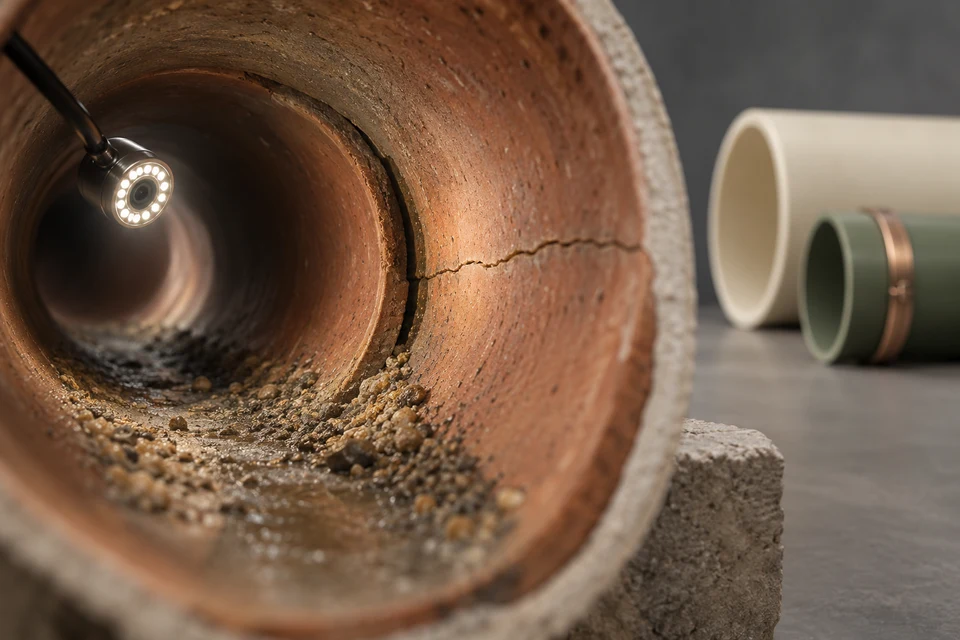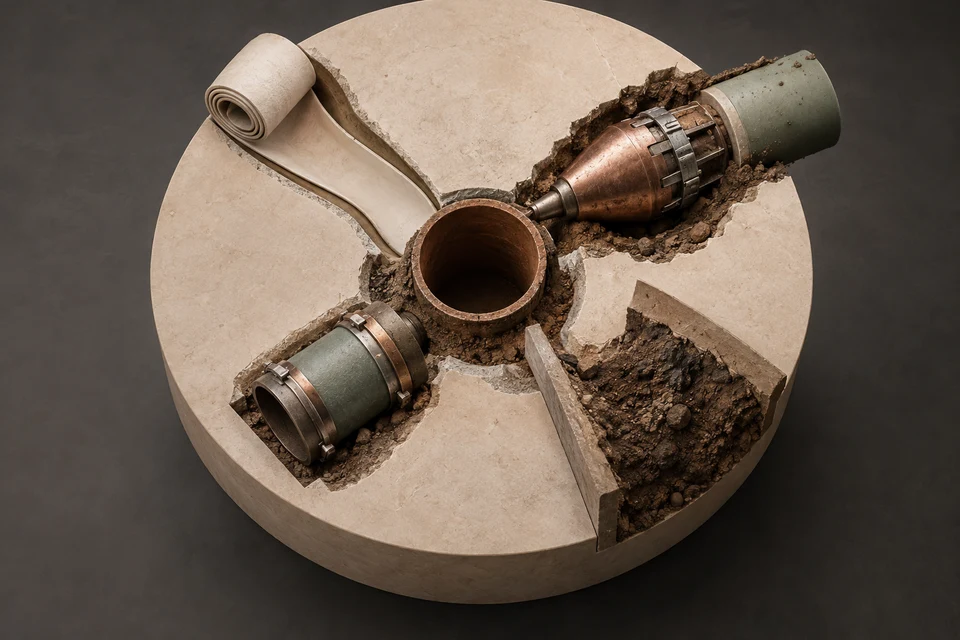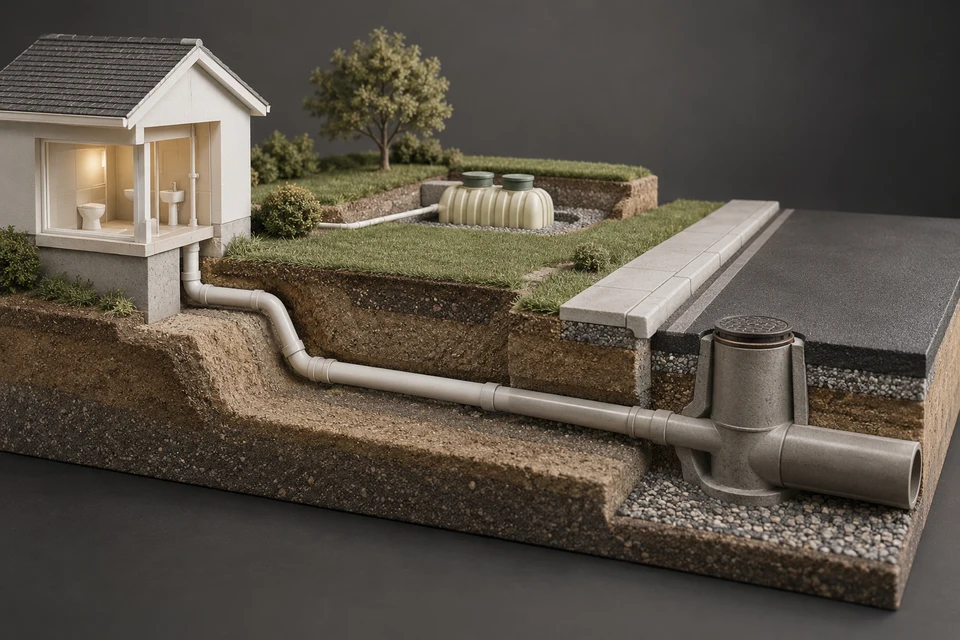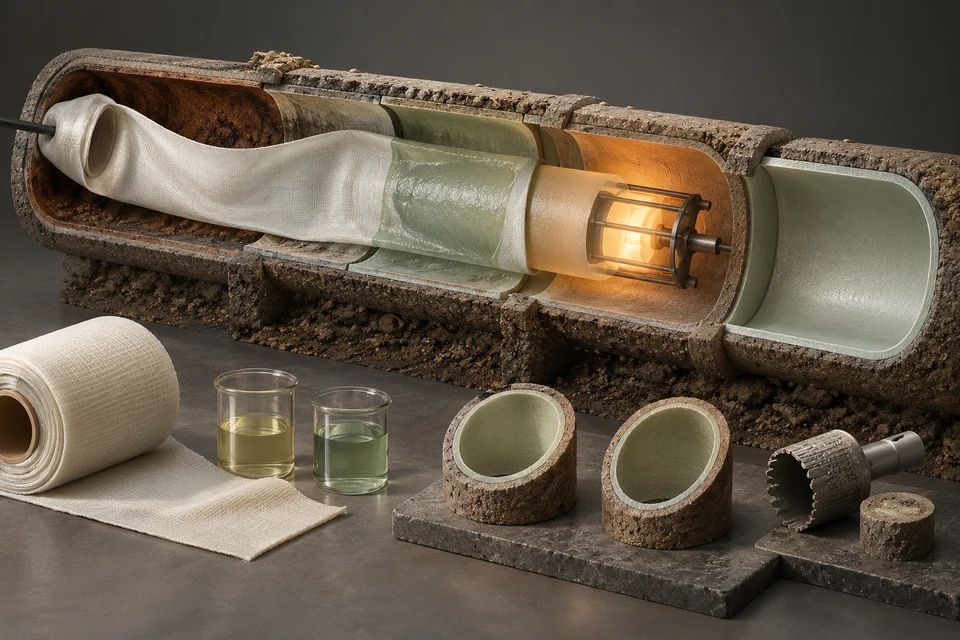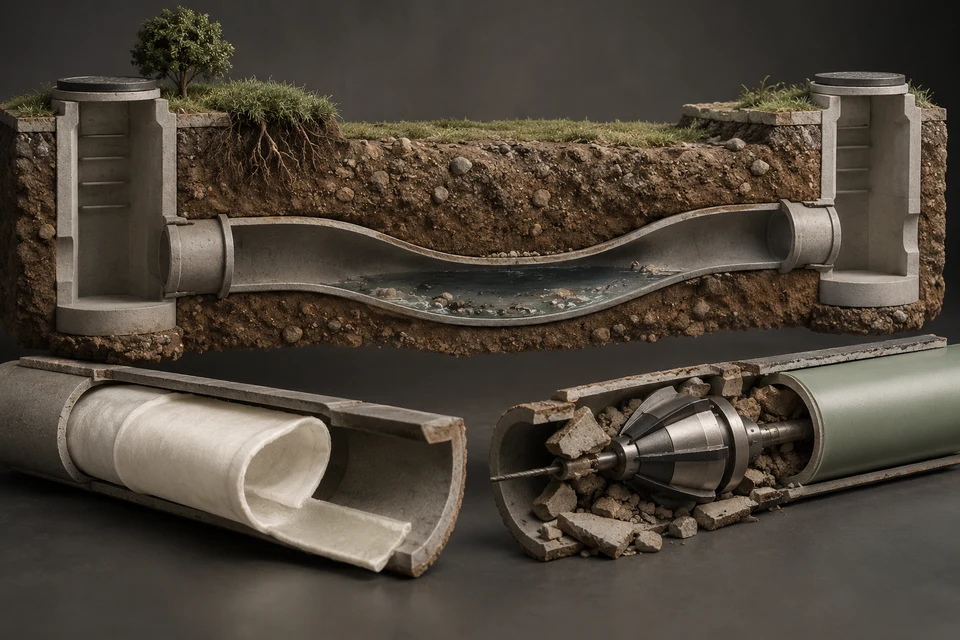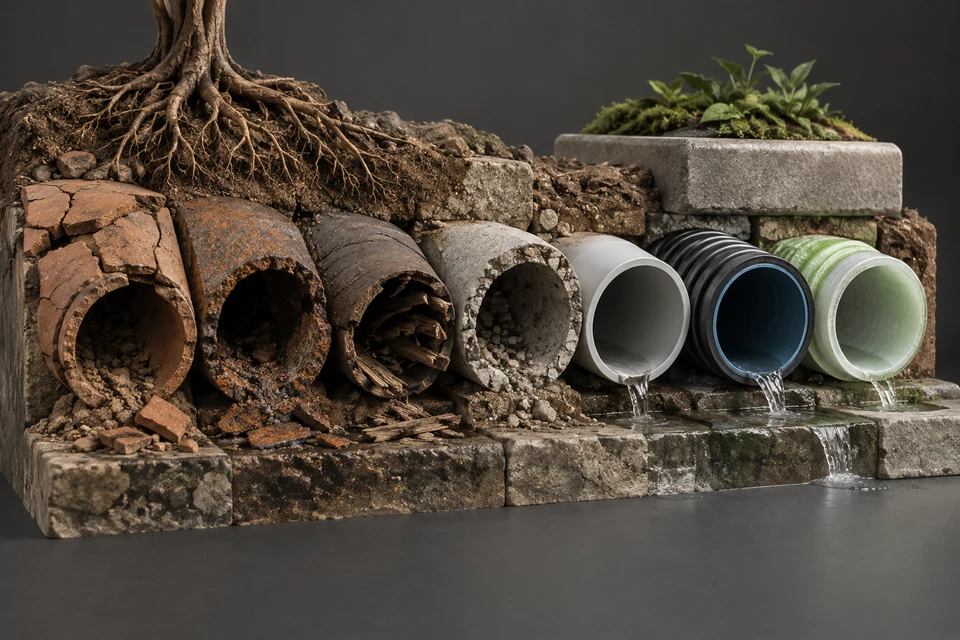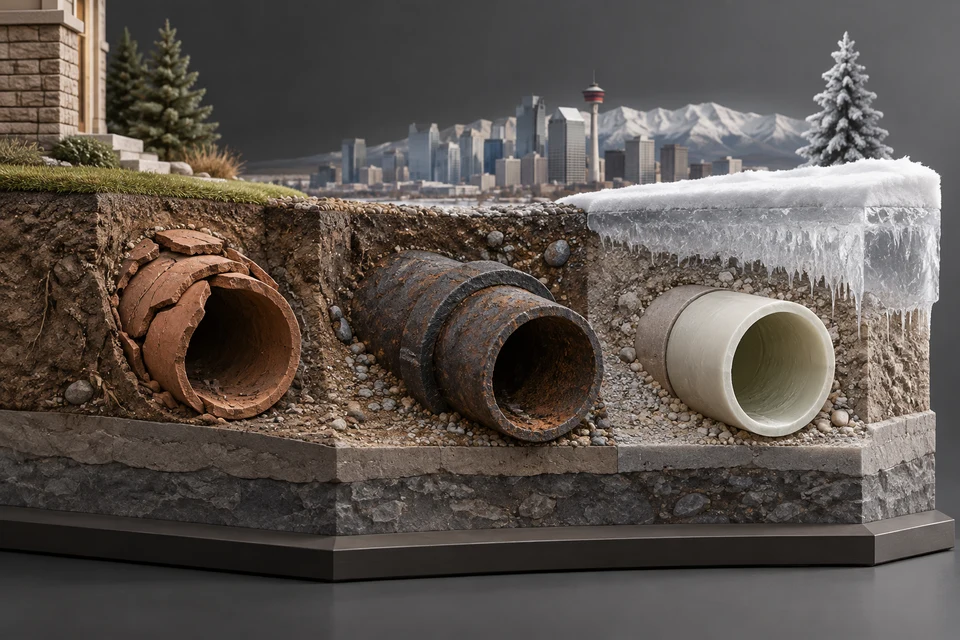
Calgary replacement decisions start with era. The City's open data shows clay tile dominating 1960s and 1970s City-side service lines, cast iron installed mostly from the 1950s to the 1970s, and PVC from the 1980s on. Round clay and cast iron lines on grade are often relining candidates; sags, collapses and deep lines under hard surfaces push toward digging. Call 311 for ownership questions.
- The City's records stop at the property line: they describe only the City-owned pipe from the main, and the private pipe to your house may differ in both material and age.
- About one in five City-side service lines is coded TIL, generally read as clay tile, and most of those were installed in the 1960s and 1970s.
- Where the City side has already been relined, the private side may now be the oldest pipe on the lateral.
- Deep, frost-protected laterals and clay-rich till with gravel and cobble lenses shape method choice in Calgary.
- According to the City's own dataset description, the pipe from the main to the property line is the City's and the pipe from the property line to the house is the owner's; 311 confirms individual cases.
01 /What pipe is under Calgary homes?
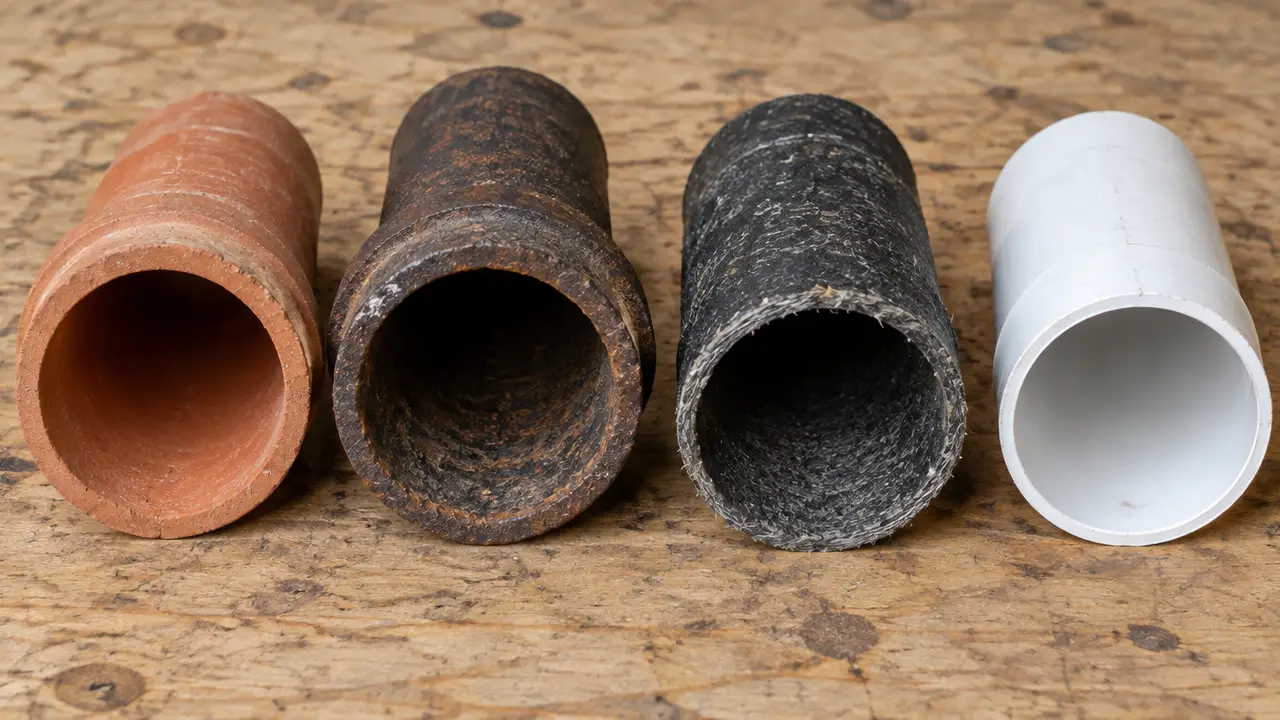
The best public evidence is the City of Calgary's Public Sanitary Service Lines open dataset, which records 367,397 active service lines. A HAUSE analysis of that data (fetched 2026-09-24) shows a citywide median install year of 1995 and this material mix: about 66.5 percent PVC, 20.2 percent coded TIL (the City's tile code, generally clay tile), 3.3 percent cast iron, 5.0 percent coded OTHER, 2.1 percent coded TP, and 1.1 percent already relined with cured-in-place pipe.
| Community structure | Service lines | % TIL (clay tile) | % cast iron | % PVC | % relined (CIPP) |
|---|---|---|---|---|---|
| 1950s | 46,833 | 23.1 | 18.5 | 22.7 | 3.8 |
| 1960s/1970s | 71,348 | 77.5 | 0.3 | 17.4 | 1.7 |
| Inner City | 23,906 | 0.1 | 11.7 | 41.6 | 3.9 |
| 1980s/1990s | 70,484 | 9.1 | 0.0 | 87.6 | 0.2 |
| 2000s | 73,482 | 2.1 | 0.0 | 95.7 | 0.0 |
Two patterns matter for replacement. Communities built out in the 1960s and 1970s, such as Lake Bonavista, Acadia, Brentwood, Varsity and Huntington Hills, are overwhelmingly clay tile on the City side. Cast iron appears in City-side records from the 1950s through the 1970s and is most common in 1950s-era and inner-city communities; the highest shares include Rosscarrock (56.6 percent, median install year 1963), St. Andrews Heights (53.1 percent, 1958), Cambrian Heights (43.7 percent, 1957) and Bowness (41.6 percent, 1968). Much of the pre-1950 record is coded OTHER, so the data cannot tell you the material of the oldest lines; a camera can.
02 /Which replacement methods suit Calgary's common line types?
The method follows the pipe's condition, but the era gives a strong first guess about what the camera will find and which methods will be on the table.
| Line type | Typical findings | Methods often considered |
|---|---|---|
| 1960s–70s clay tile, still round and on grade | Roots and leaks at joints, some cracks | Full-length CIPP relining; maintenance where roots are limited |
| Clay tile with a settled section | Belly holding water, often near the house or under a later driveway | Dig the sag, reline the rest |
| 1950s–1970s cast iron | Scale, corrosion along the bottom, cracks | Descale and reline, or replace where lines are now past 70 years |
| Inner-city lines of mixed or unknown material | Material changes, old repairs, offsets | Camera first; combinations are common |
| 1980s-onward PVC | Usually sound; occasional offsets, sags or damage from later digging | Spot repair or maintenance |
The age point is concrete in Calgary. A cast iron line installed in the 1950s is roughly 67 to 76 years old in 2026, which is the band where the Repair or Replace? Decision Engine adds its note that remaining life is limited even where the pipe has not yet failed, and where heavily scaled cast iron throughout returns a replace verdict rather than descale and reline.
03 /What if the City side has already been relined?
Then your private side may be the oldest pipe on the whole lateral. A CIPP record generally carries the year the line was relined rather than the year it was first laid, and those relining records have risen steeply since 2010. Some older communities show substantial shares of City-side lines already relined, including Highwood (22.1 percent), Glendale (19.9 percent), University Heights (19.9 percent), Rosemont (16.6 percent) and Crescent Heights (16.0 percent).
- A relined City side does not tell you anything about the pipe between your foundation and the property line.
- If your private side is original clay or cast iron, a camera run from your cleanout will show where the old pipe meets the relined section and what condition it is in.
- Where a private-side liner meets a City-side liner, the transition is a place to check on video for a clean, sealed joint.
- Replacing or relining the private side does not change the City's record for the City side.
You can look up the City-side record for a specific address with the service line lookup on CalgarySewers.ca, which queries the same open dataset.
04 /How do Calgary soils and depth affect method choice?
Calgary laterals are commonly buried deep to stay below frost, and many run through clay-rich glacial till, with gravel and cobble layers in places, particularly in river-valley areas. Depth and soil affect every method, but in different ways.
| Condition | Effect on open cut | Effect on trenchless |
|---|---|---|
| Deep line (over about 3 m) | Larger trench, shoring or trench box; the selector rates open cut 'Possible' | Pits are deep but few; lining unaffected by depth |
| Stiff clay-rich till | Holds a face briefly but still collapses without protection; heavy to haul | Bursting displaces clay less readily; ask about force and upsizing |
| Gravel and cobble lenses | Unstable walls, more shoring | Cobbles can stall a bursting head |
| Shallow sections near driveways | Easier digging | Bursting heave risk under 1.5 m |
| Frozen ground in winter | Frost must be broken or thawed; slower | Only pits are affected; ambient resin cure slows |
The Replacement Method Selector captures depth and surface, but not soil. Ask each contractor what they expect to encounter and how their price treats rock, cobbles and groundwater.
05 /How do Calgary winters and chinooks affect replacement?
Replacement can proceed in a Calgary winter, but frozen ground slows excavation and restoration is often temporary until spring. Frost goes deepest under surfaces cleared of snow, such as driveways, which matters for shallow sections of lateral and for any belly that holds water.
- Excavation: frozen crust may need breaking or thawing; allow extra time on site.
- Lining: little digging, but cold host pipe slows ambient-cure resins; ask how cure is confirmed.
- Chinook thaws: rapid melt can put water into open trenches and pits; ask how the site will be protected.
- Restoration: lawn, concrete and paving are often finished in spring; get the plan and dates in writing.
For Calgary-specific sequencing, permits and seasons, CalgarySewerReplacement.ca covers the local process step by step, and CalgarySewerReplacement.com covers Calgary costs and buying or selling a home with an older line.
06 /Who owns what, and who do you call in Calgary?
The City's own dataset description states its position: the City owns and maintains the service line from the main to the property line, and the homeowner owns and maintains it from the property line to the house. For any specific case, especially a defect near the property line, call 311 with your camera footage and the distances.
- 311 first for ownership
Ask the City to confirm responsibility for any defect at or beyond the property line before you pay for work there.
- Locates before digging
Public utility locates in Alberta go through Utility Safety Partners. Private lines, including your own sewer, need a private locate.
- Permits and inspections
Sewer work generally needs a permit and inspection. Confirm current requirements and who applies with the City; it is usually the contractor.
- Boulevard and road work
Any work on City land needs the City's permission. Confirm with the City or 311 before it is scoped.
Ready to decide? Start with the decision engine, then request quotes with your footage and the ownership boundary marked. Calgary planning prices are on SewerQuotes.com.
FAQQuestions people ask
Where does a Calgary homeowner's sewer responsibility stop?
The City describes the split in its own dataset: its responsibility runs from the main to the property line, and the homeowner's runs from the property line to the house. Call 311 to confirm specific cases.
What sewer pipe do Calgary homes have?
On the City side, about two-thirds of service lines are PVC, about one in five is coded TIL (generally clay tile, mostly 1960s and 1970s), and a smaller share is cast iron, concentrated in 1950s and inner-city areas. The private side can differ.
Is lining a good option for Calgary clay sewer lines?
Often, when the clay pipe is still round and on grade and the problems are roots and joint leaks. A sag or collapse needs excavation at that spot. The camera footage decides.
Is winter a bad time to replace a sewer line in Calgary?
Yes. Frozen ground slows excavation and restoration is often temporary until spring. Trenchless methods dig less, so winter affects them less, though cold ground slows some resin cures.
How do I find out what my City-side sewer line is made of?
The City publishes service line records as open data. CalgarySewers.ca offers an address lookup of that dataset. It covers only the City-owned portion; a camera inspection shows your private side.
Do I need locates before sewer work in Calgary?
Yes. Public utility locates in Alberta are requested through Utility Safety Partners before any digging, and private lines on your property need a private locate.