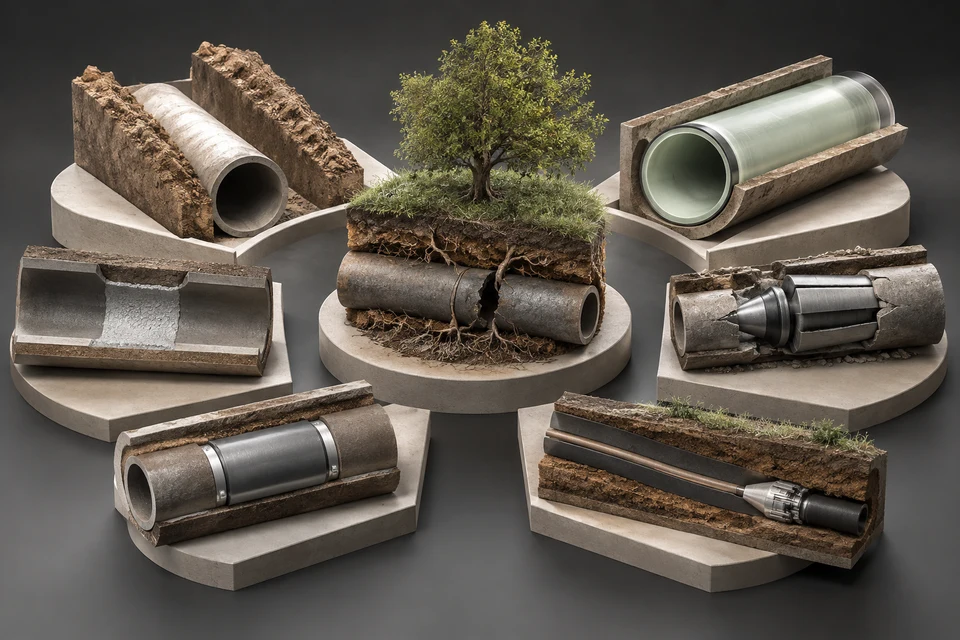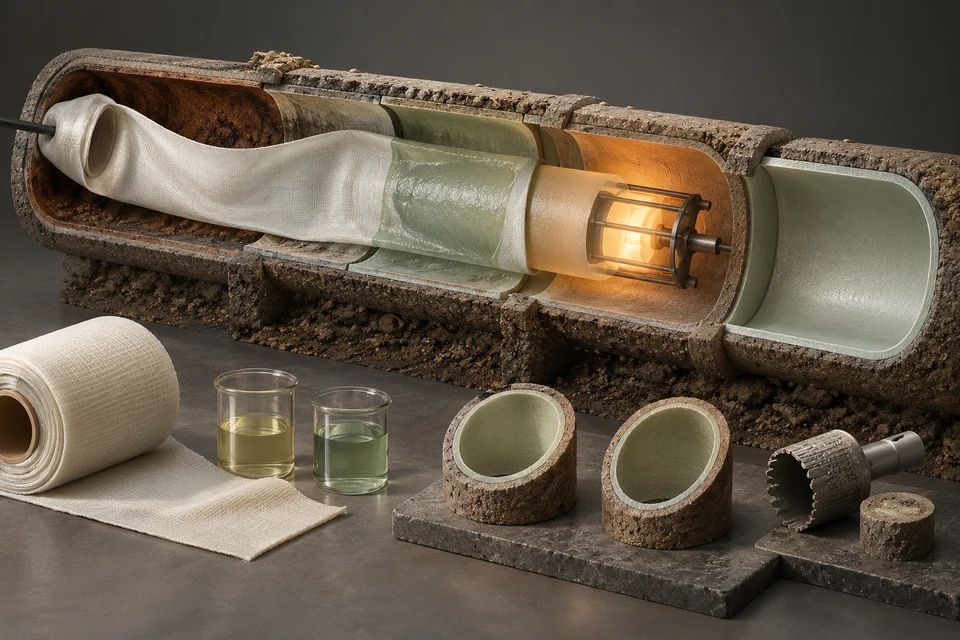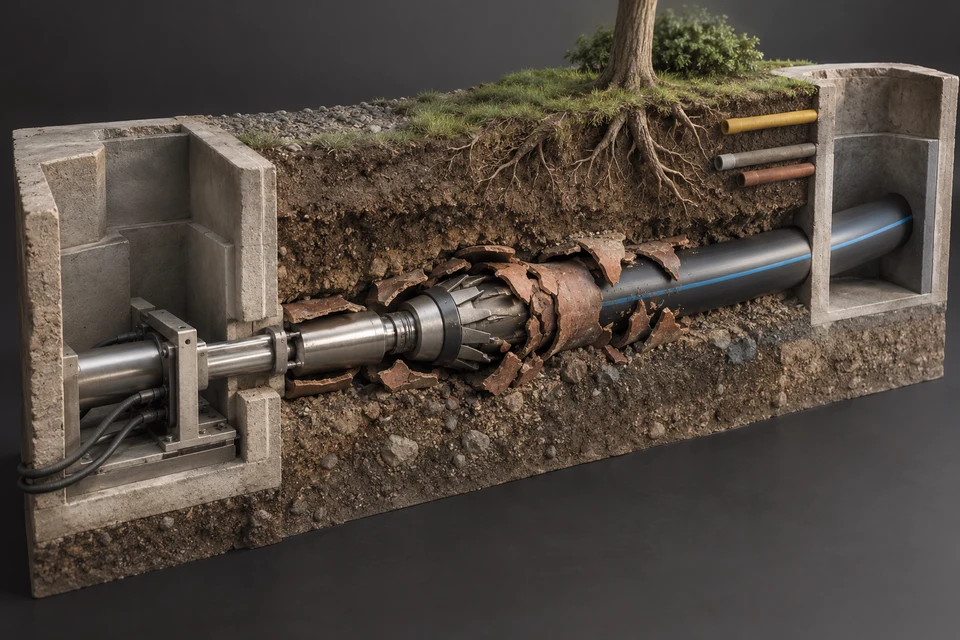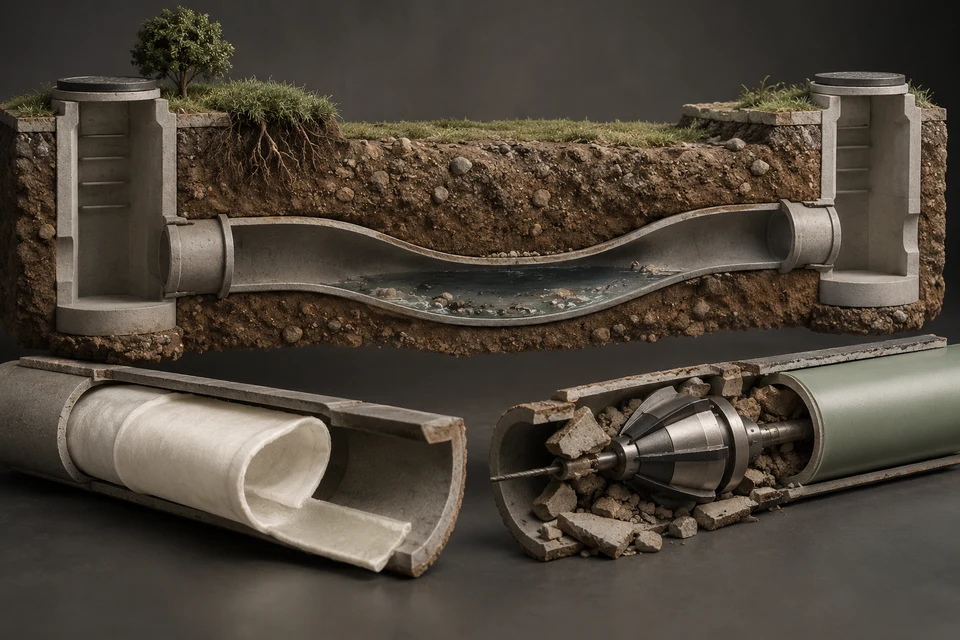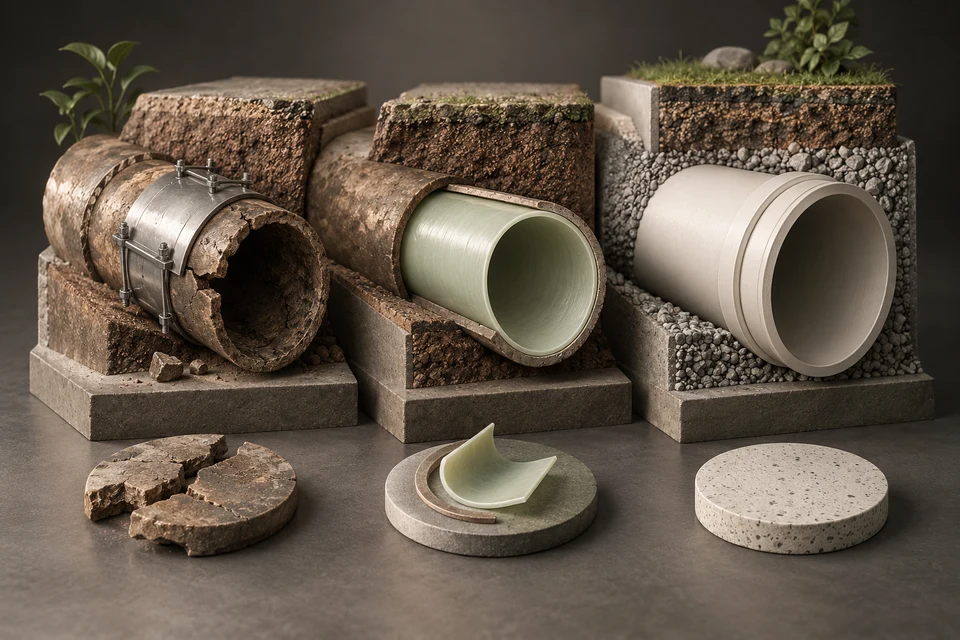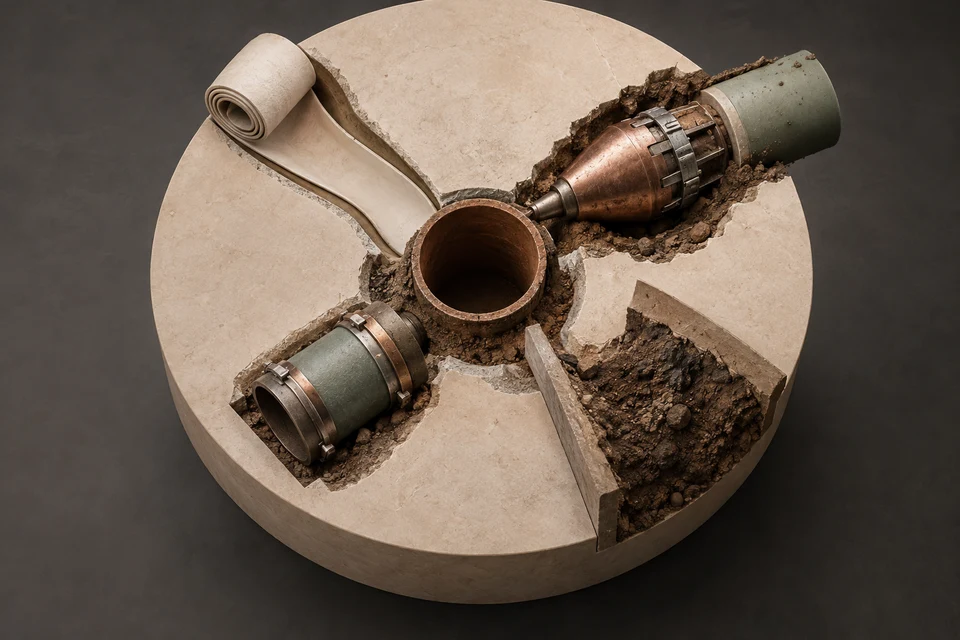
The Replacement Method Selector rates four sewer renewal methods, CIPP lining, pipe bursting, open cut and spot repair, as Good, Possible or Not suitable for your line. It uses depth, what sits on the surface, pipe condition, access points, bends and connections, then ranks the methods from Good to Not suitable and gives the reason behind each rating.
- Condition rules first: a collapse or sag makes lining unsuitable, and a sag or two or more bends makes bursting unsuitable.
- Open cut is always feasible; it drops to 'Possible' under driveways, slabs and roads or below 3 m because of cost and disruption, not engineering.
- Spot repair is only ever 'Possible', and only for leaking joints or cracks, because the camera must confirm the damage is localized.
- Length is shown in the result but does not change any rating; it drives price, not feasibility.
- The ratings are rules of thumb; soil, utilities, depth and the contractor's equipment decide the real answer.
Replacement Method Selector
01 /What does the selector ask?
Seven inputs describe the line and the site. Most come from the camera report and the locate marks; the rest you can see from the yard.
| Input | Choices | What it affects |
|---|---|---|
| Depth of the line | Under 1.5 m, 1.5 to 3 m, over 3 m | Bursting near the surface; open-cut trench size |
| What is over it | Lawn, landscaping or trees, driveway or concrete, under the house slab, road or boulevard | Open-cut cost and disruption |
| Pipe condition | Joints leaking but pipe still round, cracked, collapsed, sagging, undersized | Which methods are feasible at all |
| Length (m) | A number, 15 m by default | Shown in the result heading; no rating changes |
| Access points | Cleanouts at both ends, one end, none | Whether lining needs an access point created |
| Bends | 0 to 1, or 2 or more | Bursting feasibility; lining set-up |
| Connections along the line | None, some | Reinstatements for lining; excavations for bursting |
Pick the single condition that best describes the worst of the line. If the report shows both cracks and a sag, choose 'sagging', because that is the condition that limits your options. If you are unsure whether you have a sag, read can trenchless fix a belly first.
02 /How is CIPP lining rated?
Lining starts at Good and loses rating for conditions that stop a liner from forming, or that complicate it.
- Not suitable when the pipe is collapsed (a liner cannot pass or form through a collapse) or sagging (a liner follows the sag and the belly stays).
- Possible when the pipe is undersized, because lining reduces the bore slightly on a pipe that is already small.
- Possible with two or more bends, which need a liner and crew set up for them.
- Possible when there are connections along the line, because each one has to be reinstated from inside.
- Possible with no access points, with the note that an access point will be created first.
- Good otherwise: round, continuous pipe with access is the method's design case.
Several 'Possible' reasons can stack, and the page lists each one. A line that is undersized, with two bends and three connections, is still liner-feasible, but it is the kind of job to give to an installer with the right liner and reinstatement equipment. CIPP lining explained covers bore loss and reinstatements.
03 /How is pipe bursting rated?
Bursting also starts at Good, but two conditions rule it out entirely and three others downgrade it.
- Not suitable when the pipe is sagging, because bursting follows the old path, sag included.
- Not suitable with two or more bends, because the bursting head cannot turn tight bends.
- Possible when the pipe is collapsed, provided the pulling cable can be threaded through the collapse.
- Possible when the line is under 1.5 m deep, because shallow bursting risks heaving the surface or nearby utilities.
- Possible with connections along the line, because each one has to be excavated and reconnected.
- Every bursting rating that is not 'Not suitable' carries the reminder that it needs a pit at each end.
Notice that bursting can rate higher than lining for a collapsed pipe: lining is Not suitable there, while bursting is Possible if a cable can get through. That reflects the real difference between the methods, explained in pipe bursting explained.
04 /How are open cut and spot repair rated?
Open cut is always feasible, because digging a trench and laying new pipe can deal with any condition, including sags, collapses and undersized pipe. Its rating reflects cost and disruption, not engineering.
| Method | Rating | When | Reason given |
|---|---|---|---|
| Open cut | Possible | Surface is driveway or concrete, under the house slab, or road or boulevard; or depth over 3 m | Always feasible, but cutting concrete, breaking the slab, road or boulevard work, or a deep trench raises cost and disruption |
| Open cut | Good | Every other case | Always feasible; the only method that also corrects grade and replaces everything in the trench |
| Spot repair | Possible | Condition is joints leaking or cracked | Only if the defects are localized; the camera decides |
| Spot repair | Not suitable | Condition is collapsed, sagging or undersized | The problem is not localized |
Spot repair never rates Good because the selector cannot see whether leaking joints or cracks are in one place or all along the line. Only the footage can answer that. If they are in one place, the Repair or Replace? Decision Engine will return a spot repair verdict; if they repeat, it will point to relining.
05 /How are the results ranked?
The four methods are sorted into three groups, Good first, then Possible, then Not suitable, and each is shown with its badge and its reasons. The heading names the first method in the top group as the best fit, alongside the length you entered.
When more than one method rates Good, they keep a fixed order within the group: lining, then bursting, then open cut. Treat methods in the same group as equals and let price, restoration and contractor availability decide between them. Spot repair can only ever appear as Possible or Not suitable.
Every result ends with the same caution: these are feasibility rules of thumb, and soil, utilities, depth and the contractor's equipment decide the real answer.
06 /Worked examples
| Line | Lining | Bursting | Open cut | Spot repair |
|---|---|---|---|---|
| 1.5–3 m, lawn, joints leaking, cleanout at one end, 0–1 bends, no connections | Good | Good (pits at each end) | Good | Possible |
| Same line under a concrete driveway | Good | Good | Possible | Possible |
| 1.5–3 m, landscaping, sagging | Not suitable | Not suitable | Good | Not suitable |
| Under 1.5 m, lawn, collapsed, no access | Not suitable | Possible (cable must pass; shallow heave risk) | Good | Not suitable |
| 1.5–3 m, under the house slab, cracked, one access, 2+ bends, some connections | Possible (bends; connections) | Not suitable | Possible | Possible |
| Over 3 m, road or boulevard, undersized, access both ends, 0–1 bends, no connections | Possible (bore) | Good | Possible | Not suitable |
The last example shows why bursting is popular for deep, undersized municipal-side connections: it can upsize the pipe without a deep trench across the road. The sagging example shows the opposite: when grade is the problem, only digging solves it.
07 /What does the selector not consider?
It considers feasibility from seven inputs. It does not price anything, and it does not know several things that can change the answer on site.
- Soil and groundwater: rock, cobbles, dense till or high water can stall a bursting head or complicate a trench.
- Nearby utilities and foundations: gas lines, water services and footings close to the route change how bursting and digging are done.
- Mixed conditions: a line that is sagging in one place and cracked elsewhere often suits a combination, such as a dig at the sag and a liner for the rest.
- Equipment: a contractor can only offer the methods they own or control. Ask directly.
- Ownership: road and boulevard work usually involves the municipality. Confirm who owns and approves that section.
- Cost: planning ranges are in repair vs reline vs replace cost, and detailed pricing is on SewerQuotes.com.
08 /How should you use the ratings?
- Settle what needs doing first
Run your findings through the decision engine to know whether you need a spot repair, relining or replacement.
- Rate the methods
Enter your depth, surface, condition, access, bends and connections here.
- Ask for the Good and Possible methods
Request prices for the top group and the strongest Possible option, so you can compare.
- Test each contractor's choice
If a contractor proposes a method rated Not suitable here, ask them to explain what makes your line an exception.
- Request quotes
When you are ready, request quotes with your footage, depth marks and these ratings attached.
For the full method-by-method comparison, read sewer replacement methods compared. If the surface input is a driveway or landscaping, replacing a sewer line under a driveway or near trees covers the practical side, and if the old pipe is fibre, clay or cast iron, replacing old sewer pipe by material explains how the material limits the options.
FAQQuestions people ask
Why does open cut rate only 'Possible' under my driveway?
Because it is still feasible but becomes expensive and disruptive once concrete, a slab, a road or a deep trench is involved. The rating reflects cost and disruption, not whether it can be done.
Why can't lining or bursting fix my sagging line?
Both follow the existing pipe. A liner copies the sag and a bursting head follows it, so the belly stays. Only excavation can re-lay pipe to grade.
Does the length I enter change the ratings?
No. Length appears in the result heading so your summary carries it, but none of the rating rules depend on it. Length mainly affects price.
Why is spot repair never rated 'Good'?
The selector cannot see whether leaking joints or cracks are in one place or spread along the line. Only the camera footage can confirm a defect is localized enough for a spot repair.
Can a contractor use a method the selector rates 'Not suitable'?
The ratings are rules of thumb. A contractor may have a reason your line is an exception, such as a dig to remove a collapse before bursting. Ask them to explain it against the footage.
NETWORKGo deeper across the HAUSE Sewer network
Jet or auger? A decision tool for your blocked line
Jet or auger decision tool: enter blockage type, pipe material, camera findings, pipe size and access to see whether to jet, auger or camera first.
SewerQuotes.comSewer pipe lining cost: what a CIPP liner should cost in Canada
Sewer pipe lining cost in Canada (2026): CIPP liner ranges in CAD for full laterals and single sections, the line items, cost drivers and quality checks.
PipeCleaning.caCleaning vitrified clay sewer pipe without breaking it
How to clean vitrified clay sewer pipe safely: root cutting at joints, jetting pressure and nozzles, offsets and cracks, and when clay needs repair.