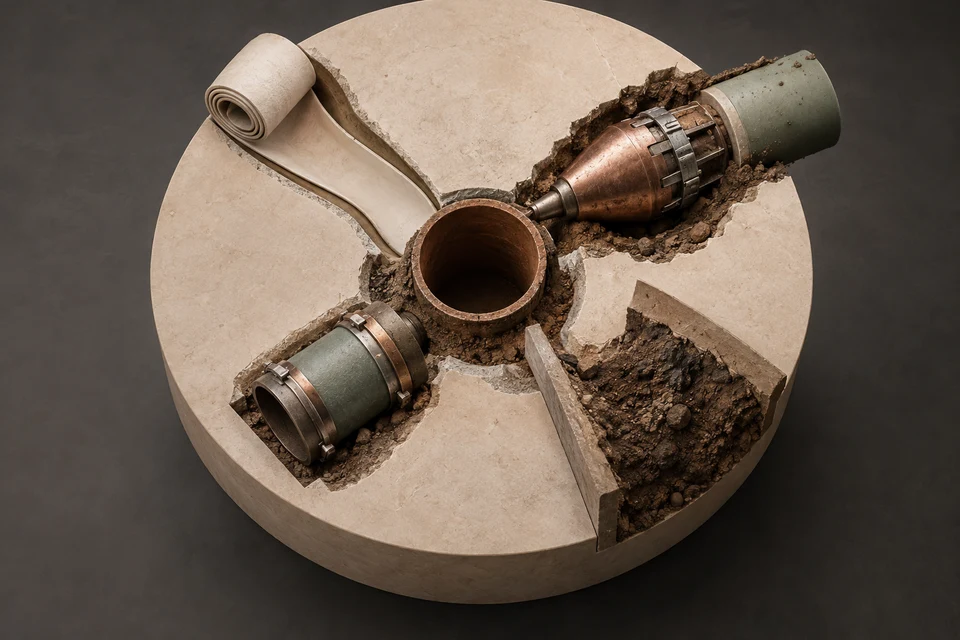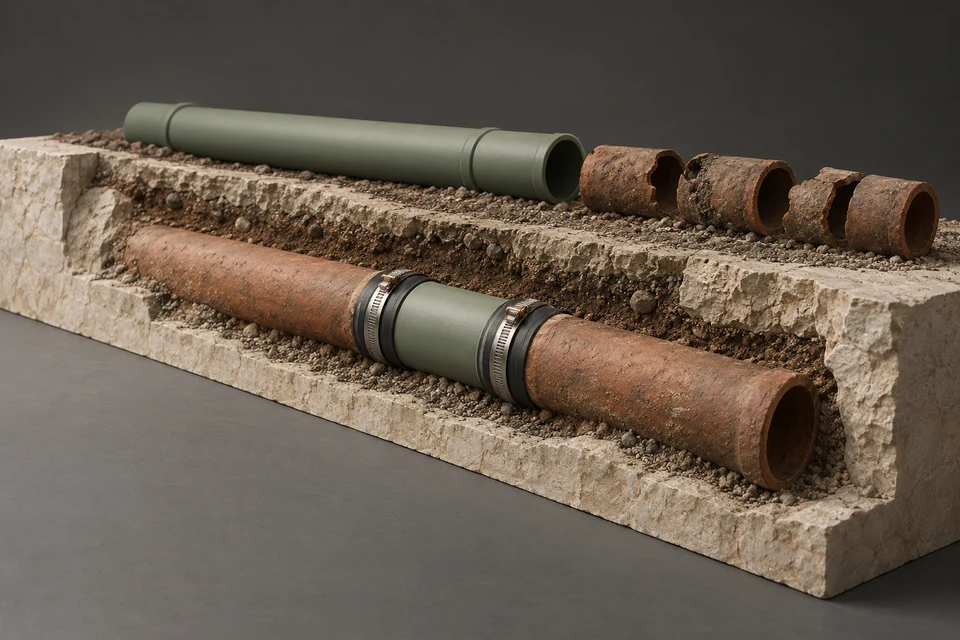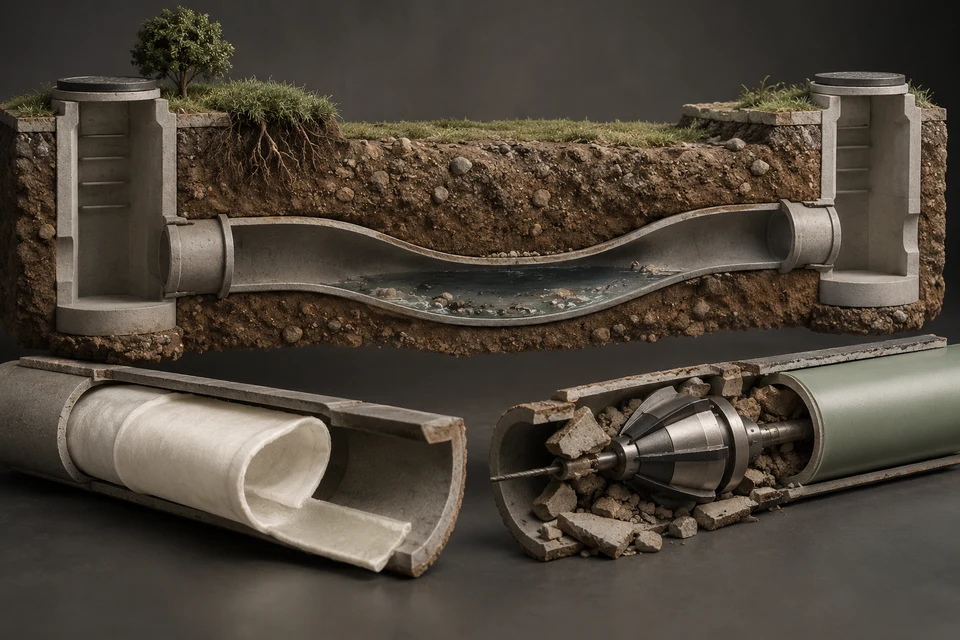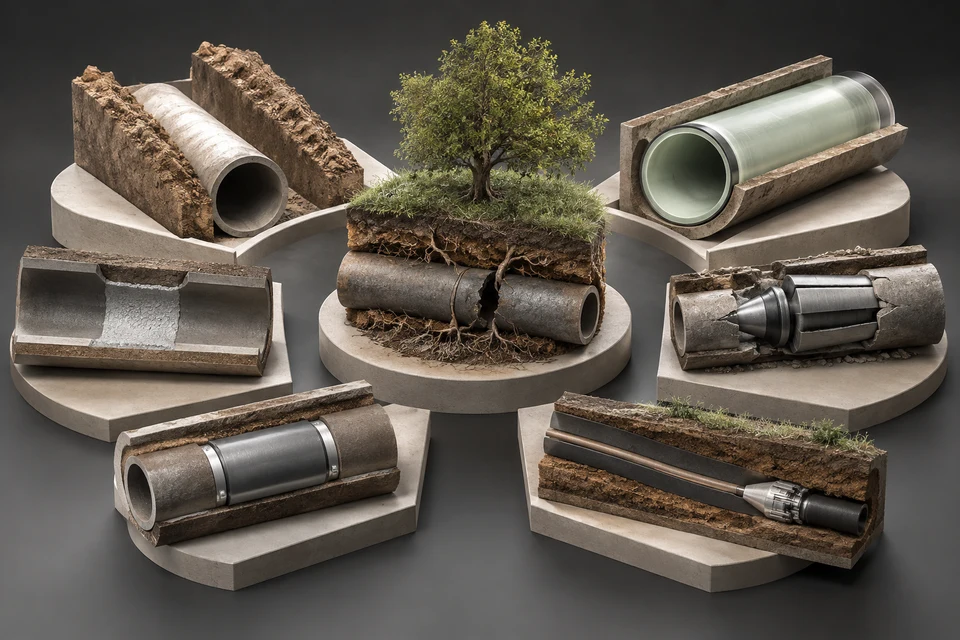
There are five practical ways to renew a residential sewer line in Canada: open-cut excavation, full-length cured-in-place lining (CIPP), pipe bursting, sectional liners and excavated spot repairs. Guided boring along a new path is a sixth, used occasionally. The right one depends on the defect, the grade, the depth, what sits on the surface, and how many connections join the line.
- Open cut is the only method that can fix any defect, including a lost grade, because the pipe is re-laid by hand on a new bed.
- Relining leaves the old pipe in place as a host, so it needs a pipe that is still round, continuous and on grade.
- Pipe bursting replaces the pipe along the old path and can upsize it, but it follows the old route, bends and sags included.
- Sectional liners and spot repairs fix one location; they are not replacements, but they are often the right answer.
- Choose the method after the camera diagnosis, never before it.
01 /What are the ways to replace a sewer line?
The options divide by how they reach the pipe. Open cut exposes the whole line in a trench. Trenchless methods work from access points instead: a liner forms a fresh pipe within the existing one, bursting drags new pipe along the route of the pipe it destroys, and guided boring cuts a different route entirely. Spot repairs and sectional liners treat one location with either a small dig or a short internal sleeve.
| Method | What happens to the old pipe | Can fix | Cannot fix | Surface disturbance |
|---|---|---|---|---|
| Open cut | Dug out and removed | Everything, including sags and reroutes | Nothing structurally; limits are cost and disruption | Full trench along the route |
| Full-length CIPP lining | Stays in place as the host | Cracks, fractures, open joints, roots, infiltration, light corrosion | Collapse, sag, severe deformation, badly undersized pipe | Usually none if cleanouts exist; otherwise one small pit |
| Pipe bursting | Broken outward into the soil | Cracked, broken, partly collapsed or undersized pipe | Sags, tight or multiple bends | A pit at each end, plus one at each connection |
| Sectional (point) liner | Stays in place | One crack, joint leak or root entry point | Anything at more than a few spots, sags, collapse | None at the defect |
| Excavated spot repair | One section cut out | Any single-location defect, including a short belly | Widespread damage | One pit over the defect |
| Guided boring on a new path | Abandoned in place | Everything, by bypassing the old line | Tight grade tolerance in soft or cobbly ground | A launch and a reception pit |
Two further techniques come up occasionally. Slip lining pulls a smaller solid pipe into the old one and fills the gap with grout. It is common on large municipal pipes and rare on house laterals because it costs too much diameter. Brush-on and spray epoxy coatings are marketed for small interior drain lines; they restore a surface rather than a structure, so treat them as a different category from a structural liner.
02 /How does open-cut replacement work, and when is it the right choice?
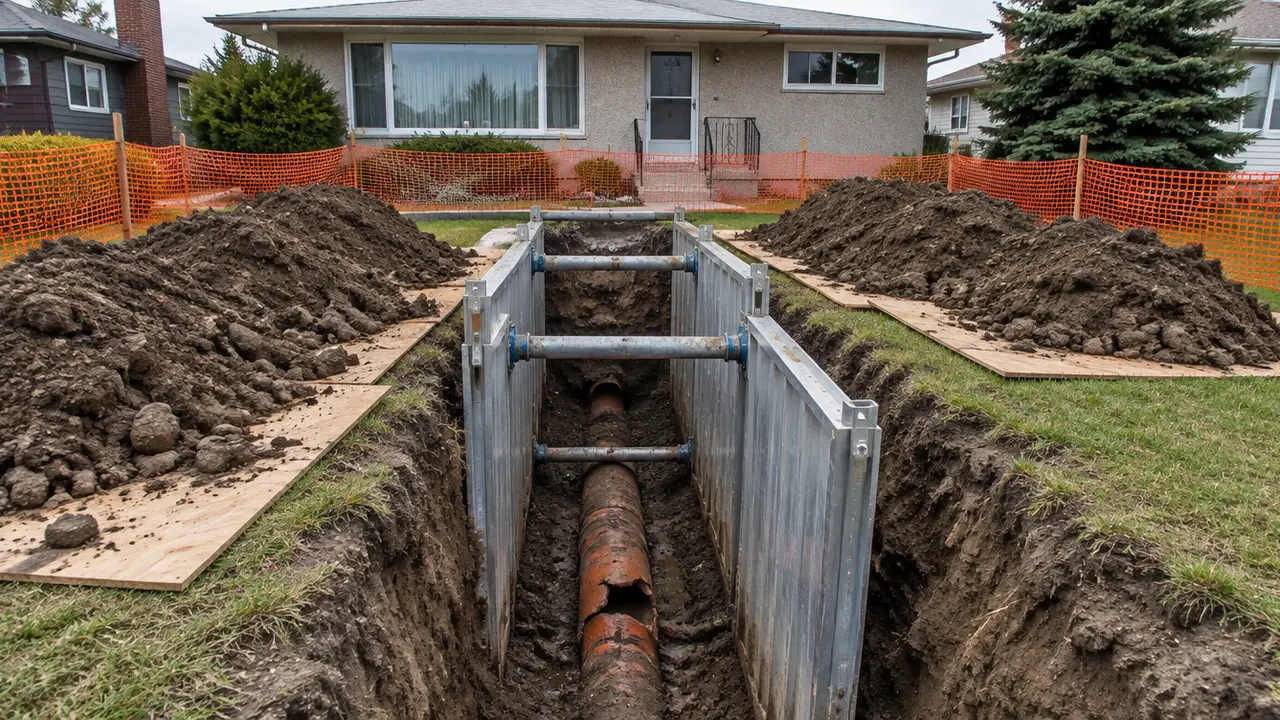
Open cut is the right choice when the line has lost its grade, when it has collapsed in several places, when it needs a new route or a larger size, or when the surface is cheap to restore. It is the traditional method: excavate a trench, remove the old pipe, prepare a bed, lay new pipe to a checked slope, have it inspected, and backfill in compacted layers.
The engineering that makes open cut reliable happens below the pipe. New PVC or ABS is only as good as the bed it sits on. A good crew removes soft or organic material from the trench bottom, places a granular bedding layer, sets the pipe to grade with a laser or a level and string line, and packs material around the lower sides of the pipe (the haunches) so it cannot settle or flatten. Skipping any of these steps is how a new pipe develops a belly a few years later.
Depth changes the job. Trenches deeper than roughly 1.2 to 1.5 metres, depending on the province, generally need sloped or benched walls or a trench box under occupational health and safety rules. That is why deep lines, lines under driveways and lines under the basement floor rate lower for open cut in the Replacement Method Selector: the method still works, but cost and disruption climb.
03 /What is full-length relining, and what does it need from the old pipe?
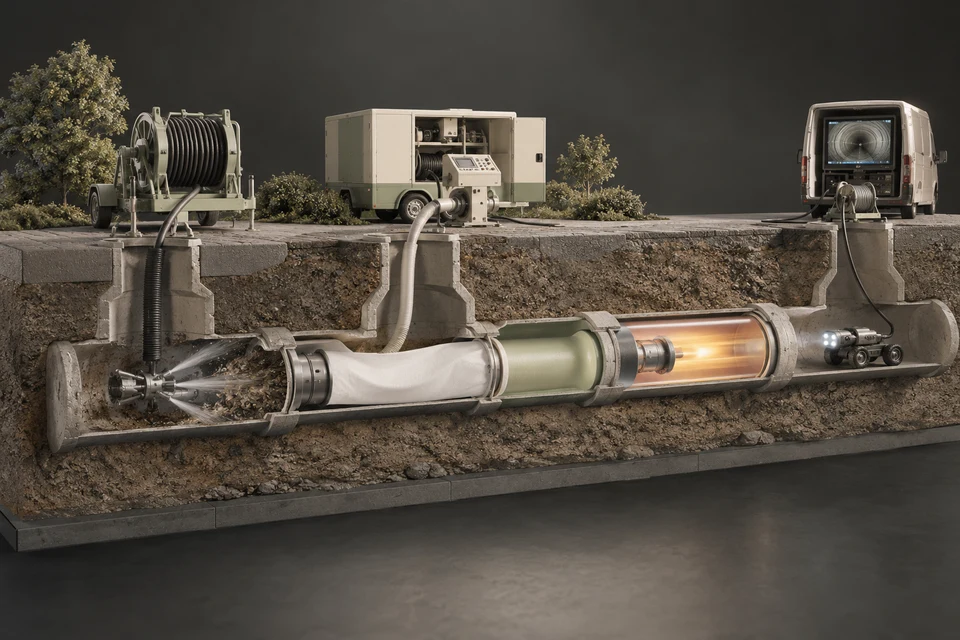
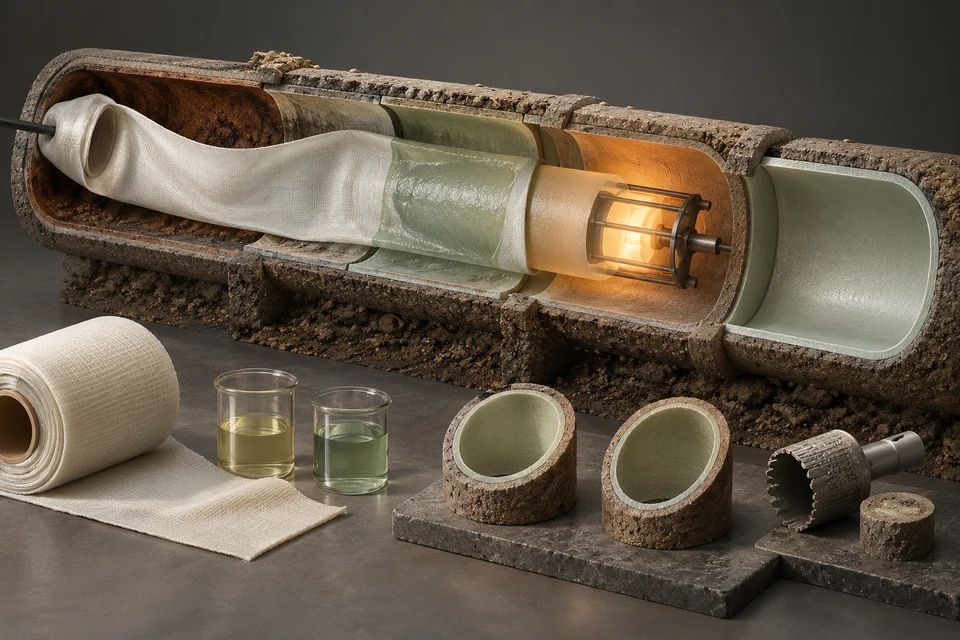
Full-length relining installs a resin-saturated fabric tube through the old pipe and hardens it into a new, jointless pipe inside the host. It is usually called cured-in-place pipe, or CIPP. It needs a host pipe that is continuous, reasonably round and on grade, because the liner takes the shape and slope of whatever it is cured against.
Relining suits the most common failure in older Canadian laterals: clay or cast iron pipe that is still in position but leaking and root-infested at the joints, or cracked along its length. It removes the joints entirely. What it cannot do is lift a sag, push out a collapse or restore a flattened pipe. The details of resin, curing and quality checks are in CIPP lining explained.
04 /What is pipe bursting, and where does it fit?
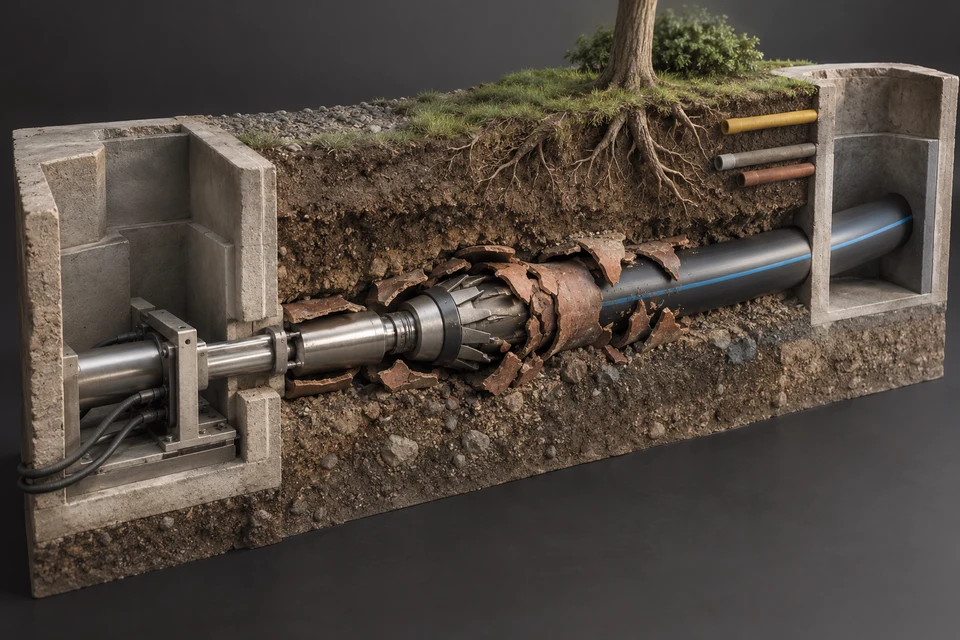
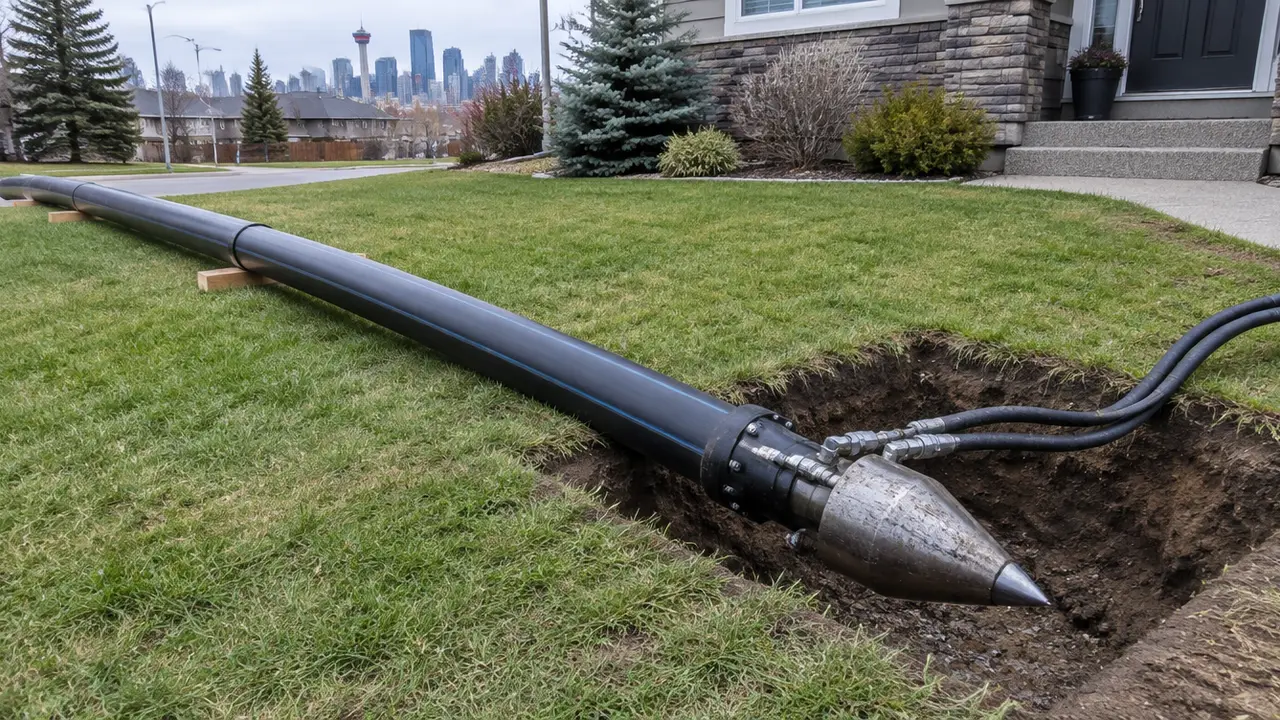
Pipe bursting pulls a cone-shaped head through the old pipe, breaking it outward into the surrounding soil while a new pipe, usually fused high-density polyethylene (HDPE), is drawn in right behind. It fits lines that are too damaged to host a liner but still have a path a cable or rod string can follow.
Bursting has two advantages over lining: it can replace a partly collapsed or broken pipe, and it can install a larger pipe than the one it replaces. Its limits come from the fact that it follows the old path. A sag stays a sag, tight bends stop the head, and every connection along the way needs its own excavation. Pipe bursting explained covers static and pneumatic systems, heave and utility clearances.
05 /When is a spot repair or sectional liner enough?
A spot repair or sectional liner does the job when the footage shows a single defect, or two far apart, in a line that is otherwise in good shape. Replacing 20 metres of pipe to fix one offset joint wastes money, while a single repair to one of many failing joints wastes money more slowly.
The judgement call is how many defects justify moving from spot fixes to a full-length solution. Spot repair vs full replacement works through that line and the warranty questions that come with it.
06 /Can directional drilling replace a sewer line?
Sometimes, but it is less common for gravity sewers than people expect. Horizontal directional drilling (HDD) steers a drill head underground and pulls back a new pipe. It works well for pressure pipes such as water services and gas lines, where small deviations in elevation do not matter. A gravity sewer, by contrast, must fall steadily from the house to the main, and a small hump or dip in a new pipe becomes a permanent belly.
Where a new path is needed and digging is not practical, contractors use grade-controlled techniques. Pilot-tube guided boring pushes a small steerable pilot along a line checked optically against a target, then enlarges the bore and installs the pipe. It gives far better grade control than conventional HDD. These methods tend to be used on longer or deeper crossings, such as under a road or a large structure, and are offered by fewer residential contractors.
- Consider a new path when the old route runs under an addition, a large tree or a neighbour's property, or when the old line is so deformed that neither lining nor bursting is possible.
- Ask about grade control before accepting any drilled sewer proposal: how is slope measured during the bore, and what tolerance is promised in writing?
- Plan for the old line: it must be disconnected and capped. See what happens to the old sewer pipe.
07 /How do you choose between open cut and trenchless?
Start with the defect, then the grade, then the site. If the camera shows a sag, a collapse that no cable can pass, or a line that must move, at least that section is an open-cut job. If the alignment is sound, compare trenchless options on access, bends and connections, then compare total cost including restoration.
Many real jobs combine methods. A common pattern is to line most of a clay lateral and dig one spot to fix a short belly, or to open-cut the shallow front-yard section and burst the section under the driveway. A good contractor will explain why a combination is or is not appropriate for your footage. Where a driveway or mature trees sit over the line, this guide to driveways and trees walks through pit placement, root protection and restoration.
To narrow the field for your own line, try the Replacement Method Selector, then read how trenchless sewer replacement works. Pricing by method is on SewerQuotes.com. When you have footage and a scope, request quotes.
FAQQuestions people ask
What is the best way to replace a sewer line?
There is no single best method. Open cut suits sags, collapses and reroutes; lining suits round pipe with joint and crack problems; bursting suits broken or undersized pipe on a straight path. The camera footage and the site decide.
Can you replace a sewer line without digging?
Almost. Lining can often be done entirely through existing cleanouts, and bursting needs only pits at each end. Some digging is usually needed for pits, connections or a new cleanout.
Which lasts longer, lining or new pipe?
New PVC or HDPE laid or pulled into place is generally expected to outlast a liner, though well-installed liners are designed for long service. Installation quality matters more than the method name.
Is pipe bursting the same as trenchless lining?
No. A liner hardens inside the existing pipe, which stays in the ground as its host. Bursting shatters the existing pipe and drags a replacement into the same channel.
Can different methods be combined on one sewer line?
Yes. Lining the sound part of a line and excavating a sagging or collapsed section is common, as is digging a shallow run and using trenchless methods under a driveway.
NETWORKGo deeper across the HAUSE Sewer network
Trenchless lining vs pipe bursting: cost, fit and trade-offs
Trenchless lining vs pipe bursting cost in Canada: 2026 CIPP and bursting ranges in CAD, line items, which defects each fixes and how to choose.
SewerRoots.caPermanent fixes for roots in sewer lines
Permanent fixes for roots in sewer lines: CIPP lining, sectional point repairs, pipe bursting and open-cut replacement compared by cost, lifespan and fit.
PipeCleaning.caHow long cast iron drain pipes last, and when to repair, line or replace
How long do cast iron drain pipes last? Why they rust and crack, how to judge remaining life, and when a repair sleeve, lining or replacement is right.