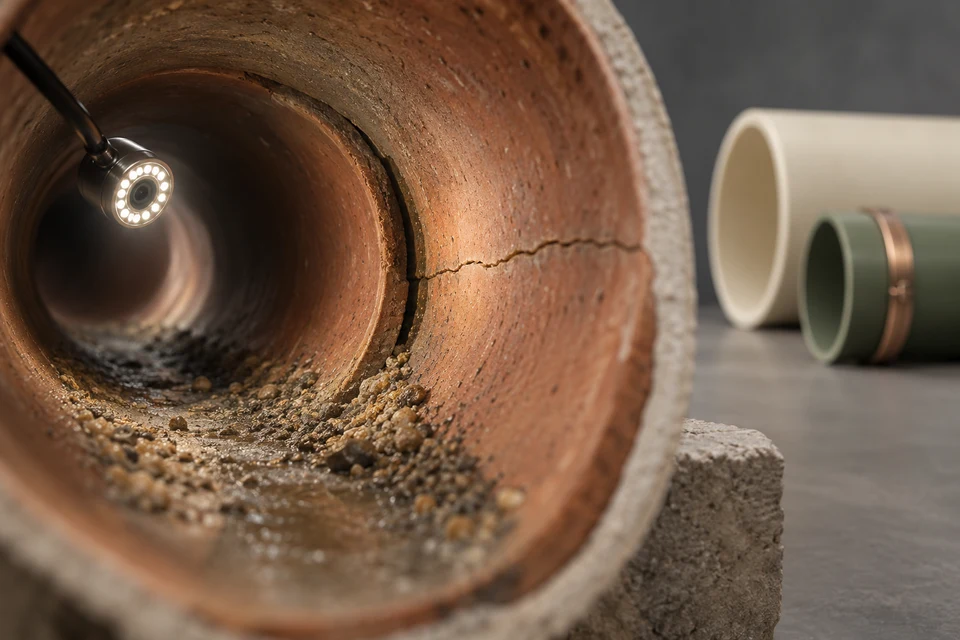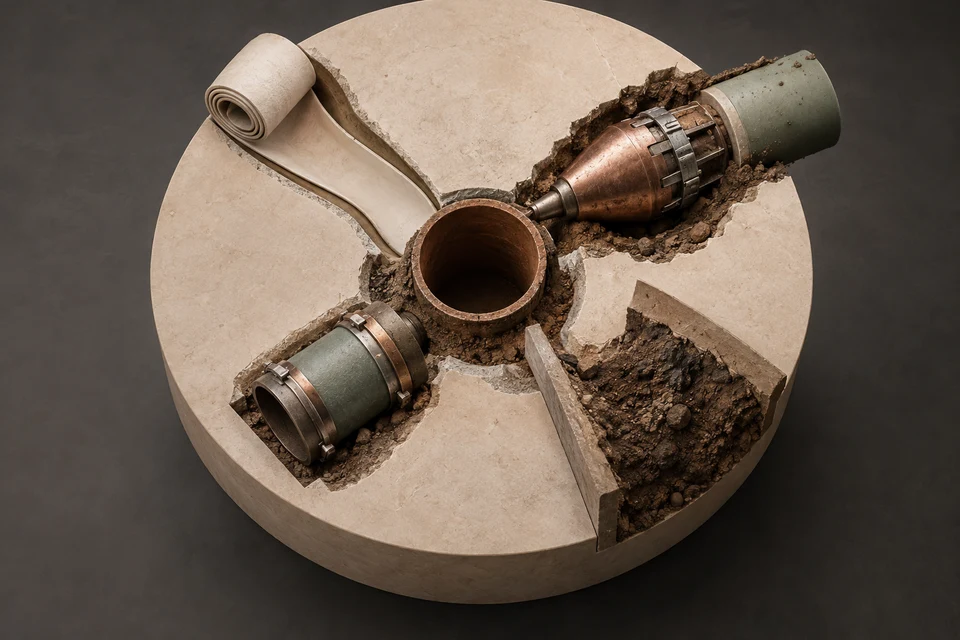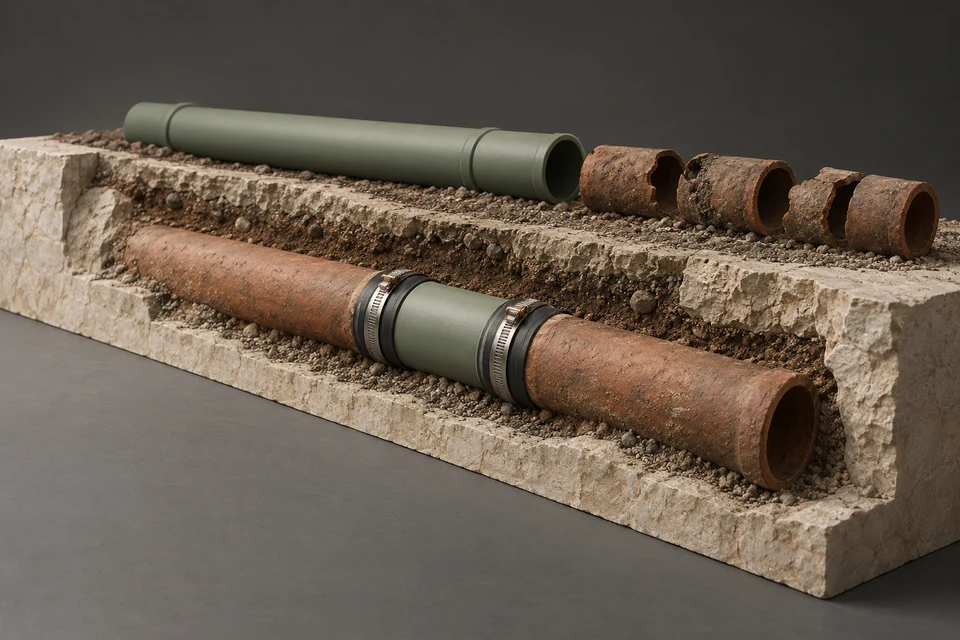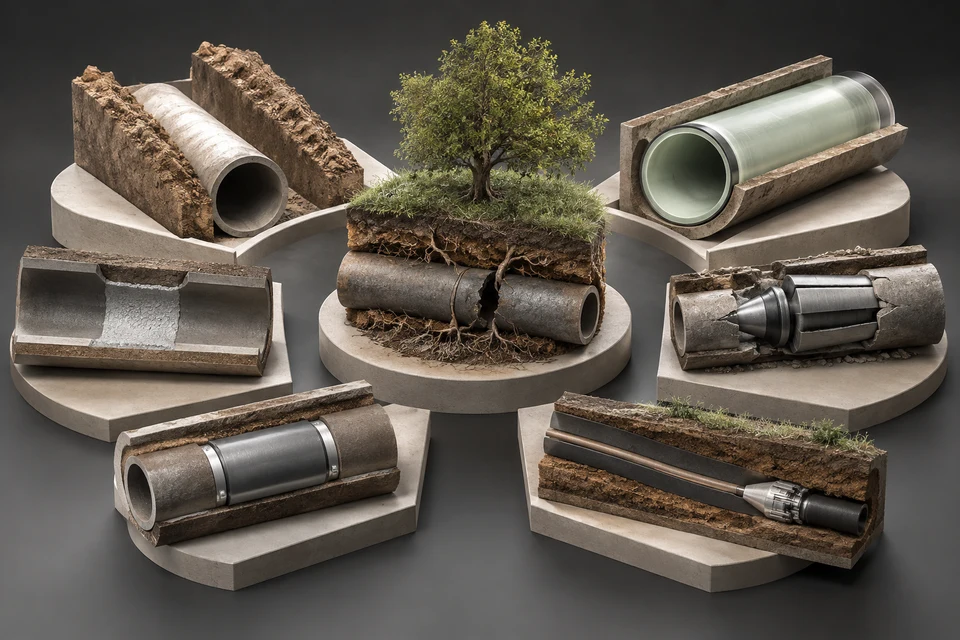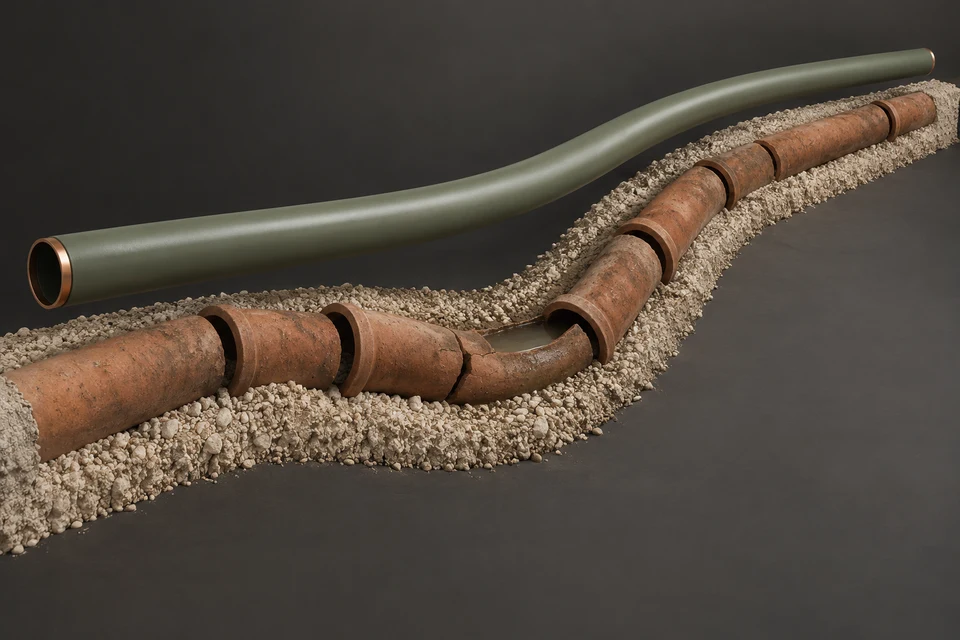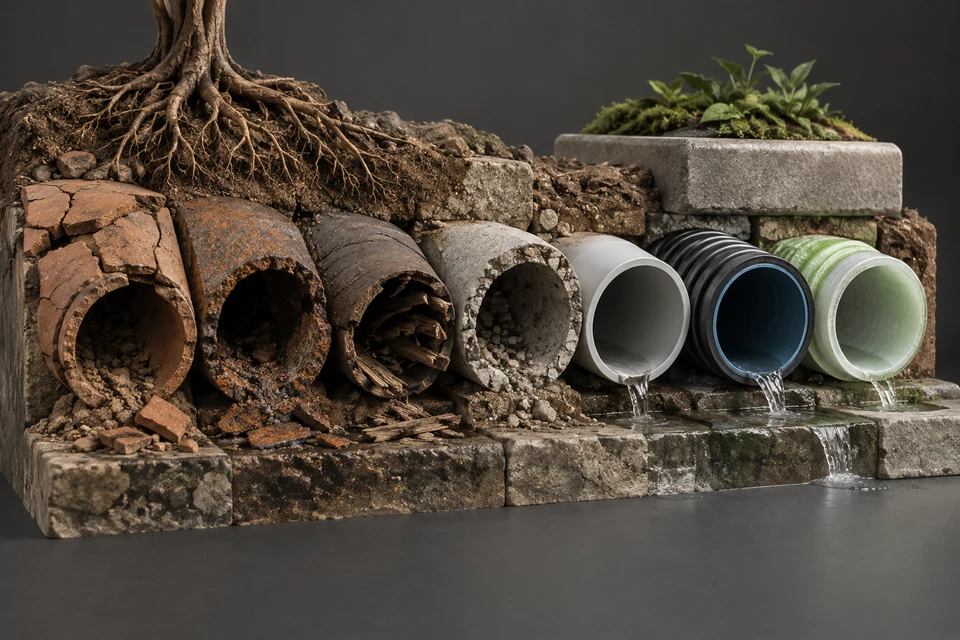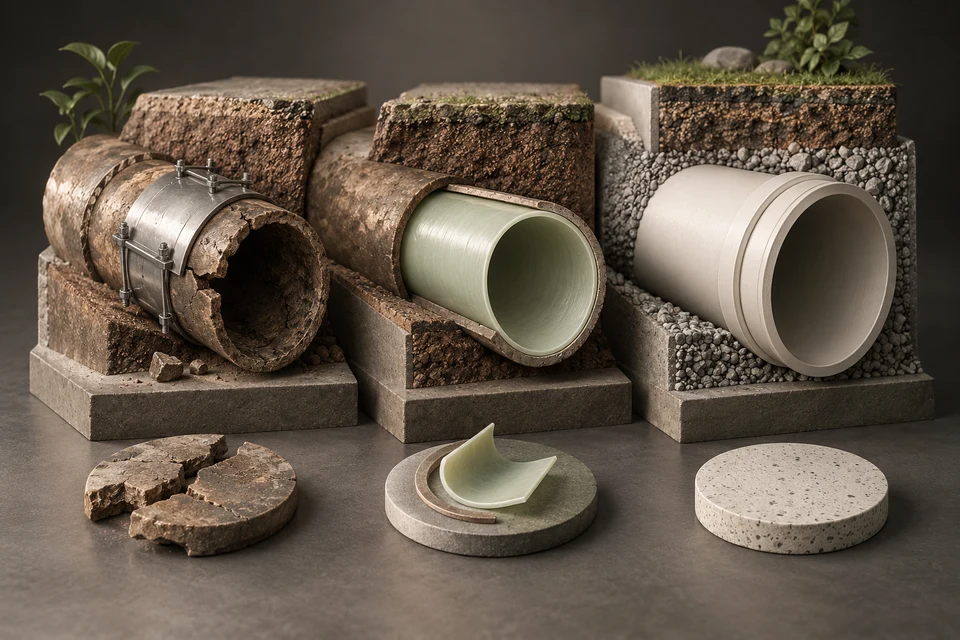
As 2026 planning estimates in CAD, a spot repair typically quotes about $3,500 to $16,000, a sectional liner $2,500 to $6,500 for the first defect, a full-length CIPP relining $9,000 to $28,000, pipe bursting $10,000 to $30,000, and open-cut replacement of a 15 to 25 m lateral $12,000 to $35,000 or more. The cheapest option is the one that fixes your defect the first time.
- Price follows depth, length, what sits on the surface and how much of the line is renewed, far more than pipe material.
- A cheap repair that leaves the next failure in place is often the expensive option over ten years.
- Open cut is frequently cheapest on a shallow lawn; trenchless usually wins under driveways, trees and finished landscapes.
- Repeated root cutting and backup cleanups can add up to the price of relining within a decade.
- These are planning ranges from SewerQuotes.com's published figures; only a scoped written quote is a price.
01 /What does it cost to repair, reline or replace a sewer line?
Each option buys a different amount of renewed pipe, so the prices are not directly comparable until you ask what each one fixes. The table lines them up with the ranges published by our sister site SewerQuotes.com, which covers sewer pricing in depth.
| Option | Planning model range | What it renews | Fixes a sag? |
|---|---|---|---|
| Main-line clearing (auger) | $200–$450 per visit | Nothing; clears a blockage | No |
| Hydro jetting, residential main | $450–$1,100 per visit | Nothing; cleans the pipe | No |
| Camera inspection with recorded video | $250–$600 | Nothing; the diagnosis | Not applicable |
| Sectional (point) liner | $2,500–$6,500 first section; $1,500–$3,500 each extra on the same visit | About one defect per section | No |
| Excavated spot repair | $3,500–$16,000 | One short section | Yes, at that spot |
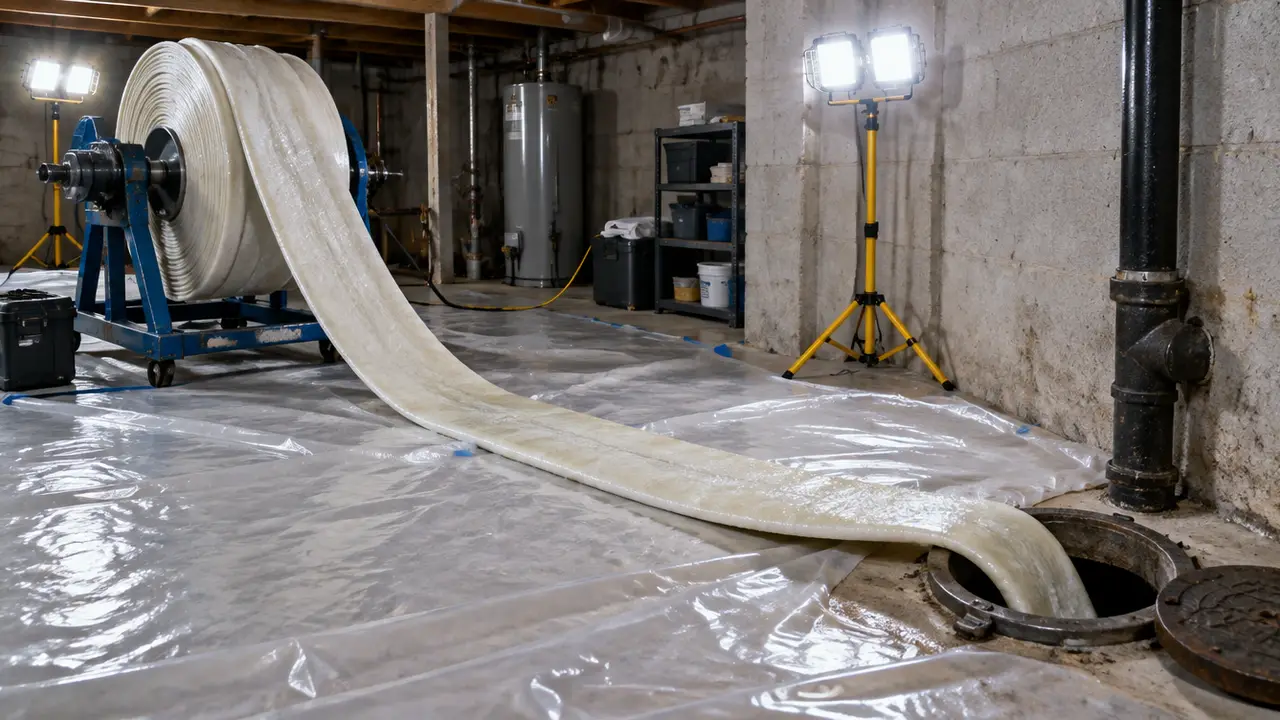
| Full-length CIPP relining (15–25 m) | $9,000–$28,000 | The whole lined length | No |
| Pipe bursting (15–25 m) | $10,000–$30,000 | The whole burst length, can upsize | No |
| Open-cut replacement (15–25 m) | $12,000–$35,000+ | The whole line, new grade | Yes |
The spot repair range is wide because depth and surface dominate. SewerQuotes.com's published breakdown runs from about $3,500 to $6,500 for a shallow dig under lawn, $5,000 to $9,000 at moderate depth, $7,000 to $16,000 for deep or hard-surface digs, and $4,000 to $12,000 for a repair under a basement slab.
02 /Why is sewer line replacement so expensive?
Because most of the money goes into getting to the pipe and putting the ground back, not into the pipe. A length of PVC sewer pipe is inexpensive. Digging a safe trench two or three metres deep, supporting its walls, working around other utilities, and rebuilding a driveway or landscape above it are not.
- Depth and trench safety: deeper trenches need sloping, benching or a trench box under provincial safety rules, plus larger equipment and more time.
- Restoration: concrete, pavers, asphalt, trees and landscaping over the line can cost as much as the pipe work. SewerQuotes.com's published line items run from about $500 for seed to $15,000 or more for hard surfaces.
- The municipal side: work at the main or in the road ranges from nothing, where the municipality handles it, to $15,000 or more with a road cut and traffic control.
- Equipment: trenchless jobs carry setup and equipment costs even on short lines, which is why short runs cost more per metre.
- Permits, locates and inspection: SewerQuotes.com lists permits at roughly $150 to $1,000 or more depending on scope.
- Risk: contractors price rock, groundwater and unknown obstructions into their rates or their exclusions.
03 /What is the cheapest way to replace a sewer line?
The cheapest way is the one that renews only what needs renewing, by the method that disturbs the least expensive surface. There is no universally cheapest method; the site decides.
| Situation | Usually lowest cost | Why |
|---|---|---|
| One defect in otherwise sound pipe | Spot repair or sectional liner | Renews only the failed spot |
| Shallow line under open lawn, many defects | Open cut | Cheap to dig and restore |
| Line under a driveway, pavers or mature trees, pipe still round | CIPP relining | Avoids rebuilding the surface |
| Broken or undersized pipe, straight route, few connections | Pipe bursting | Two pits instead of a trench |
| Sag in one place, clay joints elsewhere | Dig the sag, reline the rest | Each problem gets its cheapest fix |
| Deep line, hard surfaces, several defects | Compare lining and bursting | Open-cut restoration costs climb fast |
The Replacement Method Selector rates each method for your depth, surface and access. It rates open cut 'Possible' rather than 'Good' under driveways, slabs and roads, or below 3 m, precisely because that is where cost and disruption rise. For the site choices behind those ratings, including pit placement and restoration, see replacing a sewer line under a driveway or near trees.
04 /Is maintenance cheaper than replacing? The break-even math
Maintenance is cheaper in any single year and can be more expensive over a decade. The honest way to compare is to add up the maintenance a line actually needs and set it against a one-time renewal. The figures below are illustrative arithmetic using the planning ranges above, not a forecast for your line.
| Pattern | Ten-year maintenance arithmetic | Compared with |
|---|---|---|
| Jetting every two years, plus two camera runs | 5 × $450–$1,100 + 2 × $250–$600 = about $2,750–$6,700 | Relining: $9,000–$28,000 |
| Jetting every year, plus three camera runs | 10 × $450–$1,100 + 3 × $250–$600 = about $5,250–$12,800 | Relining: $9,000–$28,000 |
| Yearly jetting plus two backups with insurance deductibles and cleanup | The row above plus the deductibles, cleanup and damage you actually bear | Relining, and the backups stop |
The pattern is clear even with wide ranges: a line cut every couple of years can be maintained for a decade for less than the price of relining, while a line that needs yearly service and backs up is approaching the cost of a permanent fix, before counting the disruption. That is the reasoning behind the decision engine's rule 5: roots at a few spots with zero or one backups means maintain, while two or more backups means reline.
The cheapest sewer is the one you only pay for once, but only if it actually needed replacing.
05 /What does each option cost per year of service?
Dividing a price by the service it buys is a useful sanity check. Using the planning ranges and commonly quoted design lives gives rough figures, which are arithmetic, not predictions.
- Full-length relining at $9,000 to $28,000 over a commonly quoted design life of about 50 years works out to roughly $180 to $560 per year for the whole lined length.
- Open-cut replacement at $12,000 to $35,000 buys new pipe with a design life commonly quoted at many decades, often at a lower cost per year than relining on a shallow lawn and a higher one under hard surfaces.
- A spot repair at $3,500 to $16,000 renews one location. On a modern line it may be all you ever need. On an old clay line, its cost per year depends on how soon the next joint fails.
- Maintenance at a few hundred to over a thousand dollars per year buys time, not pipe.
Service life depends on installation quality, soil and use; see how long sewer pipes last before leaning on any of these numbers.
06 /How do you get real numbers for your line?
- Start with footage
A recorded camera run with distances and depths is what every quote should be based on.
- Decide what needs fixing
Run the findings through the Repair or Replace? Decision Engine so you know whether you are pricing a spot repair, a relining or a replacement.
- Write one scope
Start and end points, method or methods to price, pipe and restoration standard, and the ownership boundary.
- Price alternatives on the same footage
Ask for a spot repair price and a full-length price, or lining and bursting, side by side.
- Compare line by line
SewerQuotes.com's quote comparison worksheet and cost estimator help normalise quotes and check them against planning ranges.
When you are ready, request quotes with your footage attached. For financing, payment schedules and insurance questions, see SewerQuotes.com.
FAQQuestions people ask
How much does sewer line replacement cost in Canada?
Using 2026 planning ranges, digging out and replacing a 15 to 25 m house lateral usually quotes around $12,000 to $35,000 CAD or more, relining about $9,000 to $28,000 and bursting about $10,000 to $30,000. Depth, surface and the municipal connection move the price most.
Why is sewer line replacement so expensive?
Most of the cost is excavation, trench safety, restoration of the surface and work at the municipal connection, plus permits and equipment. The pipe itself is a small share of the total.
Is relining cheaper than digging up the line?
Often when a driveway, pavers, trees or landscaping sit over the line, because trenchless avoids rebuilding them. On a shallow open lawn, open cut is frequently cheaper. Trenchless cannot fix a sag.
Is sewer line replacement tax deductible in Canada?
For a home you live in, generally not. For a rental property, the Canada Revenue Agency distinguishes current expenses from capital expenses, and a replacement may be treated either way depending on the facts. Ask an accountant.
Does replacing a sewer line increase home value?
It rarely adds value the way a kitchen does, but it removes a known risk that buyers and their inspectors look for in older homes. Documentation of the work, including the video and permit, is what makes that visible.
Can you finance sewer line replacement?
Many owners use contractor payment plans, lines of credit or home equity. Compare interest costs and avoid large deposits. SewerQuotes.com covers payment schedules and financing in more detail.
NETWORKGo deeper across the HAUSE Sewer network
Sewer line replacement cost: open-cut vs trenchless, line by line
Sewer line replacement cost in Canada for 2026: open-cut, CIPP lining and pipe bursting planning ranges in CAD, per-metre math, line items and what moves price.
SewerRoots.caSewer root removal cost in Canada: cutting, chemicals and permanent fixes
Sewer root removal cost in Canada for 2026: planning ranges for cable cutting, jetting, camera, lining, bursting and replacement, plus cycle-versus-fix math.
SewerInspector.caScope the sewer before you renovate, finish the basement or landscape
Why to get a sewer inspection before renovation, basement development, a suite or landscaping: what to check, when to book it, and how findings change plans.