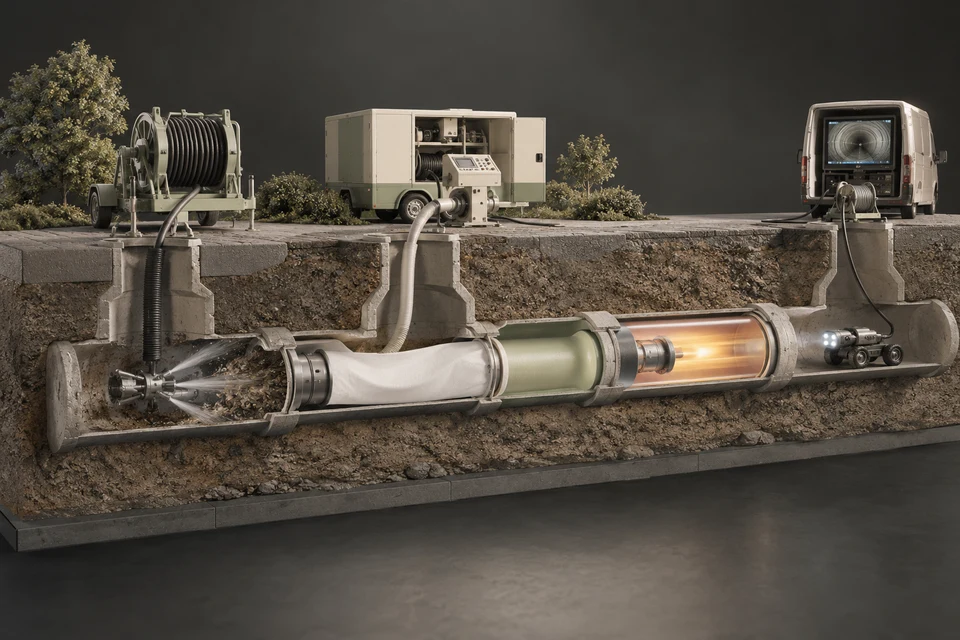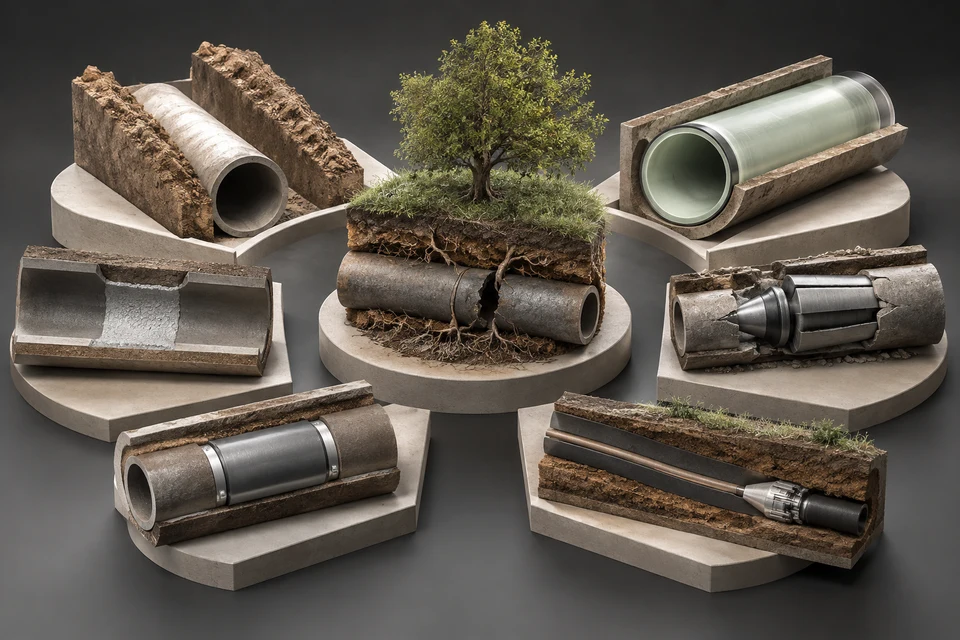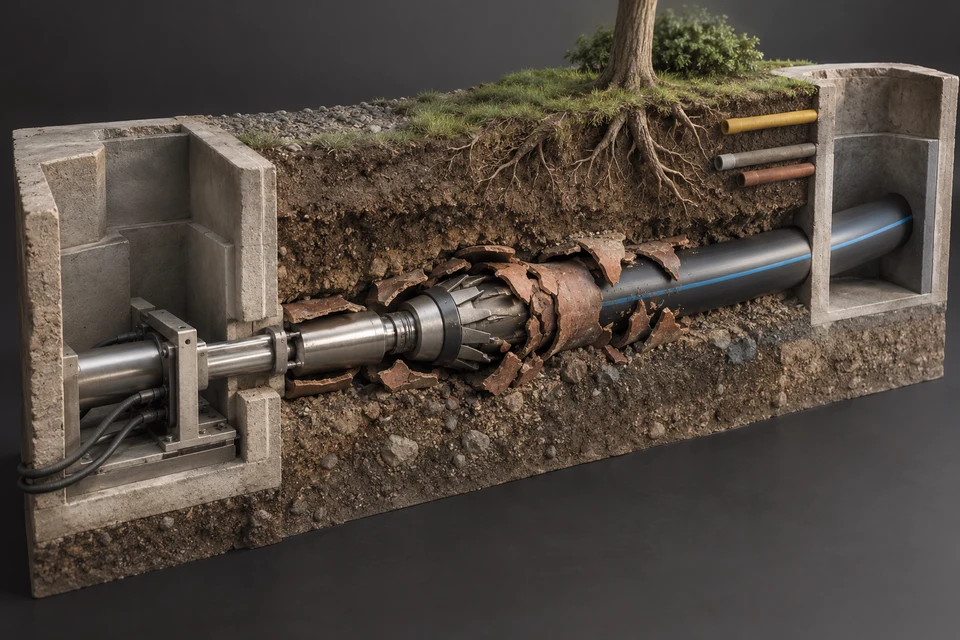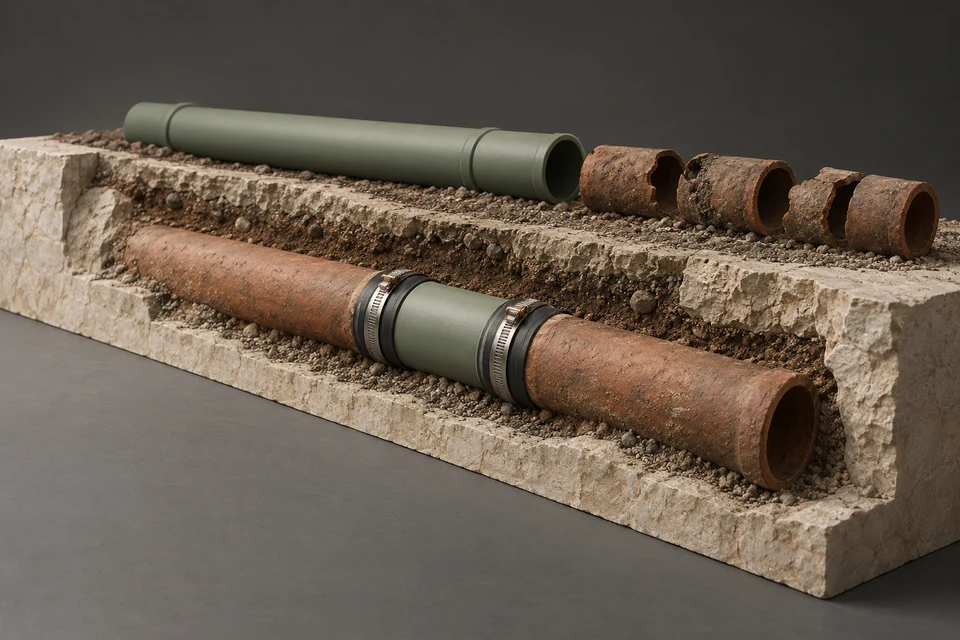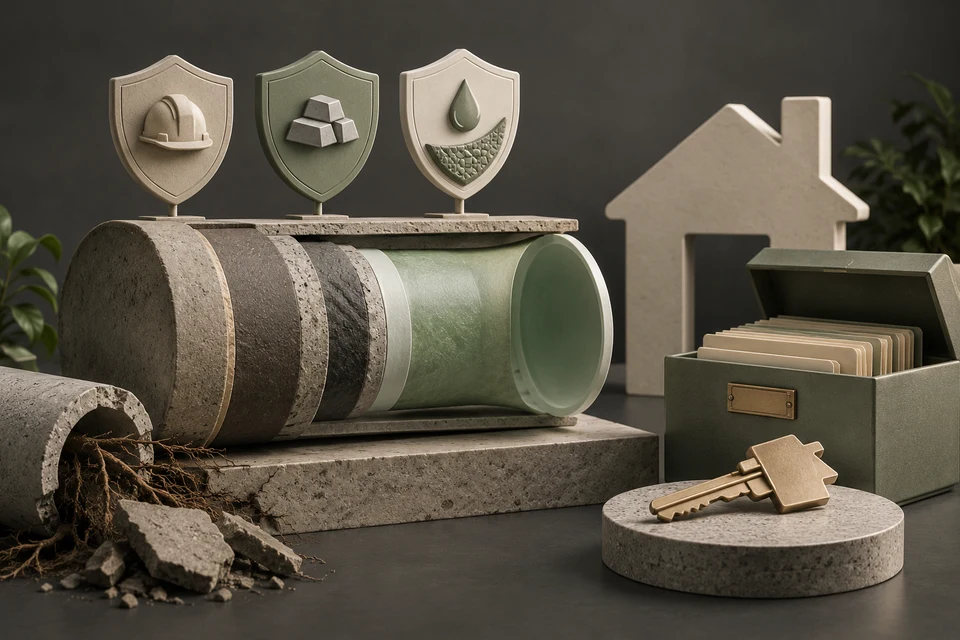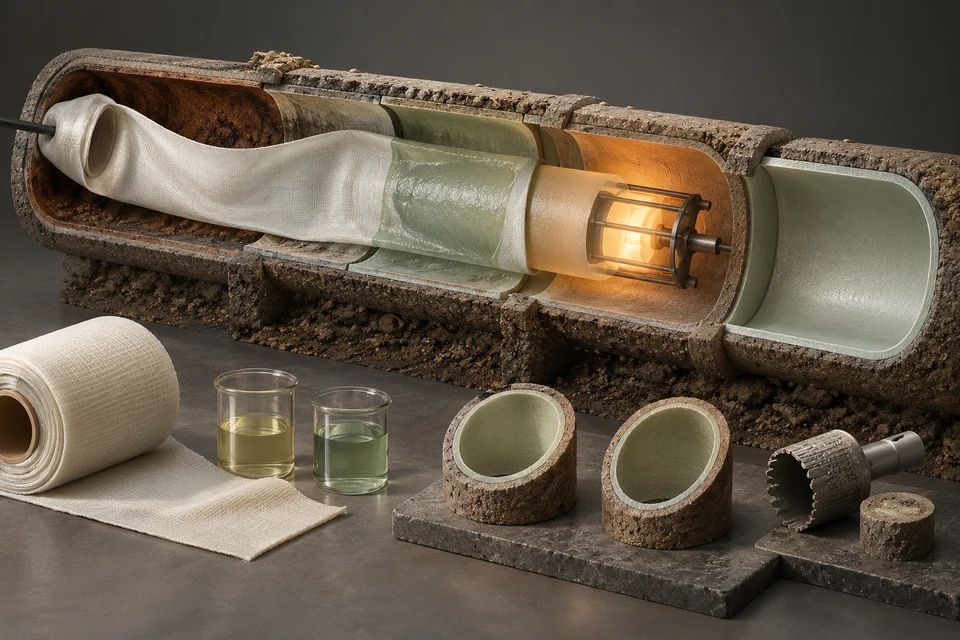
Cured-in-place pipe (CIPP) lining turns a resin-saturated fabric tube into a jointless pipe inside an old sewer. The tube is inverted or pulled into the cleaned host, pressed against its wall, and cured with ambient heat, hot water, steam or UV light. The result is slightly smaller than the host but smoother, and it seals cracks, joints and root entry points.
- A liner is only as good as the preparation: it takes the exact shape of whatever it is cured against.
- Epoxy resins are common on house laterals; polyester and vinyl ester resins are common on municipal mains.
- A liner a few millimetres thick costs some cross-section, but its smooth wall usually keeps flow capacity close to the original.
- Reinstating branch connections and sealing the ends are where residential liners most often go wrong.
- The post-lining video is the proof of quality; review it before the final payment.
01 /What is a CIPP liner made of?
A CIPP liner is two materials that become one: a flexible fabric tube and a thermosetting resin. The fabric, usually needled polyester felt and sometimes glass fibre, carries the resin into place and reinforces it. The resin, once cured, provides the stiffness and the watertight wall. Most tubes also carry a thin plastic coating on one face that ends up as the inner surface of the new pipe, or that keeps resin contained during installation.
| Resin | Where it is common | Notes |
|---|---|---|
| Epoxy | Residential laterals and building drains | Strong bond to the host, low odour, sensitive to accurate mixing and cure temperature |
| Unsaturated polyester | Municipal mains | Economical for large volumes; conventional formulations release styrene odour during cure |
| Vinyl ester | Mains and aggressive effluent | Better chemical resistance than polyester; also styrene-based in conventional forms |
| Silicate and other specialty systems | Niche applications | Used by some installers for specific conditions; ask for the product data sheet |
For a house lateral in Canada you will most often be offered an epoxy system. Ask the contractor for the name of the liner system and its technical data sheet. A serious installer will provide it without hesitation, and it tells you the resin type, cure method and design standard.
02 /How is the liner installed in the old pipe?
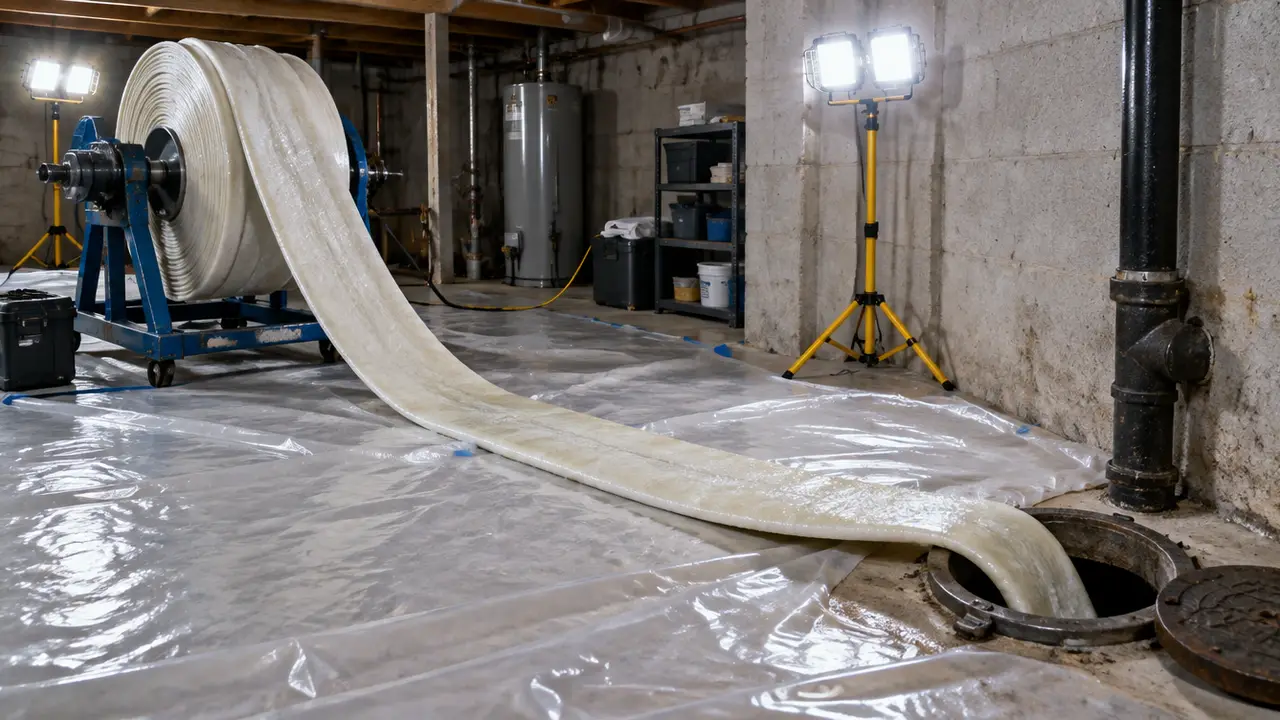
The liner goes in by inversion or by pull-in-place after the host has been cleaned and inspected. Inversion is the common approach on house laterals because it can be done from a single cleanout, sometimes from inside the basement.
- Measure and cut
The liner is cut to the measured length plus allowance, and sized to the host diameter. Diameter changes along the run need a transition liner or separate sections.
- Wet out
Resin is mixed and drawn or rolled through the fabric so it is fully saturated with no dry patches. On lateral jobs this is often done at the truck immediately before installation.
- Insert
An inversion drum or launcher turns the liner inside out into the pipe using air or water pressure. For pull-in-place, the liner is winched in and a bladder inflated inside it.
- Hold and cure
Pressure keeps the liner against the host while the resin hardens. Cure time runs from under an hour with steam or UV to several hours at ambient temperature, depending on the system and the temperature of the ground.
- Trim, seal and reinstate
The ends are cut back and sealed, and a robotic cutter reopens every branch the liner covered.
03 /What are the curing methods, and does the choice matter?
Curing is the chemical hardening of the resin, and every method is a way of controlling its speed and completeness. The choice matters mostly for time on site, resin compatibility and cold-weather performance.
| Method | How it works | Practical notes |
|---|---|---|
| Ambient cure | Resin hardens at ground temperature | Simple equipment; slow in cold ground, which matters in a Canadian winter |
| Hot water | Heated water circulated inside the liner | Even heat along the run; water must be managed afterward |
| Steam | Steam passed through the liner | Fast; common on laterals where the no-water window must be short |
| Ultraviolet (UV) light | A light train drawn through the liner cures light-sensitive resin | Fast and controlled; needs a compatible glass-fibre liner |
Ask one practical question: how does the installer confirm the resin is fully cured before the line goes back into service? Answers may include temperature monitoring, cure-time logs, or a cured sample kept at the surface. An undercured liner can remain soft in spots and deform later.
04 /How thick is a liner, and how much bore does it cost?
Residential lateral liners are typically a few millimetres thick, commonly in the range of about 3 to 6 mm for a 100 mm (4 in) pipe, with the exact thickness set by the system's design for the host condition, depth and groundwater. The inside diameter shrinks by roughly twice the wall thickness.
Design practice distinguishes a partially deteriorated host, where the old pipe still carries soil loads and the liner mainly resists groundwater and seals the wall, from a fully deteriorated host, where the liner is designed to carry soil and surface loads on its own. The widely referenced ASTM F1216 practice includes design equations for both. A fully deteriorated design needs a thicker wall.
| Liner wall | Finished inside diameter | Cross-section remaining | Cross-section lost |
|---|---|---|---|
| 3 mm | 94 mm | About 88% | About 12% |
| 4.5 mm | 91 mm | About 83% | About 17% |
| 6 mm | 88 mm | About 77% | About 23% |
Lost area is not the same as lost capacity. Flow in a gravity pipe depends on smoothness as well as size, and a jointless liner is much smoother than old clay with offsets and root stubs. Running the standard Manning equation with typical textbook roughness values, a 91 mm liner inside a 100 mm clay pipe comes out somewhere around 90 to 110 percent of the old pipe's clean capacity, depending on the assumptions. A 100 mm lateral at a normal slope also carries several times the peak flow a single house produces. The bore loss matters most when the host is already undersized, which is why the Replacement Method Selector rates lining only 'Possible' for an undersized line.
05 /What happens at branch connections and at the ends?
Every branch that joins the lined section, such as a second building drain, a garage drain or a cleanout riser, is covered by the liner and must be reopened. This is done from inside with a remote-controlled cutter, guided by the camera and the distances recorded before lining.
- Under-cut reinstatements leave a lip of liner across part of the opening, which catches paper and debris.
- Over-cut reinstatements damage the liner around the opening and can let roots return at that point.
- Unsealed connections can leak between liner and host even when the opening looks clean; some systems add a connection seal or short branch liner.
- End seals stop groundwater and roots from travelling along the gap between host and liner. Ask what seal is used at each end.
The junction between your lateral and the municipal main is a special case. Some lining systems include a connection liner with a brim that seals against the inside of the main. That work sits on the municipal side in most cities and usually needs the municipality's permission or its own crews. Confirm who owns and approves that junction before it is quoted.
06 /What should you look for in the post-lining video?
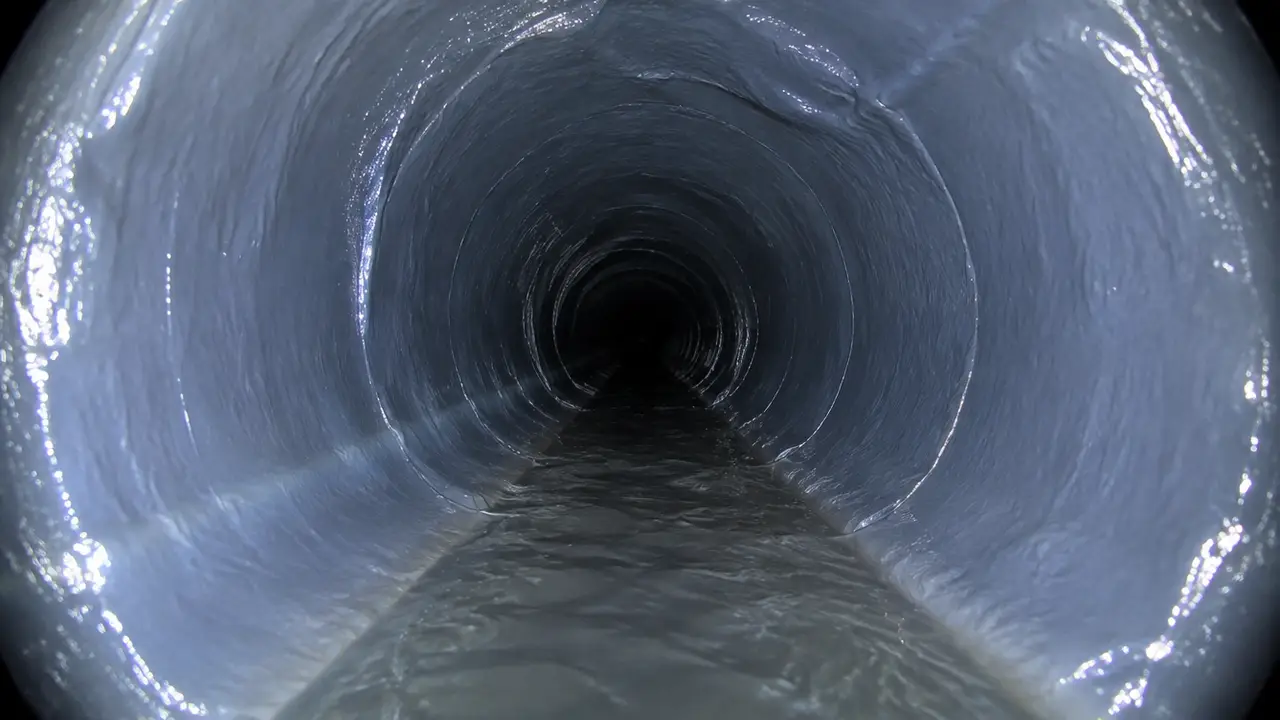
The post-lining video should show a continuous, smooth pipe from the access point to the end of the liner, with every connection open. Some imperfections are normal; others are defects that should be corrected before you pay the balance.
| What you see | Usually acceptable? | Why it matters |
|---|---|---|
| Small longitudinal wrinkles at a bend | Often, if shallow | Liners gather material on the inside of bends |
| A fold or fin that catches water or debris | No | Traps solids and starts blockages |
| Liner pulled away from the host (a lift or bulge into the bore) | No | Reduces the bore and may indicate groundwater or cure problems |
| Branch connection partly covered | No | Catches debris and restricts the branch |
| Standing water in a low spot | Only if it existed before | Lining follows grade; a new belly means something moved |
| Visible cracks, holes or soft areas | No | Suggests incomplete cure or damage |
| Gap at the liner end with soil or roots visible | No | End seal missing or failed |
07 /Are there safety or odour concerns during lining?
There can be. Conventional polyester and vinyl ester resins release styrene vapour during cure, and that odour can travel up through house drains whose traps have dried out. Epoxy systems common on laterals have much lower odour, but uncured resins in general are skin and eye irritants and should be handled only by the crew.
- Run water into every floor drain, basement fixture and unused trap before work starts so traps are sealed.
- Ventilate the basement if an odour appears, and tell the crew immediately.
- Keep children and pets away from the access point, resin containers and the heated liner.
- Do not use water that drains to the line until the crew confirms cure is complete.
Hydrogen sulphide and low-oxygen air can collect in sewer pits and manholes. Crews should follow confined-space procedures for any pit someone must enter, and no one else should enter at all.
08 /How long does a CIPP liner last?
Liner systems are commonly designed and marketed for a service life of around 50 years, and municipal liners installed in the 1970s and 1980s are still in service in many places. Residential lateral lining is younger, so long-term field records for house laterals are thinner. Installation quality, the host's condition and root pressure at the ends decide the real life of a particular liner.
If relining is on your shortlist, compare it with bursting and open cut in sewer replacement methods compared, check the lifespan context in how long sewer pipes last, and see planning prices on SewerQuotes.com. Ready to price your line? Request quotes with your camera footage.
FAQQuestions people ask
What does CIPP stand for?
Cured-in-place pipe. A resin-saturated fabric tube is placed inside an old pipe and hardened there, forming a new jointless pipe within the host.
Does CIPP lining reduce the pipe diameter?
Yes, by about twice the liner thickness. A 100 mm pipe with a 4.5 mm liner ends up near 91 mm inside. The smoother wall usually keeps flow capacity close to the original clean pipe.
Can CIPP lining be done in winter?
Yes, often, because little or no excavation is needed. Cold ground slows ambient-cure resins, so winter jobs commonly rely on heated cure methods. Ask the installer how cure is confirmed.
Can roots grow through a CIPP liner?
A properly cured, sealed liner has no joints for roots to enter. Roots can return where a liner ends without a proper seal or where a connection was cut badly.
Can a liner go around bends?
Many lateral liners can negotiate bends, including some fairly tight ones, though wrinkles form on the inside of the bend. Sharp or multiple bends make installation harder and should be discussed before you commit.
How soon can I use water after lining?
Once the installer confirms the resin is cured and connections are reopened. That can be within an hour or two with steam or UV, or several hours with ambient cure.
NETWORKGo deeper across the HAUSE Sewer network
Sewer lining for tree roots: will a CIPP liner stop them for good?
Sewer lining for tree roots: how a CIPP liner seals root-damaged joints, which lines qualify, preparation, weak points at the ends, and planning costs.
SewerJetting.caJetting before trenchless lining: why the prep cleaning decides the result
Why jetting before trenchless lining matters: root removal, descaling cast iron, cleaning to a bare wall, camera checks and what rushed CIPP prep causes.
SewerQuotes.comSewer pipe lining cost: what a CIPP liner should cost in Canada
Sewer pipe lining cost in Canada (2026): CIPP liner ranges in CAD for full laterals and single sections, the line items, cost drivers and quality checks.