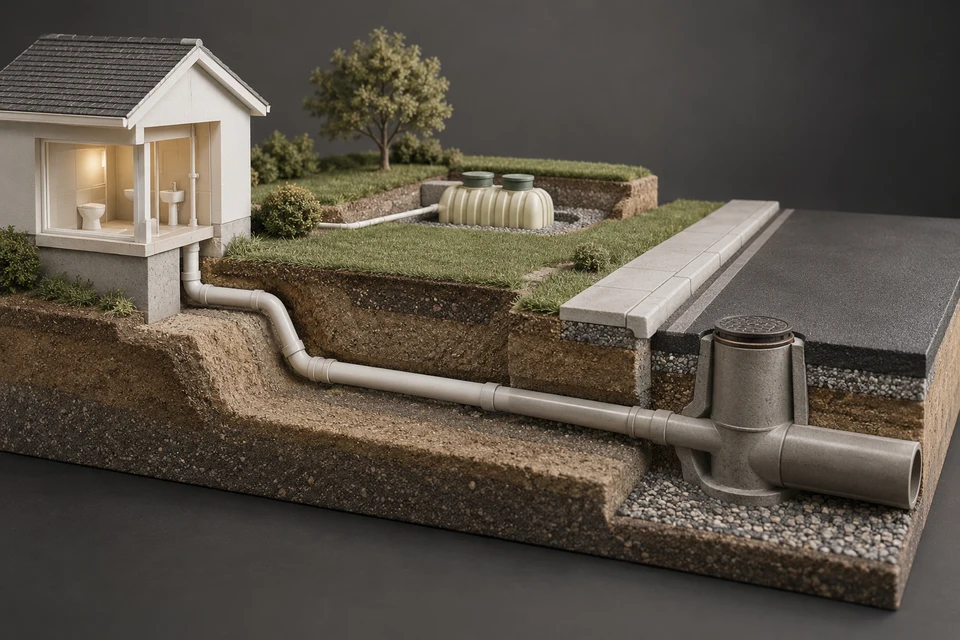
Sewer lateral replacement renews the pipe that carries a house's sewage from the foundation to the municipal main. The owner usually pays for the section on private property; the municipality often owns the section from the property line to the main, though the split varies by city. The work is planned around that boundary, the connection at the main, and any road or boulevard permit.
- A lateral has a private part and, in most Canadian cities, a municipal part; find out where your city draws the line before you get quotes.
- The connection to the main is the most regulated and least predictable part of the job.
- Work in a boulevard, sidewalk or road usually needs the municipality's permission and sometimes its own crews.
- Replacing only the private side of an old lateral can leave the weak link in place; ask what the municipal side is made of.
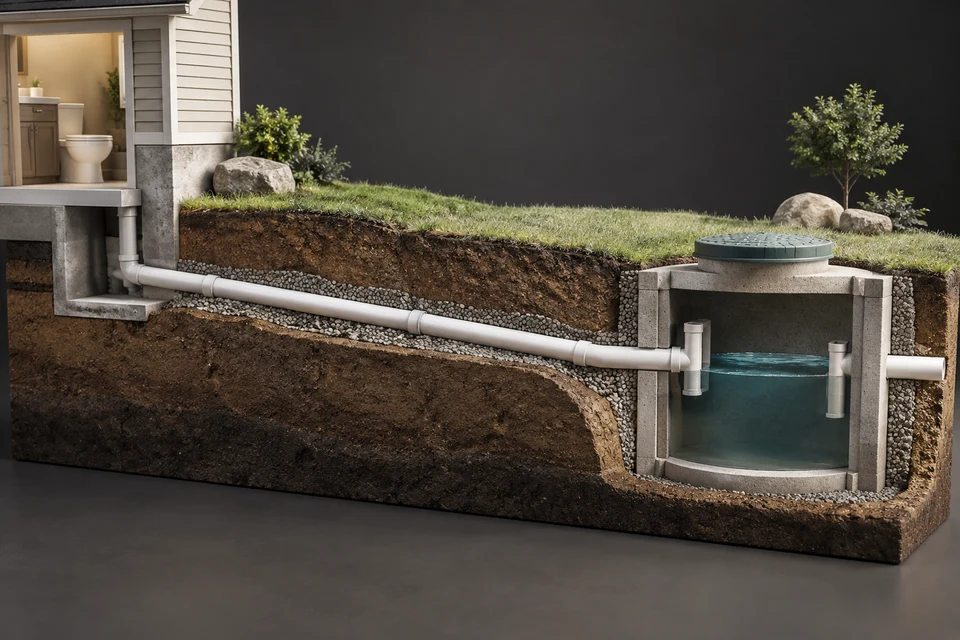
- A house on a septic system has a private lateral to the tank, governed by provincial private-sewage rules.
01 /What is a sewer lateral, and what does replacing it involve?
A sewer lateral is the pipe that runs from your house to the municipal sewer main, usually under the front yard and boulevard to a main in the street, or to the rear in a lane. Replacing it means renewing that pipe by open cut, lining or bursting, and reconnecting it at both ends: to the building drain at the house and to the main or the municipal service at the other end.
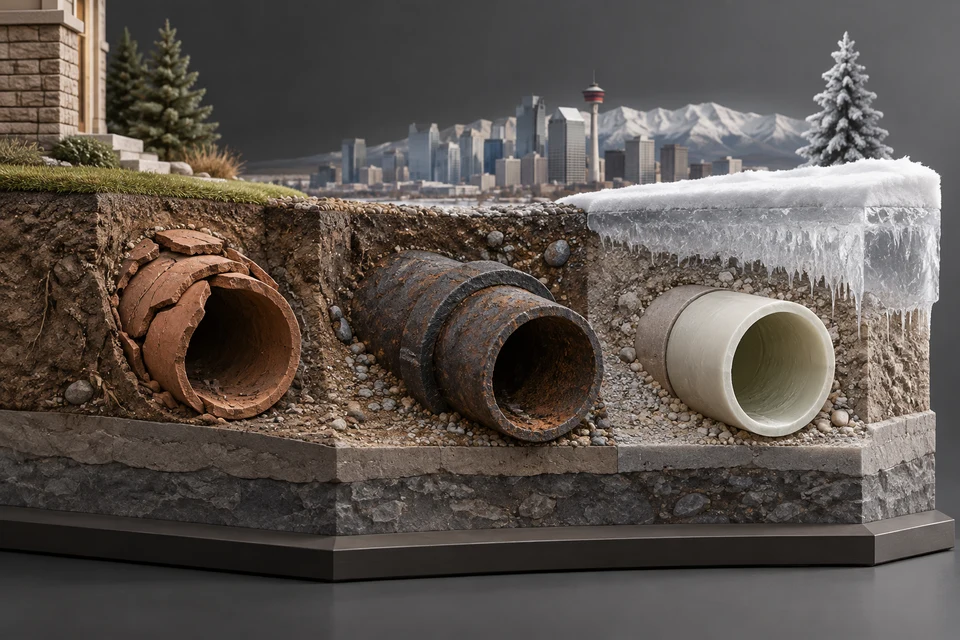
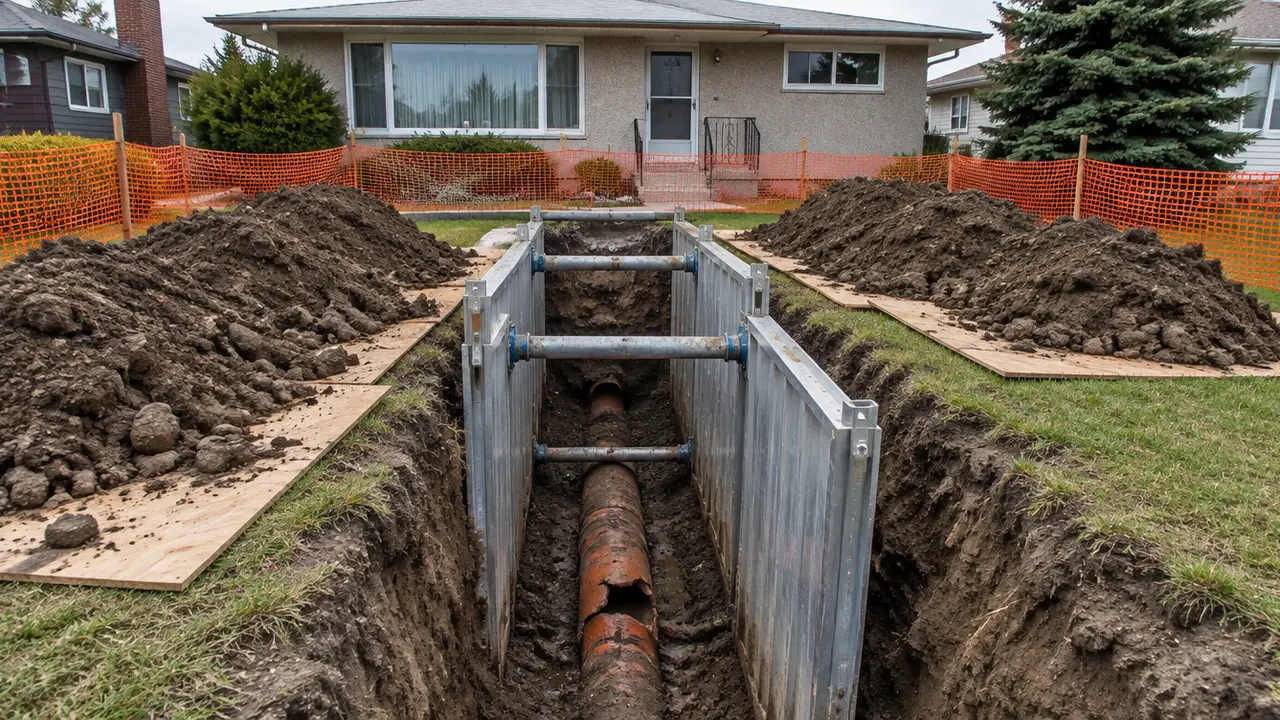
Laterals in Canadian cities are often deeper than people expect, because they must stay below frost and fall to a main that may itself be several metres down. Depth drives excavation method, shoring and pit size, so the first number to find out after the length is the depth at each end.
02 /Who owns which part of the lateral?
In most Canadian municipalities the owner is responsible for the lateral on private property and the municipality for the section from the property line to the main, including the connection. Some cities put more of the line on the owner, some share costs in defined situations, and a few run programs for specific parts of the lateral. The only reliable answer for your address is your municipality's.
| Pattern | Owner is responsible for | Municipality is responsible for |
|---|---|---|
| Split at the property line | House to property line | Property line to and including the main connection |
| Owner to the main | The whole lateral, including the connection | The main itself |
| Split with conditions | Private side, plus some municipal-side work in certain cases | Municipal side, with exceptions defined by bylaw or policy |
- Call the municipality first
Ask where your responsibility ends, who repairs the municipal portion, and whether any program or inspection applies. In Calgary, call 311.
- Bring the evidence
Share the camera footage and the distances to each defect. A defect at or beyond the property line may be the municipality's to fix.
- Write the boundary into the quote
Every quote should state exactly where the contractor's scope begins and ends, ideally on a sketch.
If a defect sits right at the boundary, get the municipality's position in writing before paying for that section. Whether it is their pipe or yours can change the scope completely. Condominiums, shared laterals and rentals add another layer of responsibility, explained in sewer replacement when more than one owner is involved.
03 /What happens at the connection to the main?
The connection to the main is where a lateral meets public infrastructure, and it is handled carefully for that reason. Older laterals may join the main at a factory-made wye fitting, or at a tap cut into the main and fitted with a saddle. New connections must meet municipal standards.
- Reusing the existing connection is common when it is sound and the new lateral can be joined to it at or near the property line.
- Replacing the connection may involve excavating at the main in the road, which usually requires the municipality's approval, traffic control and sometimes the municipality's own crews or approved contractors.
- Lining through the connection can be done with systems that seal the junction from inside the main, but that work is on the municipal side and needs the municipality's involvement.
- Property-line cleanouts or inspection chambers are required or encouraged in some municipalities so the lateral can be inspected and cleaned at the boundary.
04 /How is a lateral replaced from the house to the street?
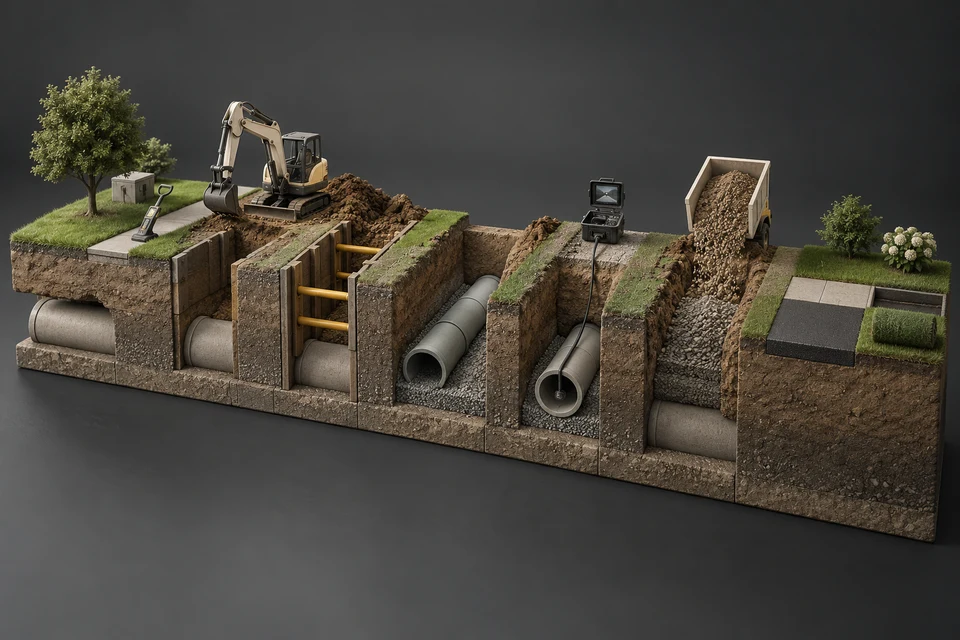
The sequence depends on the method, but a full open-cut lateral replacement typically follows the same order: prepare, expose, replace from the house outward or from the street inward, inspect, backfill and restore.
- Camera, locate and depth
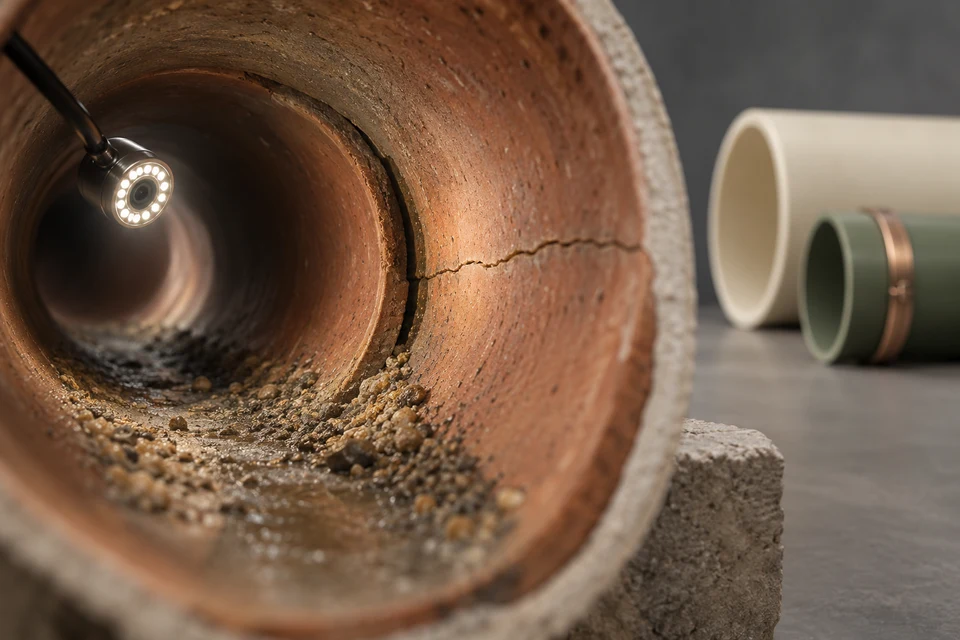
The existing lateral is recorded and located, with depths marked at the foundation, the property line and the connection.
- Permits and locates
A plumbing permit, any right-of-way or road permit, and public utility locates through the provincial one-call service. Private lines such as garage feeds or irrigation may need a private locate.
- Excavate and shore
The trench or pits are opened with protection suited to the depth. Spoil is kept back from the edge, and the route is fenced.
- Replace and connect
Old pipe is removed and new pipe laid on bedding at the required slope, connected to the building drain and to the municipal service or main as approved.
- Inspect before cover
The inspector checks the pipe, grade and connections before backfill where a permit applies.
- Backfill and restore
Material is compacted in layers; lawn, walks, driveway and any boulevard are restored to the agreed standard.
Trenchless options change the middle steps but not the boundary questions. Compare them in sewer replacement methods compared, and see what happens during replacement, day by day for the site sequence.
05 /Should you replace only your side of an old lateral?
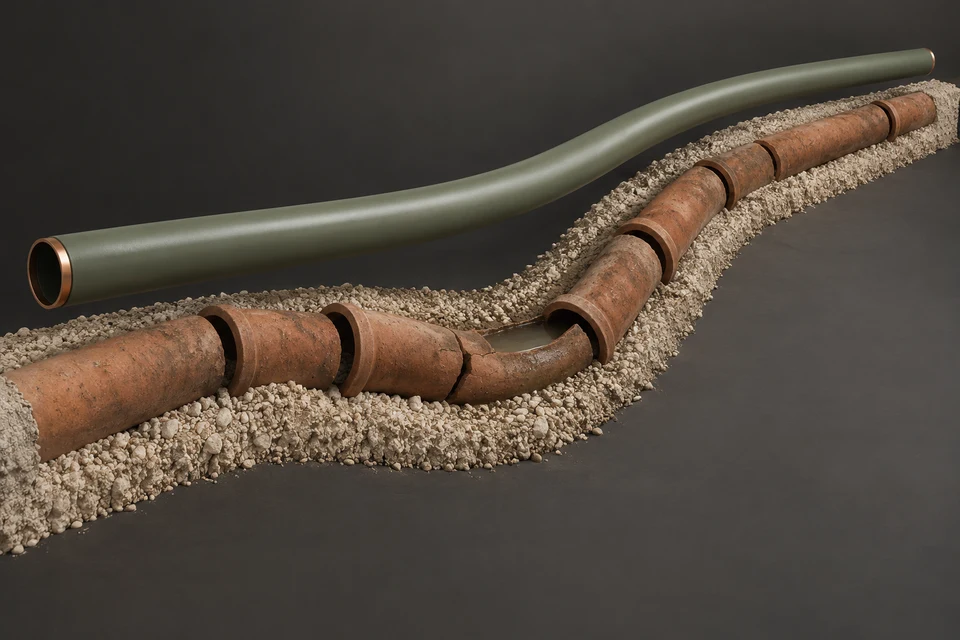
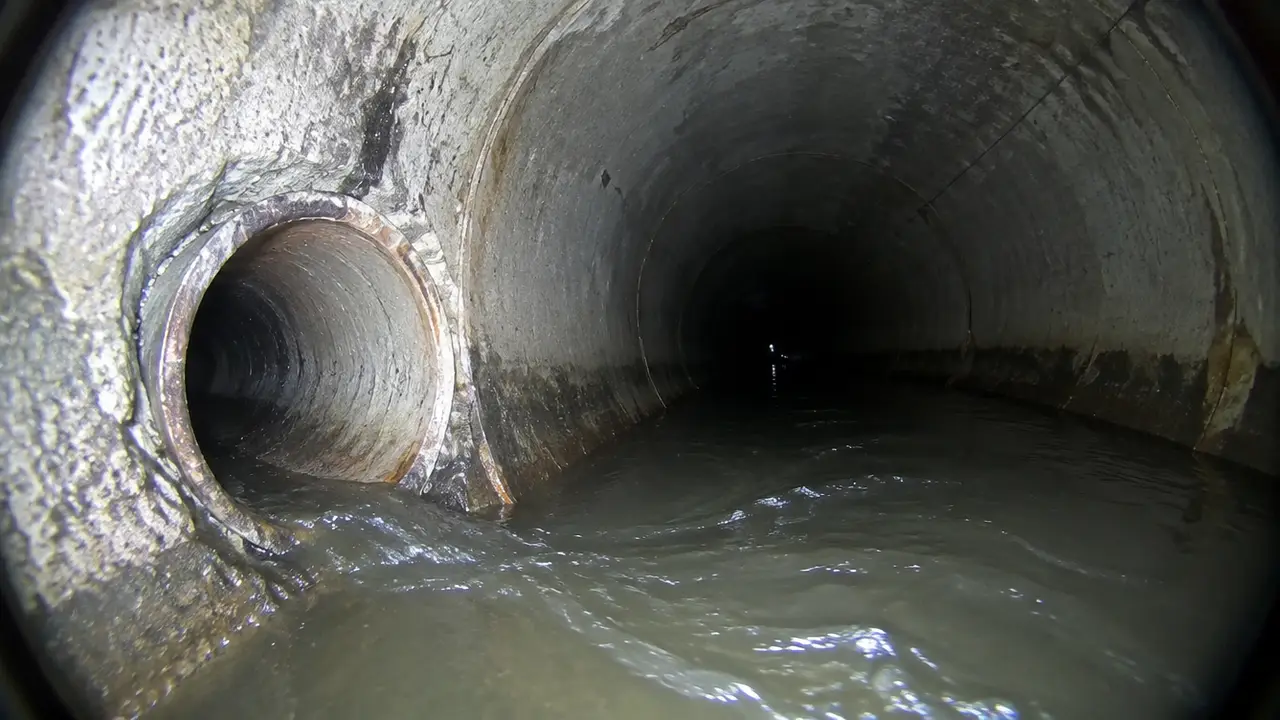
Replacing only the private side is sometimes the only option, but it can leave the oldest pipe in place. If your camera shows clay or cast iron beyond the property line in poor condition, ask the municipality whether it plans to renew that section, and whether private and municipal work can be coordinated.
- Ask what material the municipal side is. Some cities publish service line data; others will tell you through their service line.
- If the municipal side is being renewed as part of a street project, owners are sometimes invited to renew the private side at the same time.
- If the municipal side has a defect, report it with the video and distances, and keep a record of the report.
- If you renew your side first, ask for a cleanout near the property line so the municipal side can be inspected independently later.
In Calgary, the City publishes its service line records as open data, covering the City-owned portion from the main to the property line. CalgarySewers.ca turns that data into a lookup, and our Calgary page explains how it bears on replacement decisions.
06 /How long does sewer lateral replacement take?
Once permits and locates are in hand, the site work for a residential lateral is commonly one to three days by open cut and one to two days by lining or bursting. Planning, permits, locates, inspection and restoration add to that, often more than the digging itself.
| Stage | Typical planning range |
|---|---|
| Camera, quotes and decision | One to two weeks for planned work; days in an emergency |
| Permits | Days to a few weeks; longer when road or boulevard work is involved |
| Public utility locates | Allow several business days; emergency locates exist |
| Site work, open cut | About 1 to 3 days |
| Site work, lining or bursting | About 1 to 2 days |
| Inspection | Booked with the municipality or inspector |
| Restoration | Days for seed or sod; longer for concrete; winter restoration may be temporary until spring |
For Calgary-specific sequencing, permits and seasons, CalgarySewerReplacement.ca covers the local process in detail.
07 /What if the house is on a septic system?
A house on a septic system has a lateral too, running from the building drain to the septic tank. The engineering is similar: a sloped gravity pipe on good bedding, with a cleanout for access. The rules differ, because private sewage systems are regulated provincially rather than by a municipal sewer utility.
- Confirm with your province or municipality what permit applies to replacing the house-to-tank line and who may do the work.
- Keep the new pipe's slope within the code range: too flat and solids settle, too steep and liquids run ahead of solids.
- Protect the tank inlet baffle during the connection, and do not enter the tank; septic tanks are deadly confined spaces.
- If the line is being replaced because of a failed tank or field, fix the system as a whole rather than the pipe alone. The full sequence is in replacing the sewer line to a septic tank.
Ready to plan your own lateral? Start with the Repair or Replace? Decision Engine, then request quotes with the ownership boundary marked on your scope. For replacement pricing, see SewerQuotes.com.
FAQQuestions people ask
What is sewer lateral replacement?
Renewing the pipe that runs from a house to the municipal sewer main, by open cut, lining or bursting, and reconnecting it at the building drain and at the municipal service or main.
Does the city replace sewer lines?
Municipalities typically maintain and replace the mains and, in many cities, the lateral from the property line to the main. The owner usually handles the private side. Rules vary, so confirm with your municipality.
Who pays to replace the sewer line from the house to the street?
Usually the owner pays for the private portion and the municipality for its portion, but some cities make owners responsible to the main. Ask your municipality where your responsibility ends before getting quotes.
Do I need a permit to replace my sewer lateral?
In most Canadian municipalities, yes, at least a plumbing permit and an inspection. Work in a boulevard, sidewalk or road needs additional permission. Confirm requirements with your municipality.
Can I replace just the part of the lateral on my property?
Yes, and that is often all you are responsible for. If the municipal side is old or damaged, report it with your video and ask whether its renewal can be coordinated with yours.
NETWORKGo deeper across the HAUSE Sewer network
Sewer permits, inspections and who pays: owner or city?
Sewer line permits and who pays in Canada: the usual owner vs city split, permit and inspection costs, road cuts, city tree roots and what to confirm.
SewerRoots.caSewer lining for tree roots: will a CIPP liner stop them for good?
Sewer lining for tree roots: how a CIPP liner seals root-damaged joints, which lines qualify, preparation, weak points at the ends, and planning costs.
SewerCleaners.caMain sewer line cleaning: what is actually involved
Main sewer line cleaning explained: how pros access the line, cable vs jetting, camera proof, how long it lasts, and what a complete job should include.