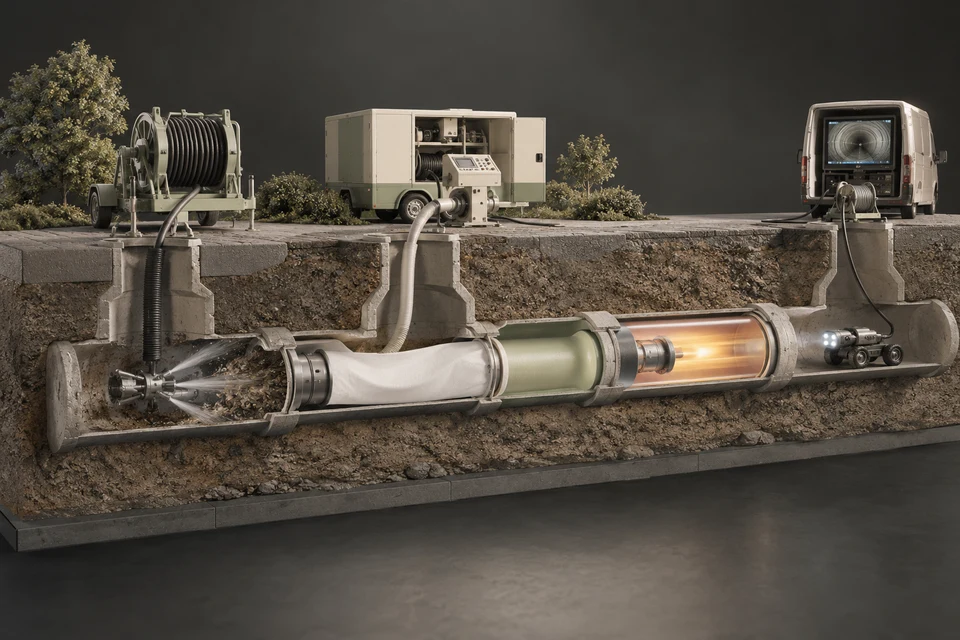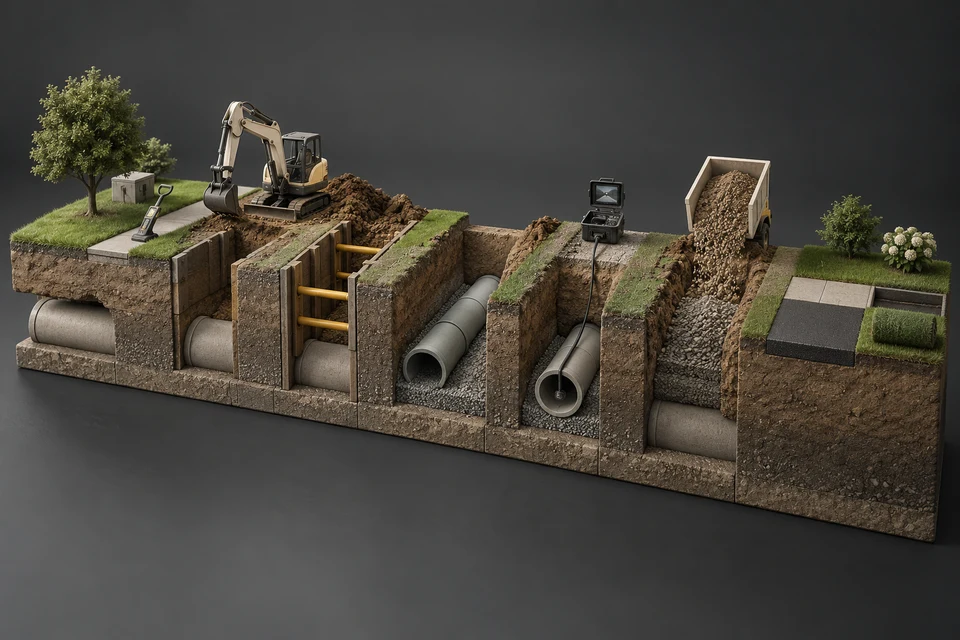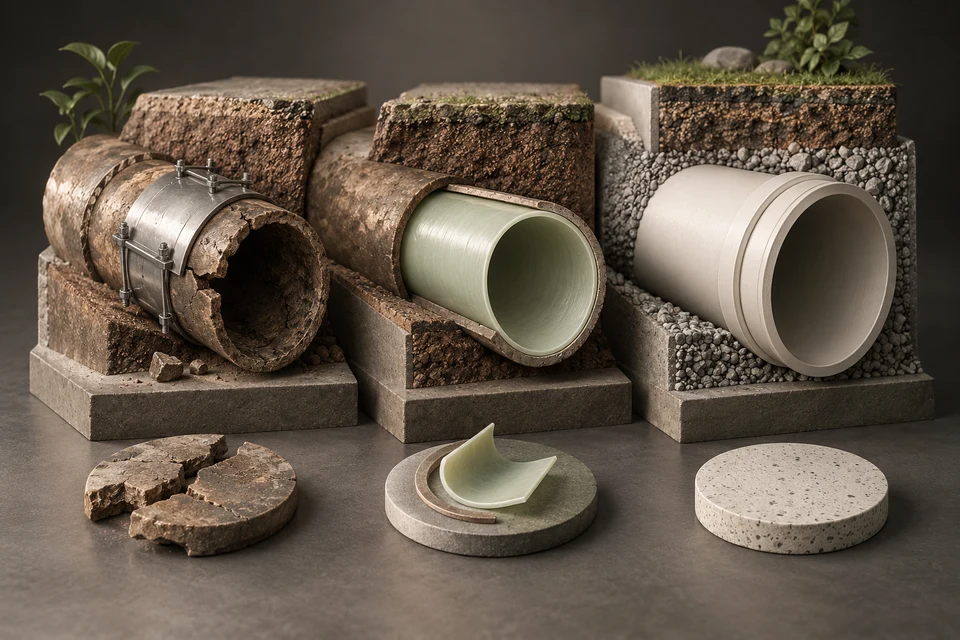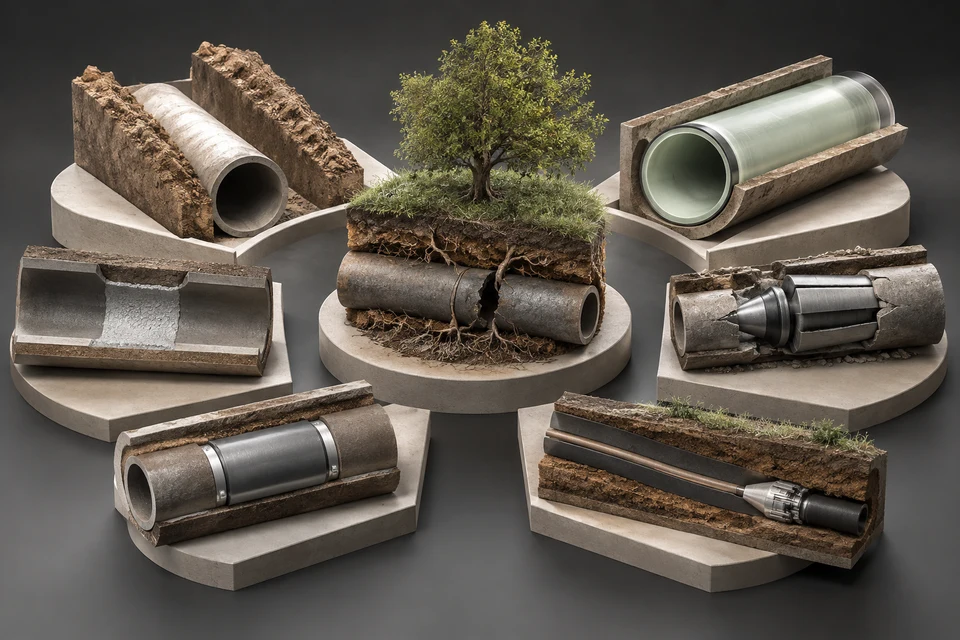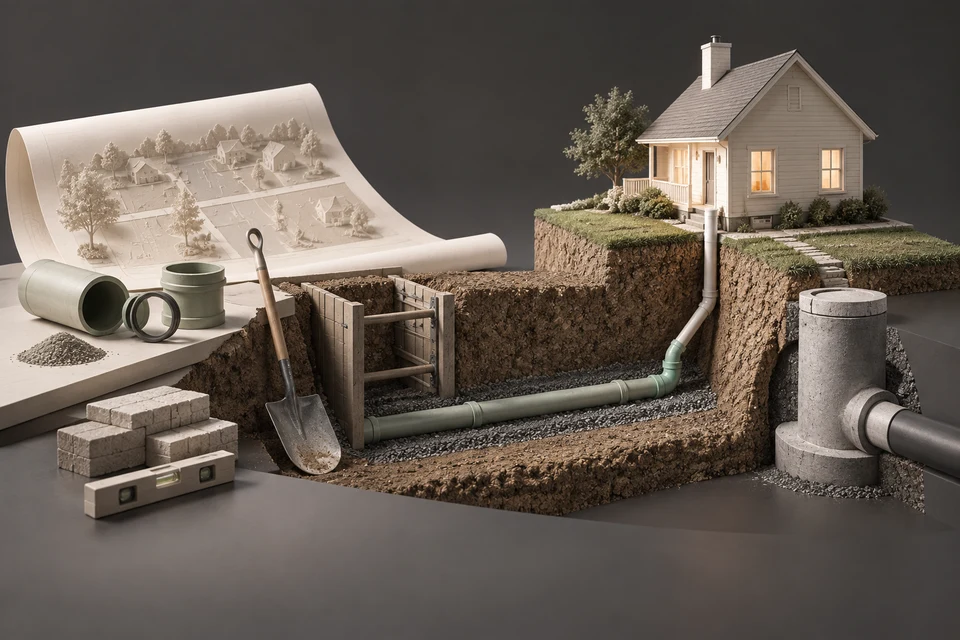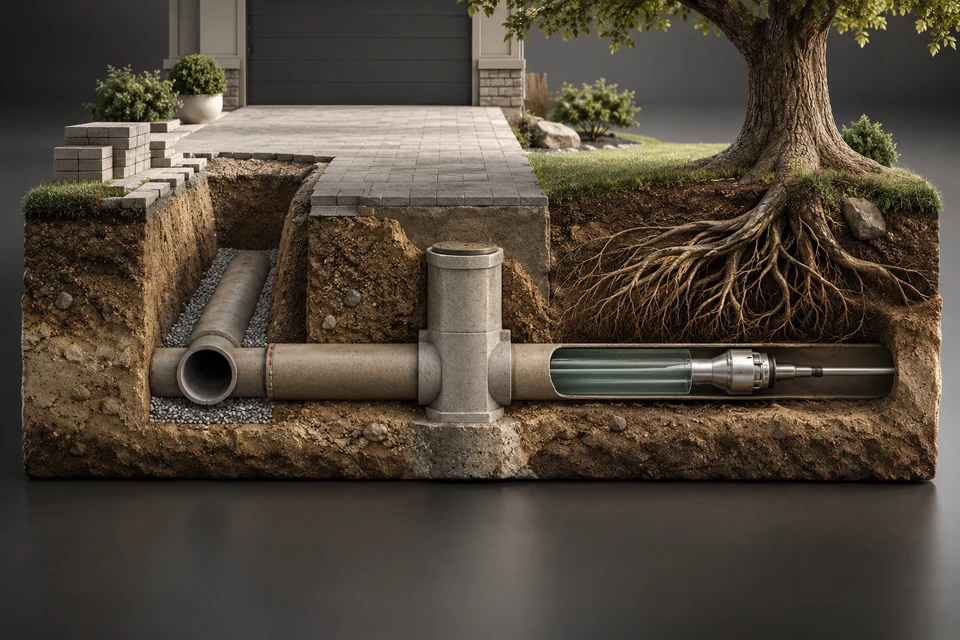
A sewer line under a driveway or mature trees can often be renewed without removing either: relining works from a cleanout if the pipe is round and on grade, and bursting needs only a pit at each end. Where the line sags or has collapsed, a narrow saw-cut trench through the driveway, or hand and vacuum excavation near roots, keeps the damage to a strip rather than the whole surface.
- What sits on top of the line often decides the method more than the pipe does, because restoring a surface can cost as much as the pipe work.
- Trenchless methods protect driveways and roots only if pit locations are planned around them; a badly placed pit can do the damage a trench would have.
- Only excavation fixes a sag, so a belly under a driveway usually means a saw-cut strip, not the whole slab.
- Many municipalities protect larger private trees and all public ones; digging inside a protection zone can need a permit.
- Restoration should be written into the quote: material, thickness, compaction, who does it and when.
01 /Can a sewer line under a driveway be replaced without tearing it out?
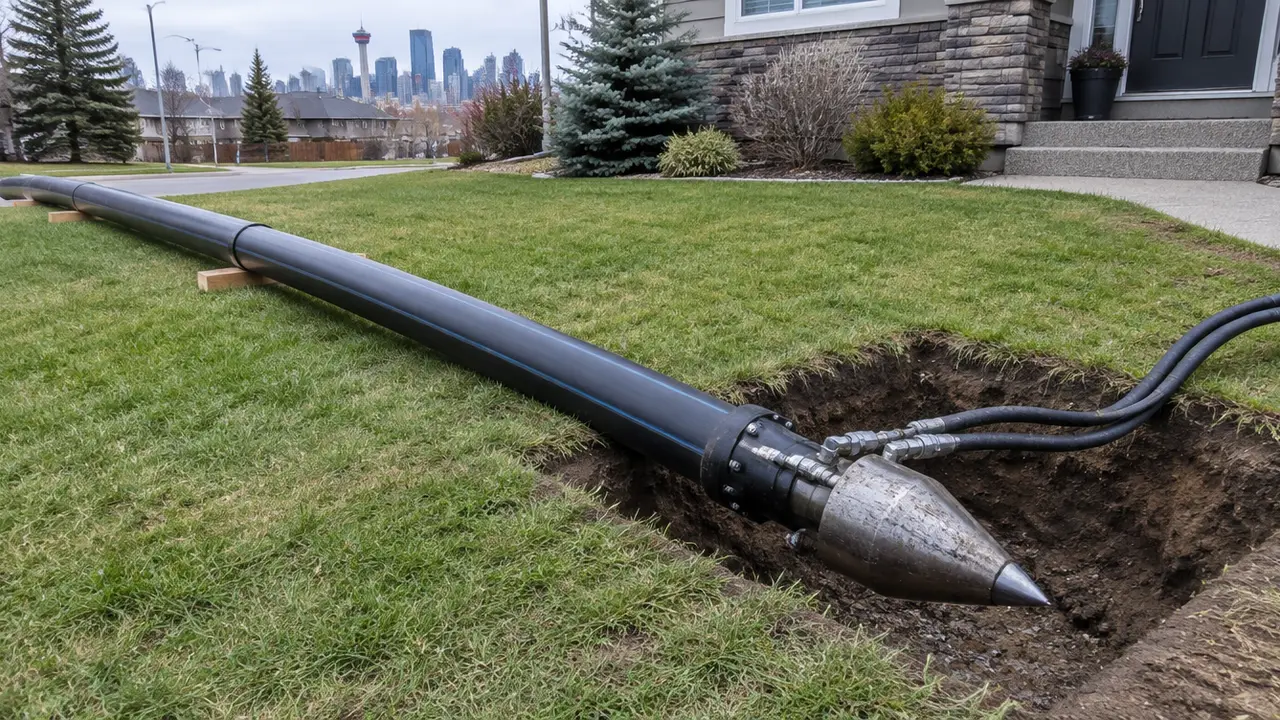
Often, yes. If the camera shows a pipe that is still round and on grade, relining renews it from a cleanout without touching the concrete. If it is broken or undersized but runs straight, bursting can replace it from a pit on each side of the driveway. Only when the line sags, has collapsed beyond what bursting can pass, or needs its route changed does the driveway itself have to be opened, and even then a narrow saw-cut strip is usually enough.
| Method | What happens to the driveway | Fits when | Watch for |
|---|---|---|---|
| CIPP relining | Usually untouched | Pipe round, on grade, with access at one or both ends | Cannot fix a sag; branch connections need reinstating |
| Pipe bursting | Untouched between two pits | Straight run, pipe broken or undersized, few connections | Pits may land on the driveway edge; shallow lines risk heave |
| Open cut, saw-cut strip | A strip about a trench width is removed and repoured | Sag, collapse, route change, many connections | Joints between old and new concrete; settlement if compaction is poor |
| Spot repair through the driveway | A single small opening | One defect in otherwise sound pipe | Locating the defect precisely before cutting |
The Replacement Method Selector reflects this. When the surface is set to driveway or concrete, it rates open cut as Possible rather than Good, not because it cannot be done but because of the cost and disruption, and it leaves lining and bursting to be judged on the pipe's condition, depth, bends and connections.
02 /How much does a driveway or finished yard add to the job?
Mostly through restoration. Using the planning ranges on our repair, reline or replace cost page, open-cut replacement of a typical 15 to 25 m lateral runs about $12,000 to $35,000 or more, while full-length relining runs about $9,000 to $28,000 and bursting about $10,000 to $30,000. The high ends of those ranges are where hard surfaces, depth and landscaping sit.
- Surface restoration alone, in SewerQuotes.com's published line items, runs from about $500 for seeding a lawn trench to $15,000 or more for hard surfaces.
- A deep or hard-surface spot repair falls around $7,000 to $16,000 in the same published ranges, against $3,500 to $6,500 for a shallow dig under lawn.
- Pavers and stone can often be lifted, stacked and relaid, which costs labour but not new material; stamped or coloured concrete is hard to match, so a strip repair may remain visible.
03 /How do you replace a sewer line near a mature tree?
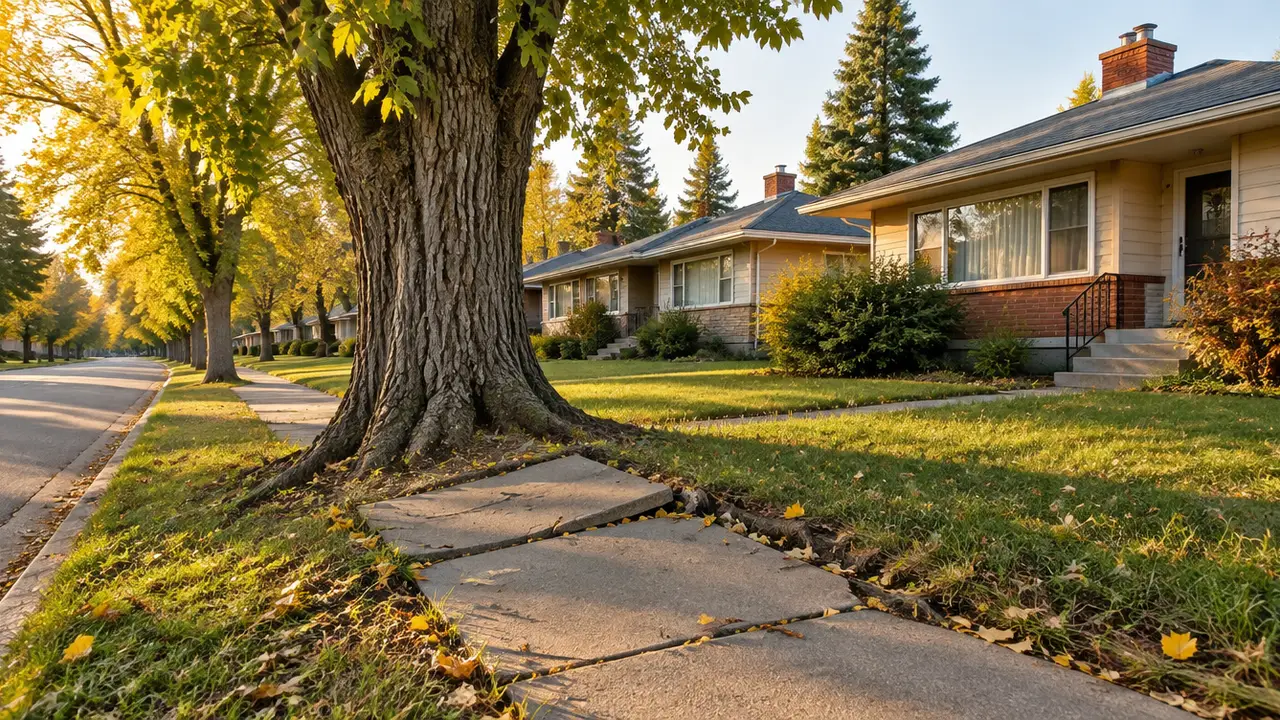
By keeping excavation out of the tree's critical root area wherever possible, and by digging gently where it is not. Most of a tree's fine feeding roots grow in the upper layers of soil and reach well beyond the trunk, so an open trench beside a mature tree can sever a large share of them in an afternoon. Trenchless methods help most here, because they renew the pipe under the roots rather than cutting through them.
Municipal rules may apply as well. In Toronto, for example, the City's tree bylaw protects private trees of 30 cm or more in diameter measured at 1.4 m above the ground, and treats excavating or trenching within a tree protection zone as an activity that can injure a tree and needs a permit. For a private tree of 30 to 40 cm in diameter the City lists a protection zone of 2.4 m. Other municipalities use different thresholds and distances, and trees on the boulevard usually belong to the municipality.
- Find out whose tree it is
Boulevard and street trees are usually municipal property. Ask the municipality before any digging near them.
- Check the local tree bylaw
Confirm the size threshold, the protection zone and whether a permit or arborist report is needed.
- Place pits outside the root zone
For lining or bursting, choose access points that keep excavation away from the trunk, even if that makes the pull slightly longer.
- Dig gently where you must
Near roots, hand digging, air excavation or low-pressure vacuum excavation exposes roots so they can be avoided or pruned cleanly rather than torn.
- Protect the ground
Keep equipment and spoil piles off the root zone, because compaction harms roots even where nothing is dug.
04 /Does the tree have to come out if its roots broke the pipe?
Usually not. Roots exploit openings; they enter at loose joints and cracks, where moisture and nutrients escape, and then grow inside the pipe. A relined pipe or a new PVC line with gasketed joints presents no such openings, so the tree and the new sewer can generally coexist. Removing a healthy mature tree to protect a new line is rarely the better choice.
- Remove or relocate a tree when an arborist finds it unhealthy or unstable, or when the only feasible route for a sagging line runs through its trunk flare.
- Ask whether the new pipe can be routed a few metres away from the trunk if the line is being replaced by open cut anyway.
- If roots from a neighbour's or a municipal tree caused the damage, record that on the footage and ask the owner of the tree how such cases are handled before cutting roots.
For the full picture of how roots damage old lines and when cutting them is enough, SewerRoots.ca covers root problems in depth.
05 /What else in a finished yard needs planning?
Everything that is buried or built between the house and the street. Public utility locates mark gas, power and communications, but they do not mark what you own. Alberta's one-call service, for example, notes that customer-owned lines such as sewer and water services and sprinkler systems are not registered with it and need a private locator.
- Irrigation lines and low-voltage lighting are shallow and easily cut; mark them yourself or have them located.
- Decks and fences may sit on posts that straddle the line. Pits and trenches can often be placed around them, but sometimes a section must be removed and reinstalled.
- Retaining walls and steps need support if a trench passes near their footings; ask how the contractor will keep them stable.
- Gas lines and electrical services often share the front yard with the sewer. Within about a metre of a locate mark, crews expose lines by hand before machine digging.
- Downspout and weeping tile connections may join the lateral in older houses; the replacement is the moment to confirm where they go and whether the municipality permits them.
06 /How should the surface be restored so it does not sink later?
By compacting backfill in thin layers and restoring the surface only once the ground beneath is ready for it. Most complaints about sunken strips, cracked driveways and dips in the lawn trace back to backfill dumped in one lift, or concrete poured over soil that has not finished settling.
| Mistake | What you see later | What to ask for instead |
|---|---|---|
| Backfill dumped in one go | A trench-shaped dip after the first thaw | Compaction in lifts, with the method named in the quote |
| Concrete poured on soft fill | Cracks along the saw cuts; a sunken strip | Compacted granular base, dowels or a thickened edge where the strip meets old slab |
| Heavy equipment on the driveway | Cracks well away from the trench | Plywood or mats, and a plan for where machines travel |
| Winter restoration treated as final | Cold patch and gravel that never get replaced | A written date for permanent restoration in spring |
| Sod laid over rocky spoil | Patchy, dry grass along the trench line | Topsoil depth stated in the quote |
Restoration of boulevards and sidewalks follows the municipality's standards and is sometimes done by the municipality itself. Settlement can appear months later, so ask whether the contractor returns to top up soil or repair a sunken strip, and for how long. Sewer replacement warranties explains how to get that promise in writing.
07 /What should the quote say about the surface?
Everything you would otherwise argue about afterward. Two quotes for the same pipe work can differ by thousands of dollars purely in restoration, so make the surface work explicit before comparing prices.
- Which method, and where every pit or trench will be, marked on a sketch of the yard.
- What is removed and what is reinstated: concrete strip dimensions, paver area, fence panels, deck boards, sod or seed.
- Concrete thickness, reinforcement and finish, and whether an outside trade does it.
- How trees are protected, and whether an arborist or tree permit is included.
- Who restores the boulevard or sidewalk, and to whose standard.
- What happens if restoration is delayed by winter, and the date permanent work will be done.
With those points settled, request quotes that price the pipe and the surface separately. For how the crew sequences the work, read what happens during replacement, day by day; for how trenchless methods run on site, see how trenchless sewer replacement works.
FAQQuestions people ask
Will a trenchless sewer replacement damage my driveway?
Relining normally leaves it untouched. Bursting can too, provided the pits are placed off the driveway and the line is deep enough that the expanding pipe does not heave the surface. Ask where every pit will be before agreeing.
Can tree roots grow into a new PVC sewer line?
Rarely, if it is installed well. Roots enter through openings, and gasketed or fused joints on a properly bedded line give them none. Poorly made joints or a coupling that shifts can reopen the door.
Do I need permission to cut the roots of a neighbour's tree to replace my sewer?
It depends on local rules and the size of the tree. Many municipalities protect larger trees wherever they stand, and cutting major roots can harm a neighbour's property. Talk to the neighbour and check the bylaw first.
How soon can I drive on a driveway strip after a sewer dig?
That depends on the concrete mix, the weather and the contractor's advice; new concrete needs time to gain strength before vehicles use it. Ask for the date in writing and keep heavy vehicles off until then.
Who repairs the lawn after sewer line replacement?
Whoever the quote says. Some contractors include topsoil and seed or sod, some only rough-grade the trench, and some leave landscaping to the owner. Get the restoration scope written before the work starts.
NETWORKGo deeper across the HAUSE Sewer network
Sewer line replacement cost: open-cut vs trenchless, line by line
Sewer line replacement cost in Canada for 2026: open-cut, CIPP lining and pipe bursting planning ranges in CAD, per-metre math, line items and what moves price.
SewerInspector.caScope the sewer before you renovate, finish the basement or landscape
Why to get a sewer inspection before renovation, basement development, a suite or landscaping: what to check, when to book it, and how findings change plans.
SewerRoots.caWhose tree, whose pipe: who pays when roots block a sewer line
Who is responsible when a city or neighbour's tree sends roots into your sewer line: the general Canadian pattern, the evidence, and how to raise it.