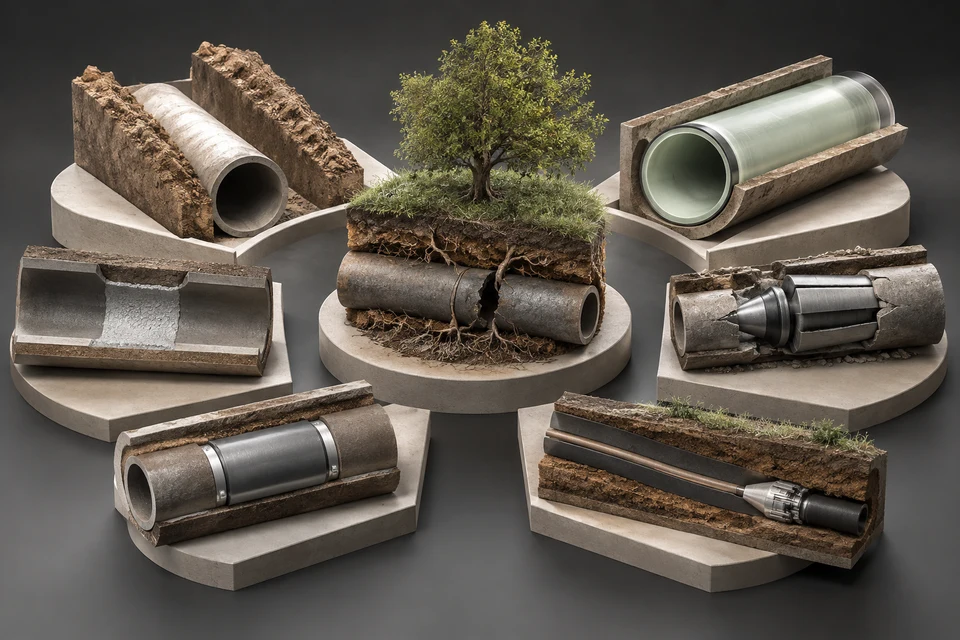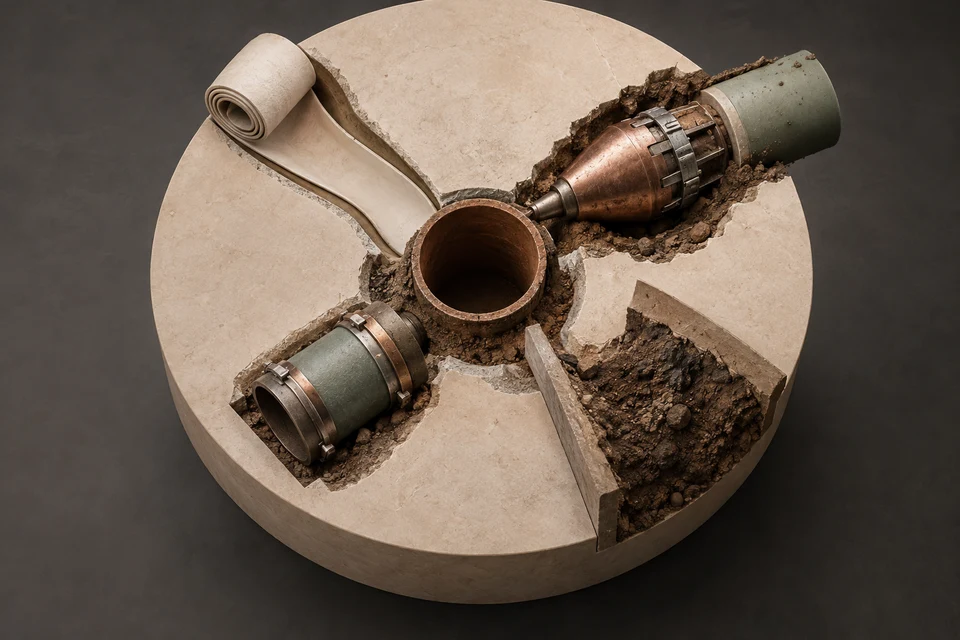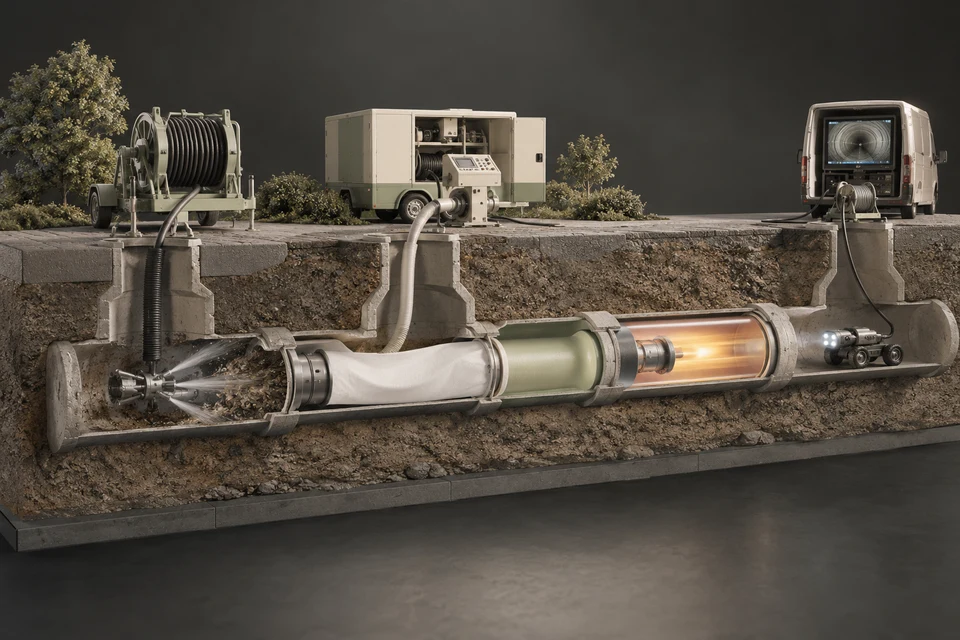
Trenchless sewer replacement renews a line from access points instead of a full trench. The crew cameras and locates the pipe, opens access at a cleanout or small pit, cleans the old pipe, then either cures a resin liner inside it or bursts it outward while pulling new HDPE pipe in behind. Connections are reopened and a final camera run proves the result.
- Every trenchless job follows the same backbone: diagnose, access, prepare, install, reconnect, prove.
- Preparation decides quality. A liner cured over roots, scale or debris is a liner with a defect built in.
- Lining needs one or two access points; bursting needs a pit at each end and at every connection.
- Trenchless still involves some digging in most cases, but usually a few square metres instead of a trench.
- Insist on a recorded video before and after, taken from the same access point.
01 /What does trenchless actually mean?
Trenchless means the pipe is renewed without digging along its whole length. The work is done from the ends, through an existing cleanout, a small pit, or both. The surface between the access points stays largely untouched, which is why the method is popular where a driveway, mature tree, deck or finished landscape sits over the line.
Two families do most residential work. Lining leaves the old pipe in place and cures a new structural pipe inside it. Bursting destroys the old pipe and replaces it with a new one along the same path. They share a workflow but differ in what they need from the site and the old pipe, which the table below summarises.
| Cured-in-place lining (CIPP) | Pipe bursting | |
|---|---|---|
| New pipe | Resin-hardened fabric tube formed inside the host | Solid HDPE (sometimes other pipe) pulled into the old path |
| Old pipe | Stays as the host | Fractured outward into the soil |
| Access needed | At least one point; a cleanout often suffices | A pit at each end |
| Branch connections | Reopened from inside with a robotic cutter | Each one excavated and reconnected |
| Effect on diameter | Slightly smaller than the host | Same size or larger |
| Host condition required | Continuous and round enough to hold the liner | A path the cable or rods can follow |
02 /What happens before any trenchless work starts?
Before installation, the crew needs to know the exact length, diameter, depth, material changes and connections of the line. That comes from a camera inspection with a distance counter and a sonde locate marked on the surface.
- Camera and measure
A push camera records the whole line from the access point to the main, with distances. The crew notes every diameter change, bend, branch connection and defect, because each one affects liner sizing or pit locations.
- Locate and mark
A sonde in the camera head is traced from the surface to mark the route and depth at key points. For bursting, these marks set where the pits will go.
- Public utility locates
Before any pit is dug, gas, electric, telecom and water lines are located through the provincial one-call service, such as Utility Safety Partners in Alberta and British Columbia or Ontario One Call. Private lines on your property may need a private locator.
- Permits
Most municipalities treat sewer renewal as plumbing work requiring a permit and, often, an inspection. Work in a boulevard or road needs separate permission. Confirm the requirements with your municipality.
- Plan the no-water window
The line cannot take flow during installation. Agree on the hours when nobody in the house uses water, and whether a temporary bypass is needed for a multi-unit building.
03 /How is the old pipe prepared?
The old pipe is cleaned back to its wall. For lining, this is the step that most determines quality: the liner will bond to, and take the shape of, whatever surface it is cured against. Roots left in a joint become a lump in the liner, and loose scale can stop the liner from seating.
- Clay and concrete lines usually need mechanical root cutting and hydro jetting to remove roots and debris from every joint.
- Cast iron usually needs descaling with chain knockers or abrasive cutters to remove tuberculation until the original bore is recovered. SewerJetting.ca covers prep jetting in more depth.
- Offsets and protruding taps may need grinding back so the liner can pass and seat.
- A second camera run after cleaning confirms the pipe is ready and often reveals defects that roots or scale were hiding.
For bursting, cleaning matters less because the old pipe is destroyed, but the crew still needs a clear path for the cable or rods. A camera run confirms the route, and a collapsed section may need a small dig so the cable can be threaded through.
04 /How is a liner installed and cured?
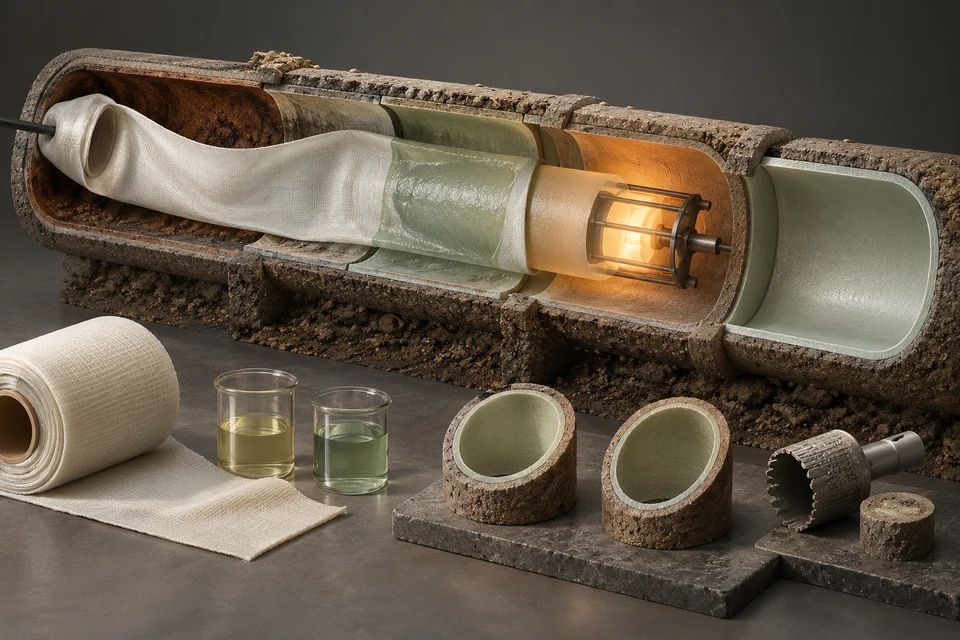
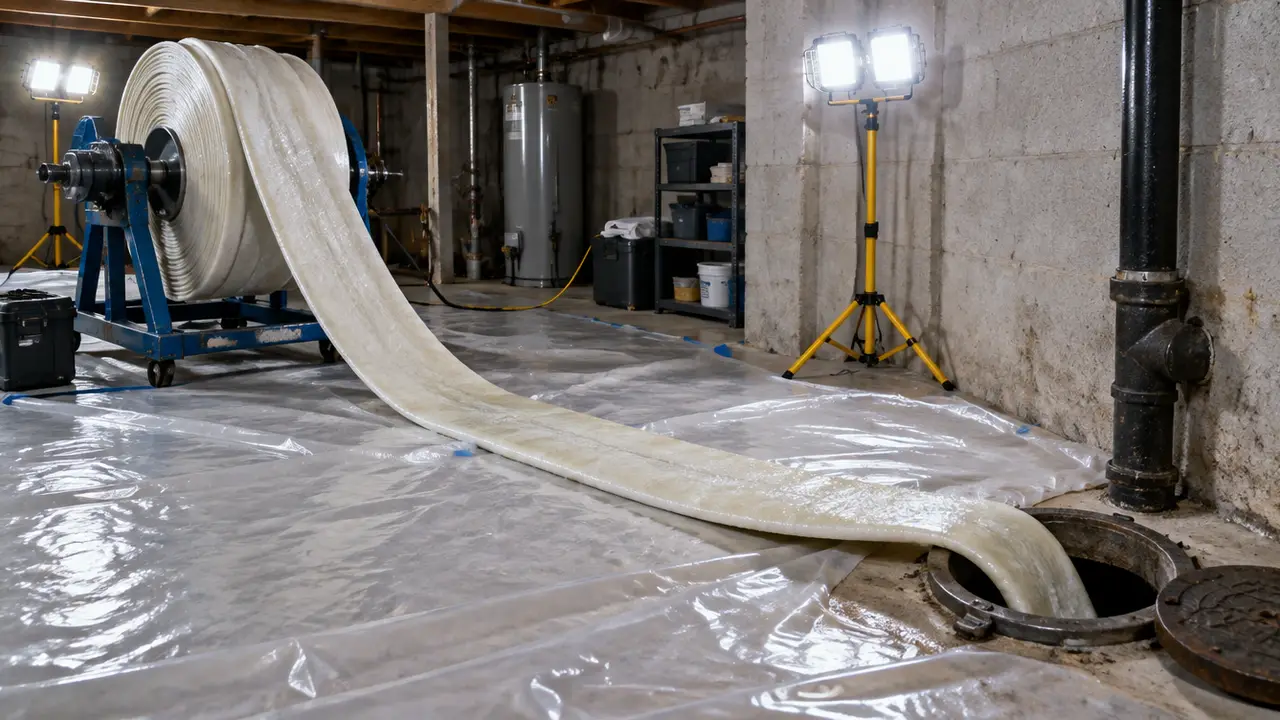
A liner is a tube of felt or glass-fibre fabric saturated with resin on site or at a shop, a step called wet-out. It is then placed in the host pipe either by inversion or by pulling it in place.
- Inversion: the liner is turned inside out into the pipe with air or water pressure from an inversion drum. The resin face ends up against the host wall.
- Pull-in-place: the liner is winched into position and then inflated with a separate bladder or calibration tube.
- Curing: depending on the resin system, the liner is left to harden at ground temperature or is sped up with circulated hot water, steam or an ultraviolet light train. Pressure is held until cure is complete.
- Finishing the ends: the liner is trimmed at the access points and the ends are sealed to the host so water cannot travel between the two.
- Reinstatement: a robotic cutter travels inside the new liner and reopens each branch connection that the liner covered.
Resin choice, liner thickness and curing method are engineering decisions, and they affect how the finished pipe performs. CIPP lining explained goes through them in detail, including how much bore the liner costs you.
05 /How does a bursting installation proceed?
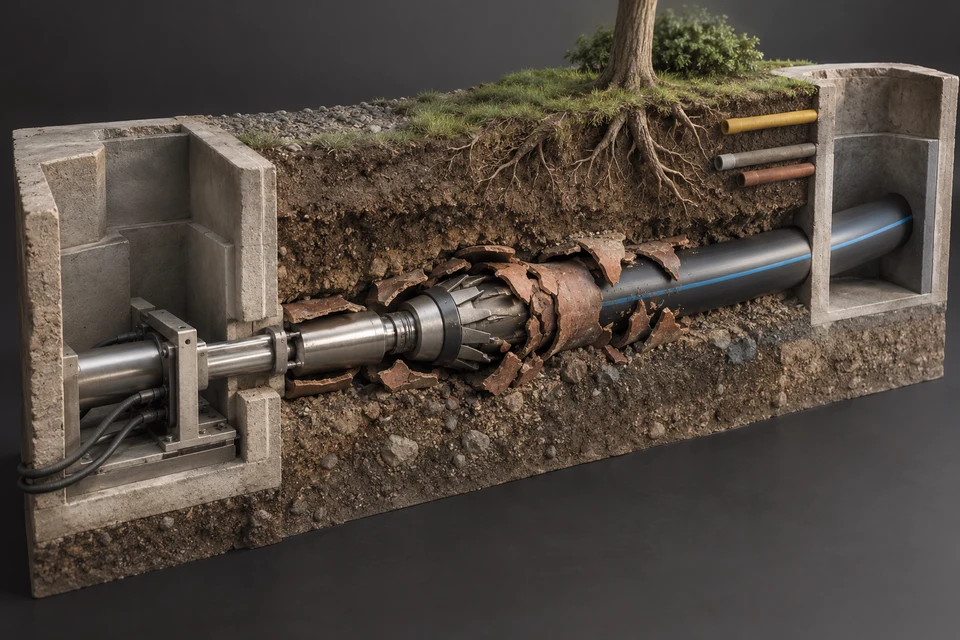
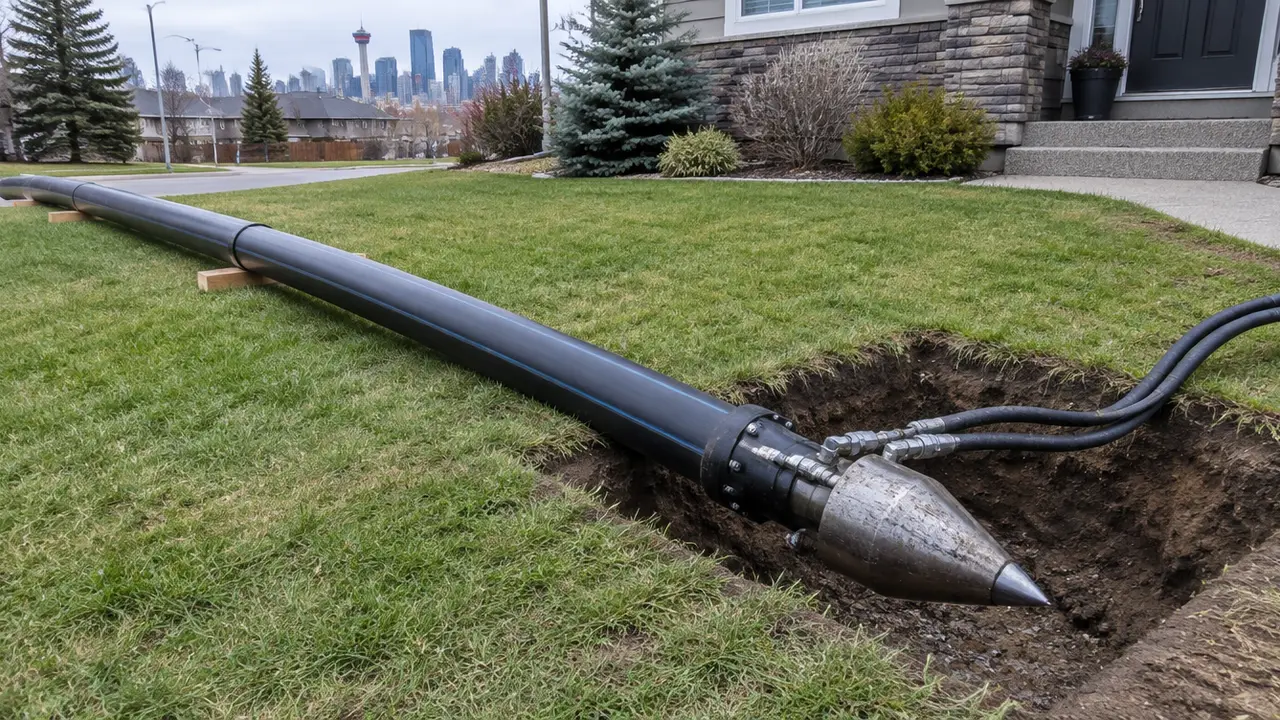
Bursting starts with two pits, one at each end of the section being replaced. A cable or a string of rods is fed through the old pipe from the receiving pit to the launch pit and attached to a bursting head. The new pipe, fused into a continuous length above ground, is attached behind the head.
As the head is pulled, its expander breaks the old pipe outward and compresses the fragments into the surrounding soil, making room for the new pipe. Static systems use a hydraulic unit to pull or push steadily. Pneumatic systems add a percussive hammer inside the head to help break stubborn material. Once the new pipe arrives in the receiving pit, it is left to relax briefly, then connected at both ends, and each branch connection along the route is excavated and joined. Pipe bursting explained covers heave, upsizing and nearby utilities.
06 /What equipment does trenchless pipe replacement use?
Trenchless work is equipment-heavy, which is part of why a small job still carries a meaningful setup cost. Knowing the equipment helps you ask whether a contractor actually owns the tools for the method they are proposing.
| Equipment | Method | What it does |
|---|---|---|
| Push camera with sonde and locator | Both | Records the line, measures distances, marks route and depth |
| Root cutter, jetter, descaler | Mainly lining | Cleans the host back to its wall |
| Wet-out table or roller | Lining | Spreads resin evenly through the fabric tube |
| Inversion drum or launcher | Lining | Inverts the liner into the host under air or water pressure |
| Calibration tube or bladder | Lining | Holds the liner against the host during cure |
| Boiler, steam unit or UV light train | Lining | Speeds or controls resin cure |
| Robotic lateral cutter | Lining | Reopens branch connections from inside the liner |
| Hydraulic puller or rod pusher | Bursting | Draws the bursting head through the old pipe |
| Expander heads and splitter blades | Bursting | Fracture brittle pipe or slit ductile pipe |
| Butt fusion machine | Bursting | Heat-fuses HDPE lengths into one continuous pipe |
07 /What can trenchless not do?
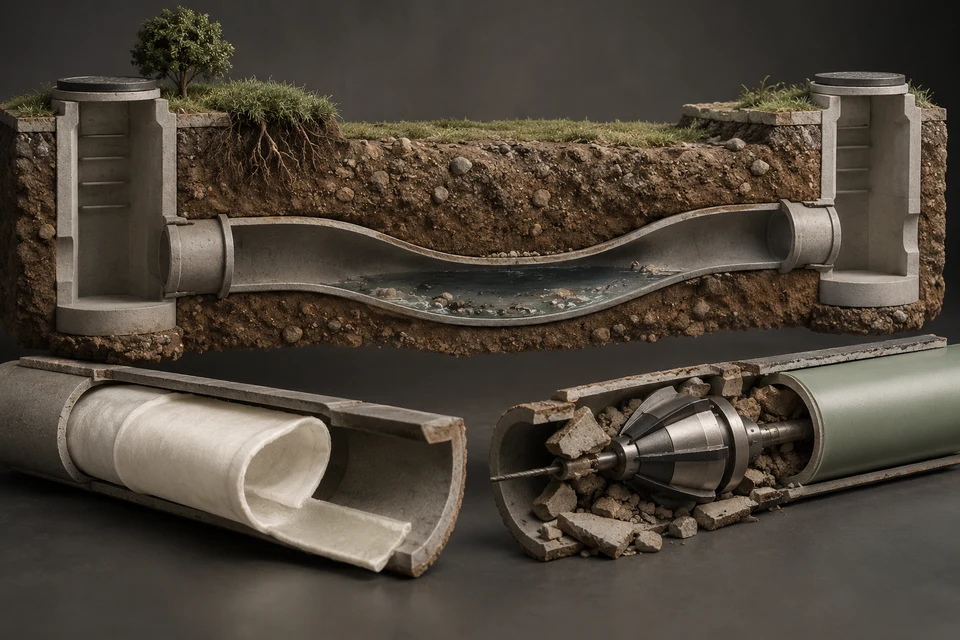
Trenchless methods cannot change the path or slope of the line. Both follow the existing pipe, so a belly holding water, a line that runs under an addition you want to move, or a route that needs to avoid a new foundation all need an open-cut section or a new bored path. Neither method can pass a collapse that the crew cannot get a cable or camera through without a dig.
- Sags: lining copies the dip exactly; bursting follows it. See can trenchless fix a belly.
- Severe deformation: a flattened fibre pipe or crushed section may not hold a liner in round.
- Many connections: each one needs a reinstatement (lining) or a pit (bursting), which erodes the trenchless advantage.
- Tight bends: lining can negotiate some bends with the right liner; bursting handles bends poorly.
If you are weighing these limits for your own line, the Replacement Method Selector rates lining, bursting, open cut and spot repair against your depth, surface, condition, access, bends and connections.
08 /How do you know the job was done properly?
You know from a recorded video of the finished pipe, taken from the same access point as the original inspection so the distances line up. Watch it, or have someone independent watch it, before the final payment.
- The pipe is continuous from the access point to the main with no gaps, holes or visible joints in a liner.
- Branch connections are fully reopened with smooth edges, not partly covered.
- Wrinkles or folds in a liner are minor and do not catch debris.
- There is no standing water beyond what the original grade would explain.
- Burst pipe arrives at both ends without visible damage and is properly joined.
Keep that video with the permit, the invoice and the written warranty. Sewer replacement warranties and final checks lists what to ask for, and when you are ready to price the work, request quotes with your footage attached.
FAQQuestions people ask
How does trenchless sewer line replacement work?
The crew accesses the line at a cleanout or small pit, cleans it, and either cures a resin liner inside the old pipe or bursts the old pipe while pulling new HDPE pipe into its place. Connections are reopened and the result is recorded on camera.
Does trenchless sewer repair really work?
Yes, when the method matches the pipe. Lining works well on round, continuous pipe with cracks and joint problems. Bursting works on broken or undersized pipe on a reasonably straight path. Neither fixes a sag.
How long does trenchless sewer replacement take?
Once permits and locates are in place, a residential lining job is commonly done in a day and bursting in one to two days, not counting pit restoration or cure time for some resins.
Do I need to leave the house during trenchless work?
Usually not, but you cannot use water that drains to the line while it is being cleaned, lined or burst. Ask for the no-use window in writing and ask about ventilation if a resin with a strong odour is used.
Is any digging needed for trenchless sewer replacement?
Often a little. Lining can sometimes be done entirely through cleanouts, but a pit may be needed for access or a new cleanout. Bursting always needs pits at both ends and at each connection.
NETWORKGo deeper across the HAUSE Sewer network
Jetting before trenchless lining: why the prep cleaning decides the result
Why jetting before trenchless lining matters: root removal, descaling cast iron, cleaning to a bare wall, camera checks and what rushed CIPP prep causes.
SewerQuotes.comSewer line replacement cost: open-cut vs trenchless, line by line
Sewer line replacement cost in Canada for 2026: open-cut, CIPP lining and pipe bursting planning ranges in CAD, per-metre math, line items and what moves price.
SewerInspector.caLateral defect map: plot your sewer inspection findings
Turn a sewer camera report into a strip map: enter footage-counter distances, defect types and depths to see where each finding sits and how urgent it is.