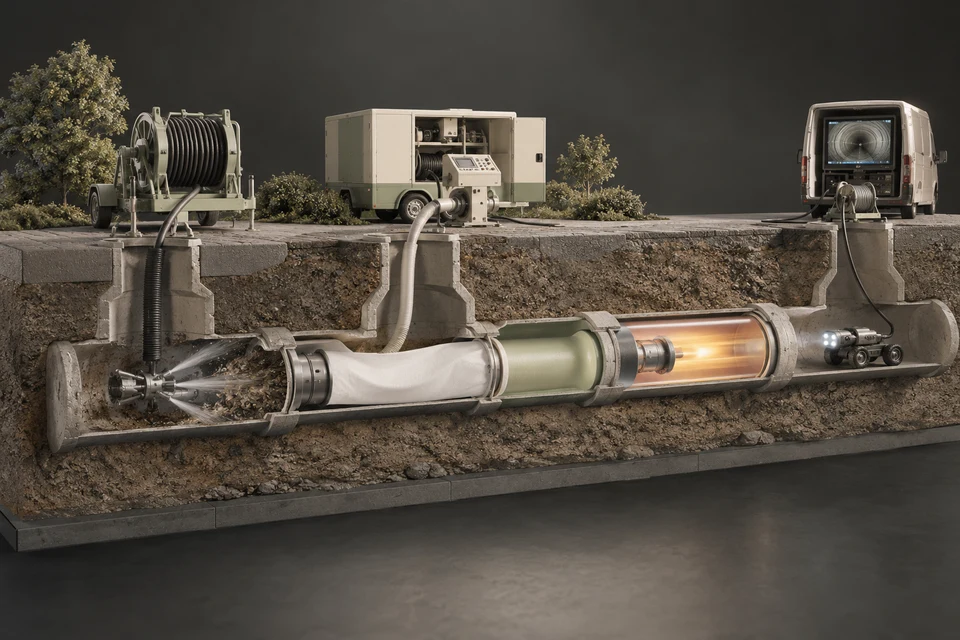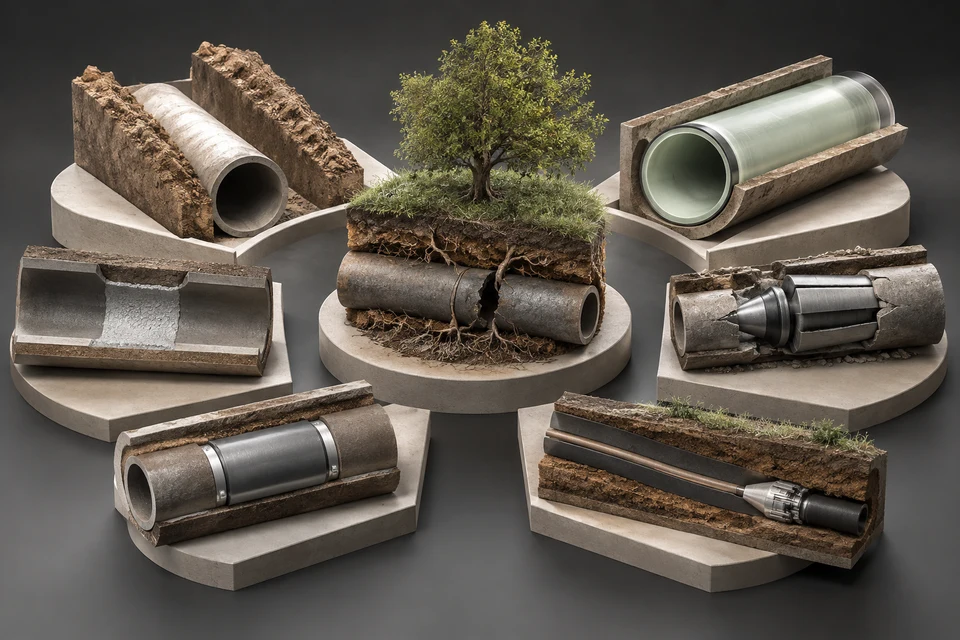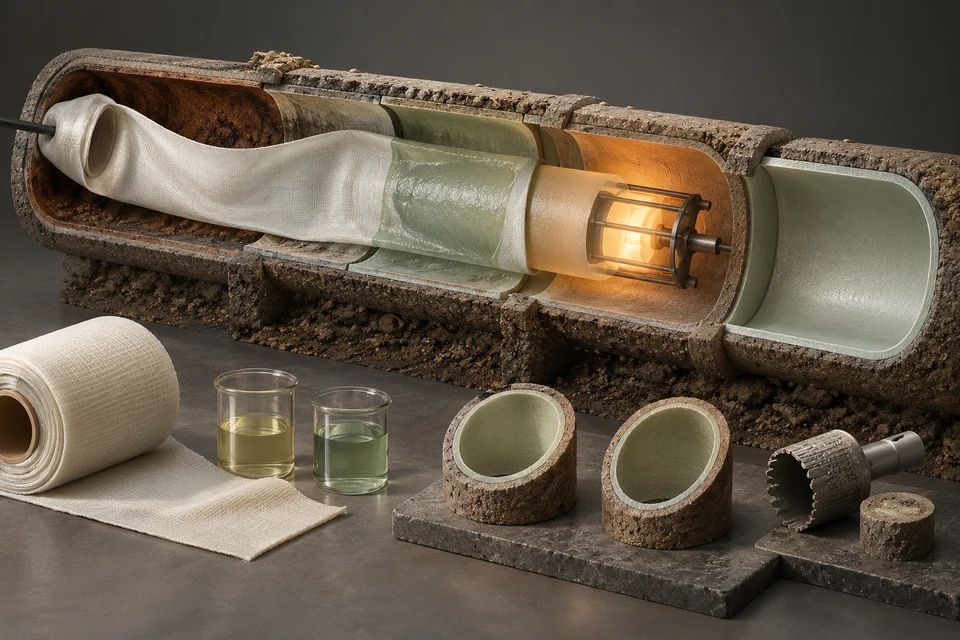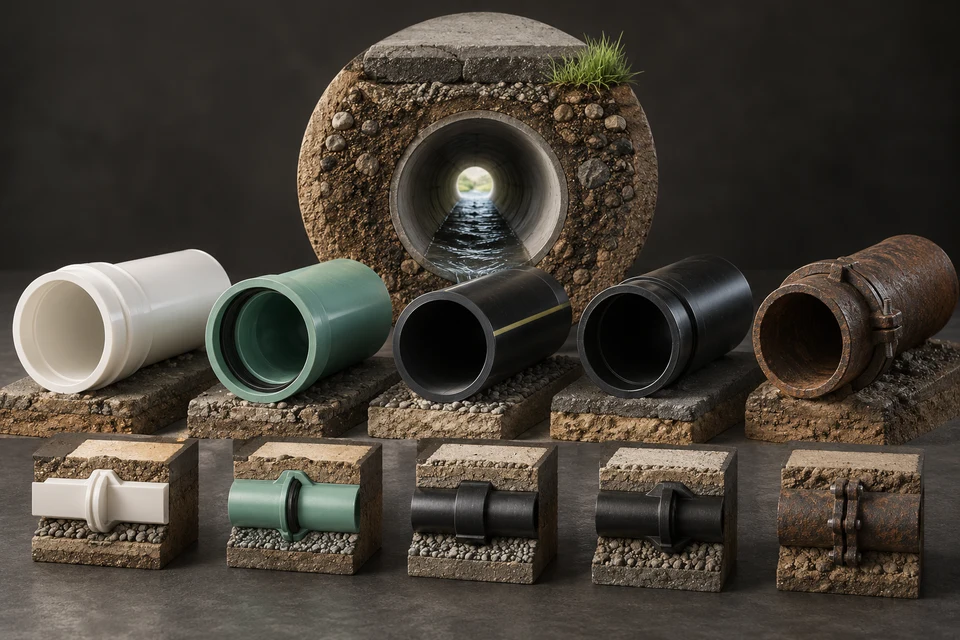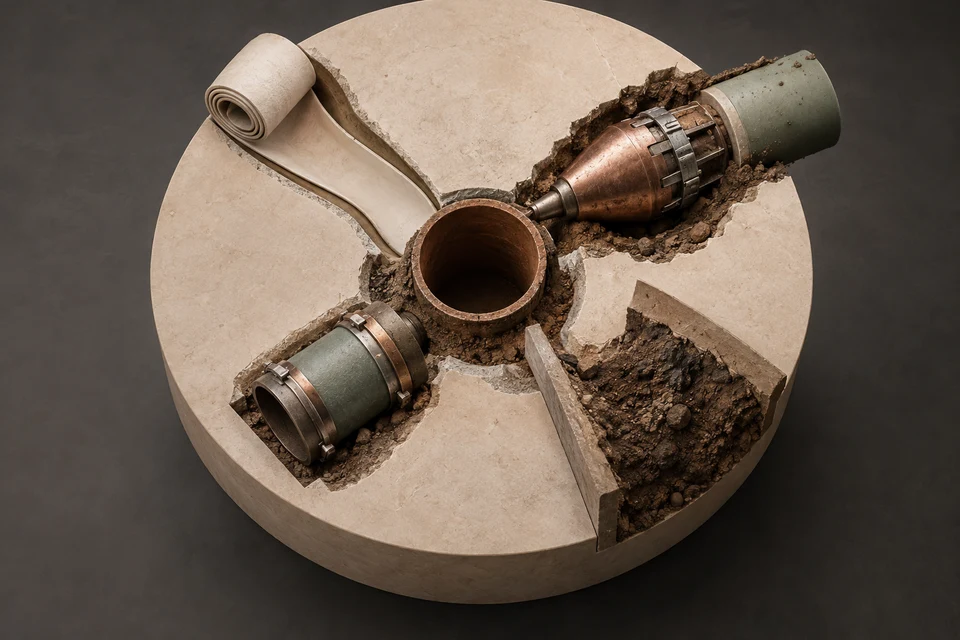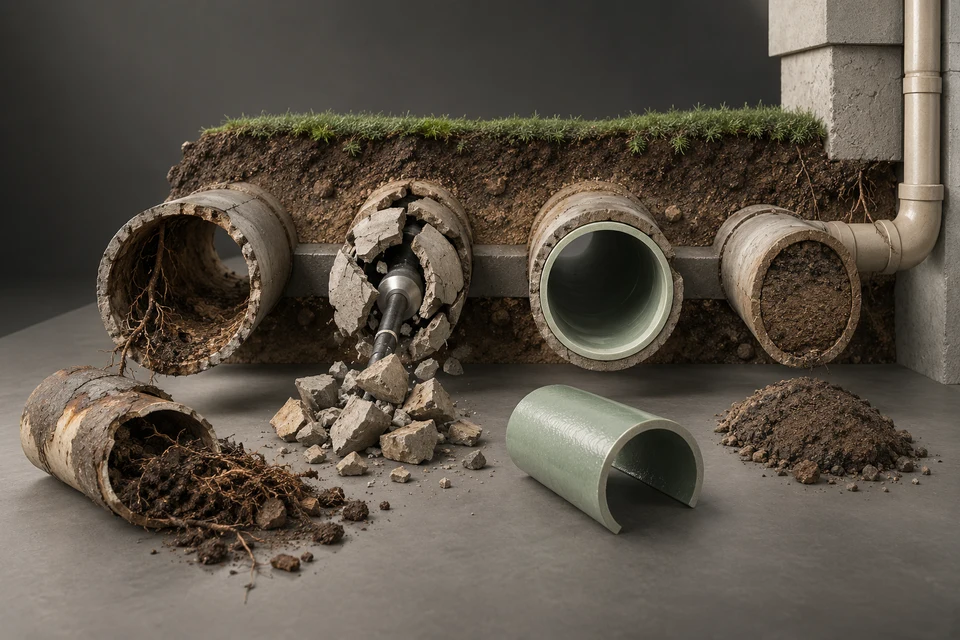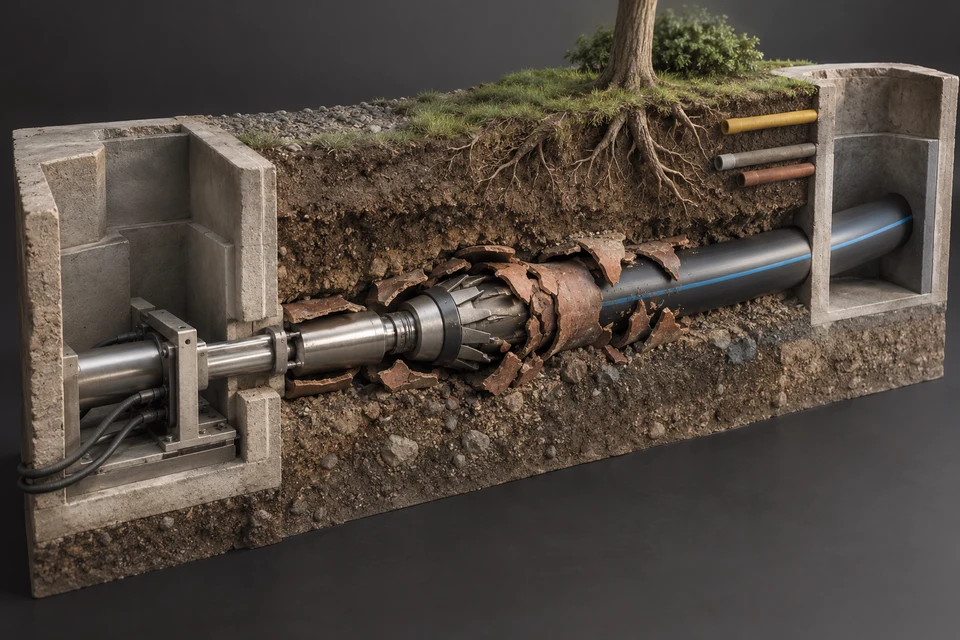
Pipe bursting replaces a sewer line along its existing path. A cone-shaped head is pulled through the old pipe from a launch pit to a receiving pit, fracturing the pipe outward into the soil while a new fused HDPE pipe is drawn in behind it. It can replace broken or undersized pipe and even upsize it, but it follows the old route, so it cannot correct a sag.
- Bursting gives you a brand-new, jointless pipe without a trench, and it can increase the pipe size.
- It needs a pit at each end and an excavation at every branch connection along the run.
- Brittle pipes such as clay, cast iron and concrete burst well; ductile pipes need splitting tools.
- Shallow lines, nearby utilities and foundations need care because the expander pushes soil outward.
- Like lining, bursting follows the old path: sags stay and tight bends stop the head.
01 /What is pipe bursting sewer line replacement?
Pipe bursting is a trenchless replacement method in which the old pipe is destroyed in place and a new pipe is installed in the same path in one pass. The new pipe does not depend on the old one for anything except direction, which is the key difference from lining.
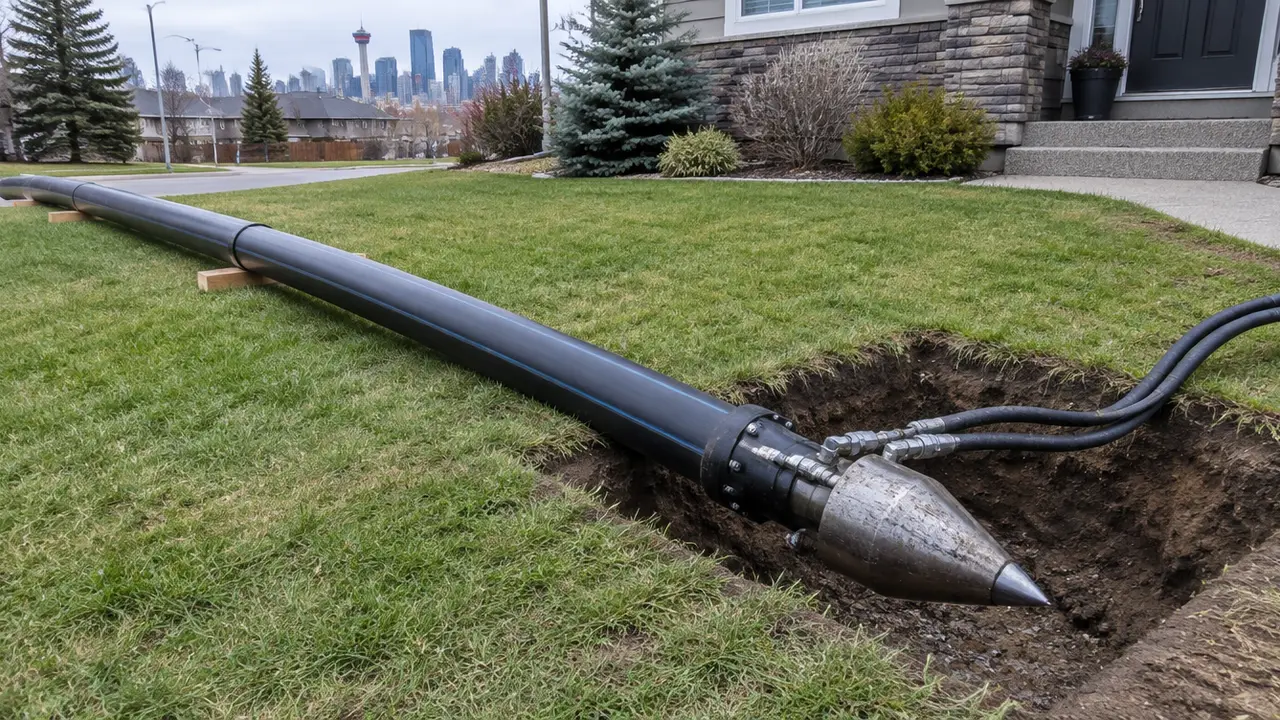
The head is shaped like a cone with a leading nose that follows the old pipe and a trailing expander slightly larger than the new pipe's outside diameter. As it advances, the old pipe cracks into fragments that are forced into the surrounding soil, leaving an enlarged channel for the new pipe. The new pipe, usually high-density polyethylene (HDPE) heat-fused into a single continuous length, is attached to the back of the head and follows it through.
02 /What is the difference between static and pneumatic bursting?
Static bursting draws the head through with steady hydraulic force from a puller in the receiving pit, using linked rods or a heavy cable. Pneumatic bursting adds a compressed-air hammer inside the head that strikes repeatedly while a winch keeps tension on it. Both reach the same result; they differ in force, vibration and how they handle difficult ground.
A third variant, hydraulic expansion, uses a head whose segments open and close to push the pipe apart. On residential work you will mostly hear about static and pneumatic systems. Ask which one a contractor proposes and how it will behave near your foundation and any gas service.
03 /Which old pipes can be burst?
Brittle pipes burst best, because they fracture cleanly under the expander. Ductile pipes stretch instead of breaking, so they need a head fitted with cutting blades or rollers that slit the pipe open before the expander spreads it. That technique is often called pipe splitting.
| Host material | Typical behaviour | Approach |
|---|---|---|
| Vitrified clay | Fractures readily | Standard bursting head |
| Cast iron | Brittle; fractures | Standard head; sharp fragments are pushed into the soil |
| Concrete | Fractures; heavier pipe | Standard head, higher force |
| Bituminous fibre (Orangeburg) | Soft, often already deformed | Commonly replaced by bursting if a cable can be threaded |
| PVC and ABS | Ductile; tends to stretch | Splitting blades, then expander |
| Ductile iron or steel | Very tough | Heavy splitting systems; uncommon on house laterals |
Repair clamps, stainless steel bands and concrete encasement left from earlier repairs can stop a head cold. That is one reason the pre-work camera run matters: every old repair is a potential obstruction, and a contractor who knows about it can plan a small dig to remove it.
04 /What kind of new pipe goes in?
HDPE is the standard replacement pipe for bursting because it is tough, flexible enough to be bent gently into the launch pit, and can be joined by butt fusion into a single length with no gasketed joints for roots to find. Wall thickness is described by its dimension ratio (DR), the outside diameter divided by the wall thickness, so a lower DR means a thicker, stiffer pipe.
- Butt fusion heats the squared ends of two HDPE lengths and presses them together to form a joint as strong as the pipe. Ask whether the fusion operator is trained on the fusion procedure used.
- Relaxation: HDPE stretches slightly under pulling tension and shortens again afterward. Installers leave the pipe to relax for the period their procedure calls for before making final connections.
- Upsizing: a common residential upsizing is from 100 mm to 150 mm (4 in to 6 in). Larger upsizes need more force and push more soil aside.
- Connections: HDPE is joined to PVC or cast iron at each end with approved transition couplings or fittings, and branch connections are made at excavations along the route.
For the full comparison of HDPE with PVC and ABS, see best pipe for sewer replacement.
05 /What site conditions make bursting risky?
Anything close to the old pipe is at risk when the expander pushes soil outward. Shallow lines, nearby utilities, foundations and hard surfaces directly above the route all need planning. None of these rules bursting out automatically, but each changes how the job is done.
| Condition | Risk | Typical mitigation |
|---|---|---|
| Line shallower than about 1.5 m | Surface heave: lawns, walks and slabs can lift | Limit upsizing, use static equipment, expose sensitive spots |
| Gas, water or electrical service crossing or running parallel | Damage from displaced soil or fragments | Locate precisely and hand-expose crossings before the pull |
| Foundation, footing or retaining wall close to the route | Movement or vibration damage | Static bursting, reduced upsizing, monitoring |
| Rock, cobbles or very dense till | Head stalls; soil cannot compress | Higher-force equipment, or switch to open cut |
| Loose, wet sand | Voids and settlement after the pull | Assess groundwater and plan pit dewatering |
| Two or more bends | Head cannot follow a sharp change in direction | Add a pit at each bend or choose another method |
06 /How many pits does a bursting job need?
At minimum, two: a launch pit where the new pipe enters and a receiving pit where the puller sits. Every branch connection along the route adds an excavation, and so does every bend the head cannot negotiate. This is the main reason the Replacement Method Selector rates bursting only 'Possible' when there are connections along the line and 'Not suitable' with two or more bends.
- Launch pit near one end, long enough for the new pipe to bend gently into the path.
- Receiving pit at the other end, housing the puller or winch and room to disconnect the head.
- Connection pits at each branch, where the new pipe is tapped and the branch rejoined.
- Bend pits where the old pipe changes direction more than the head can follow.
On a house lateral, one pit is typically outside near the foundation, or at an existing cleanout location, and the other near the property line or the connection to the main. Where the connection to the main is in the road, that end usually involves the municipality.
07 /When is bursting the wrong choice?
Bursting is the wrong choice when the line has a belly, when it bends sharply more than once, or when so many connections join it that the pits add up to a trench. It is also a poor fit where a shallow line runs directly under a slab you cannot risk lifting.
- A sag: the head follows the old path, so the new pipe inherits the dip. Fix grade with an open-cut section. See can trenchless fix a belly.
- A long collapse: if a cable cannot be threaded through, a dig is needed at that point anyway.
- Many connections: each one is an excavation; lining with reinstatements may be less disruptive.
- Undersized but sound pipe with no room to expand: near foundations, the soil displacement may not be acceptable.
Compare the alternatives in sewer replacement methods compared. For planning prices by method, see SewerQuotes.com.
08 /How do you check a burst replacement?
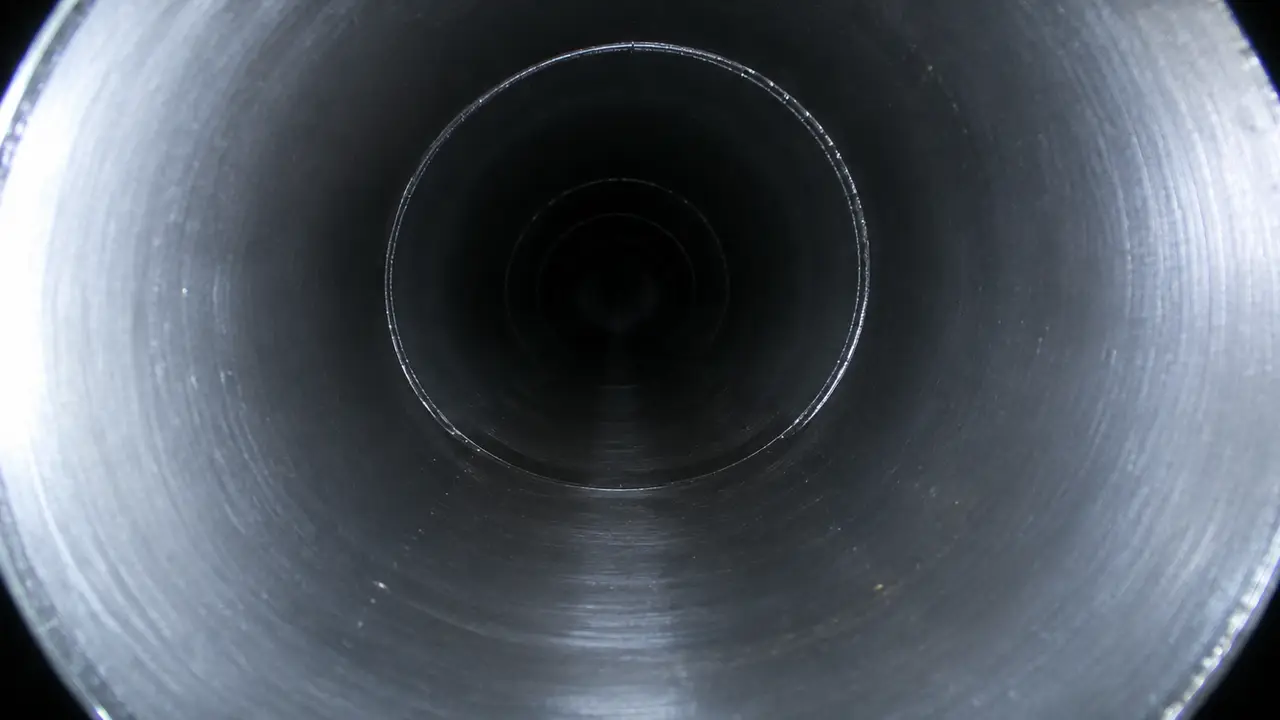
Check it with a recorded camera run through the new pipe, the same way you would check a liner. The new HDPE should be continuous and round, the fusion beads should be the only visible features, and the connections at each end and at each branch should be clean and aligned.
- No gouges or flattening in the new pipe near either pit.
- Transition couplings at each end are straight, with no step that could catch solids.
- Water drains away rather than standing, except where the old grade already held water.
- Pits are backfilled in compacted layers so the surface does not settle over the winter.
Keep the video with the warranty and permit records. Sewer replacement warranties and final checks lists the documents to ask for. When you are ready to price bursting against other methods, request quotes.
FAQQuestions people ask
What is pipe bursting sewer line replacement?
A trenchless method that fractures the old sewer pipe outward with a pulled head while a new HDPE pipe is drawn into the same path. It needs a pit at each end and one at each connection.
Can pipe bursting make my sewer line bigger?
Yes. Upsizing by one standard size, such as from 100 mm to 150 mm, is common. Larger upsizes need more force and displace more soil, which matters near foundations and shallow surfaces.
Is pipe bursting better than lining?
Neither is better in general. Bursting suits broken, partly collapsed or undersized pipe on a straight route. Lining suits round pipe with cracks and joint problems, especially where there are several connections.
Can pipe bursting damage my foundation or driveway?
It can if the line is shallow or close to the structure, because the expander pushes soil outward. Careful contractors assess depth and clearances, limit upsizing and use static equipment near structures.
What happens to the old pipe fragments?
They stay in the ground, compressed into the soil around the new pipe. The expander is sized larger than the new pipe so the fragments are pushed clear of it.
NETWORKGo deeper across the HAUSE Sewer network
Pipe bursting cost: trenchless sewer line replacement, priced
Pipe bursting cost in Canada (2026): trenchless sewer replacement ranges in CAD, pit and per-metre pricing, upsizing, and when it beats lining or digging.
PipeCleaning.caDuctile iron pipe, cement linings and how pipelines are cleaned
What ductile iron pipe is, how it is made, why it is cement lined and where it is used, plus how water mains and pipelines are cleaned with pigs and flushing.
SewerInspector.caSewer pipe materials by construction era, and what each looks like on camera
Sewer pipe materials by era in Canadian homes: clay, cast iron, Orangeburg, concrete, ABS and PVC, how each one fails and what it looks like on camera.