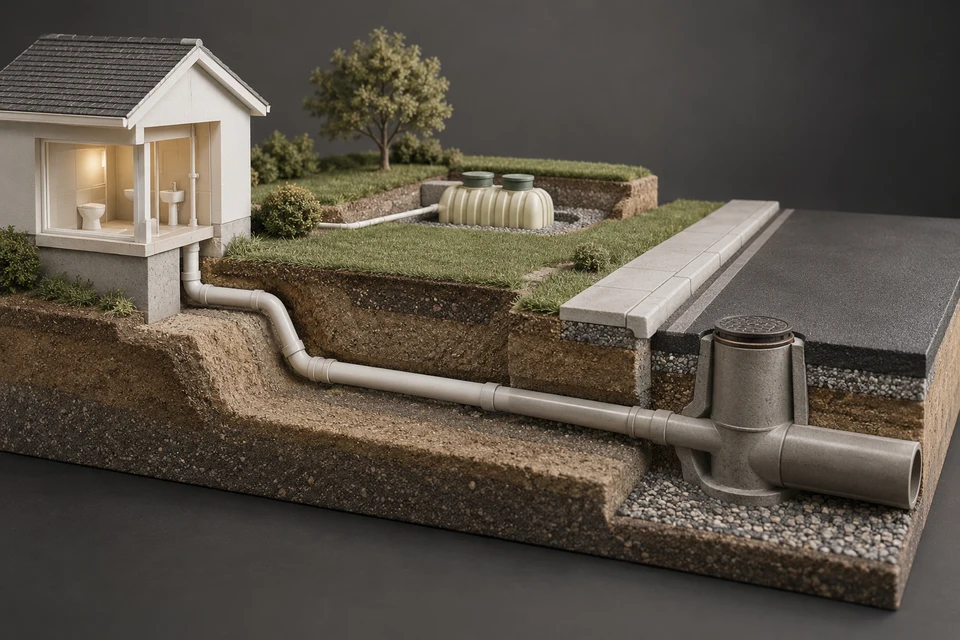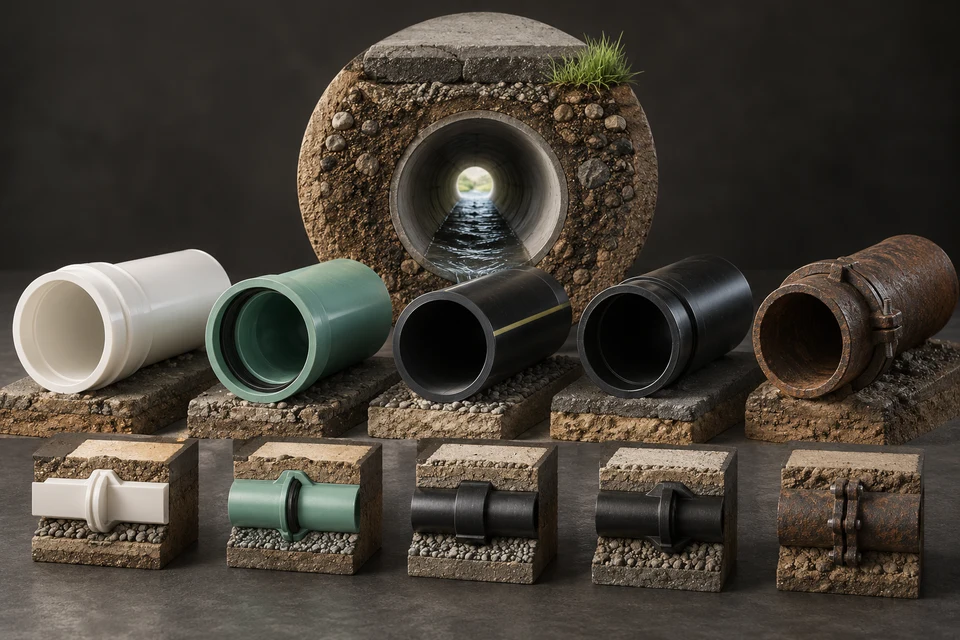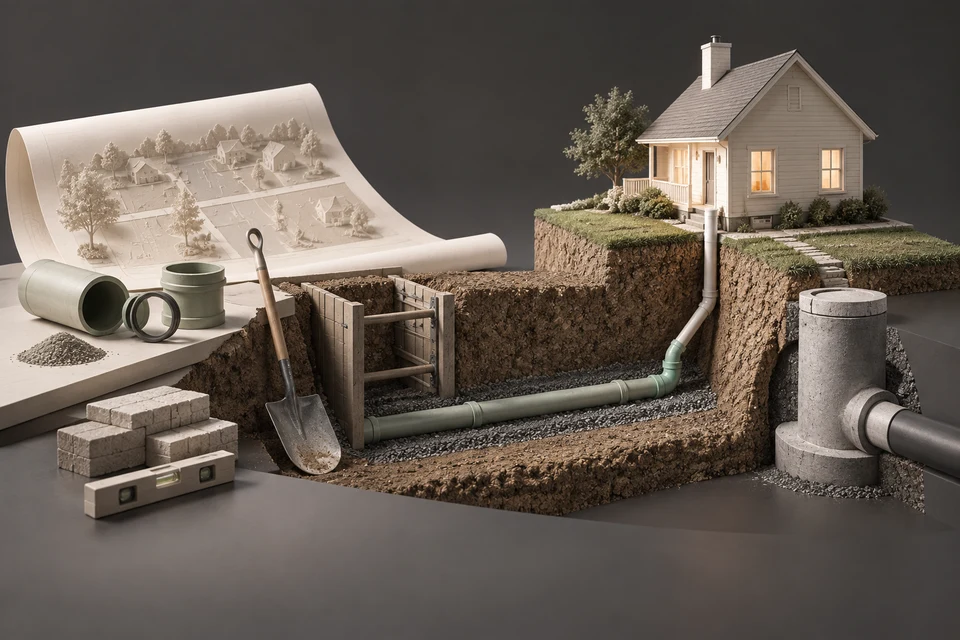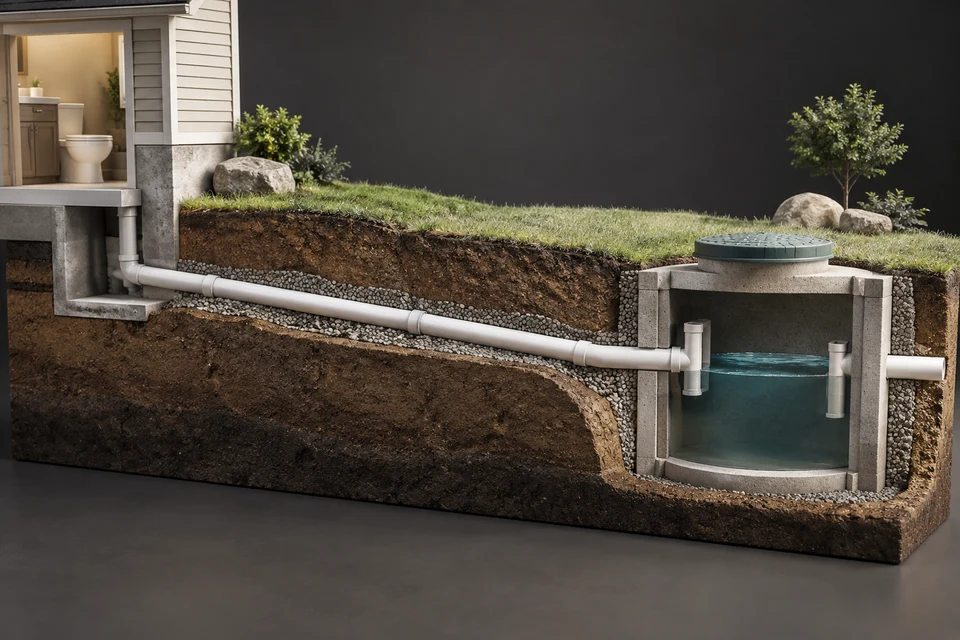
Replacing the line from a house to a septic tank means renewing the gravity pipe between the foundation and the tank inlet, usually by open cut because the run is short and shallow. Before any digging, confirm that the pipe, not the tank or the disposal field, is the problem. Permits come from whichever local authority administers private sewage systems, and the connection at the tank inlet needs particular care.
- Rule out a full tank or a failing field before replacing the pipe, because all three produce the same slow drains and backups.
- Private sewage systems are regulated provincially and administered locally, often by a different office than plumbing inside the house.
- The pipe usually fails where it crosses the disturbed soil around the tank, so support there matters more than anywhere else.
- The inlet baffle or tee must stay intact, and nobody should enter a septic tank.
- Keep vehicles, paving and trees off the tank and the disposal area while the line is being replaced and afterwards.
01 /What is different about a sewer line that runs to a septic tank?
Everything on the line is private, and the far end is a treatment system rather than a municipal main. The pipe itself is a building sewer like any other, a sloped gravity line carrying everything that leaves the house, but it ends at the inlet of a tank, and what happens there affects the whole septic system.
The rules come from a different place too. In Ontario, Part 8 of the Building Code covers sewage systems with a daily design flow of up to 10,000 litres, which includes most homes, and Ontario's SepticSmart guide notes that the local regulatory authority may be the municipality, a health unit or a conservation authority. In Alberta, the 2021 Private Sewage Systems Standard of Practice covers on-site systems handling less than 25 cubic metres of sewage a day, and contractors need a certificate of competency to obtain private sewage permits. Other provinces have their own rules.
| Feature | Line to a municipal main | Line to a septic tank |
|---|---|---|
| Ownership | Private side plus, often, a municipal portion | Entirely private |
| Typical length | Often 15 to 25 m or more to the main | Often short; set by the tank's required distance from the house |
| Far-end connection | Municipal service or main, often under a road | Tank inlet and baffle or tee |
| Who regulates | Municipal plumbing permit and utility rules | Provincial private sewage rules, administered locally |
| Typical failure point | Joints along the run; the connection at the main | The section crossing disturbed soil near the tank |
02 /Is it the pipe, the tank or the field?
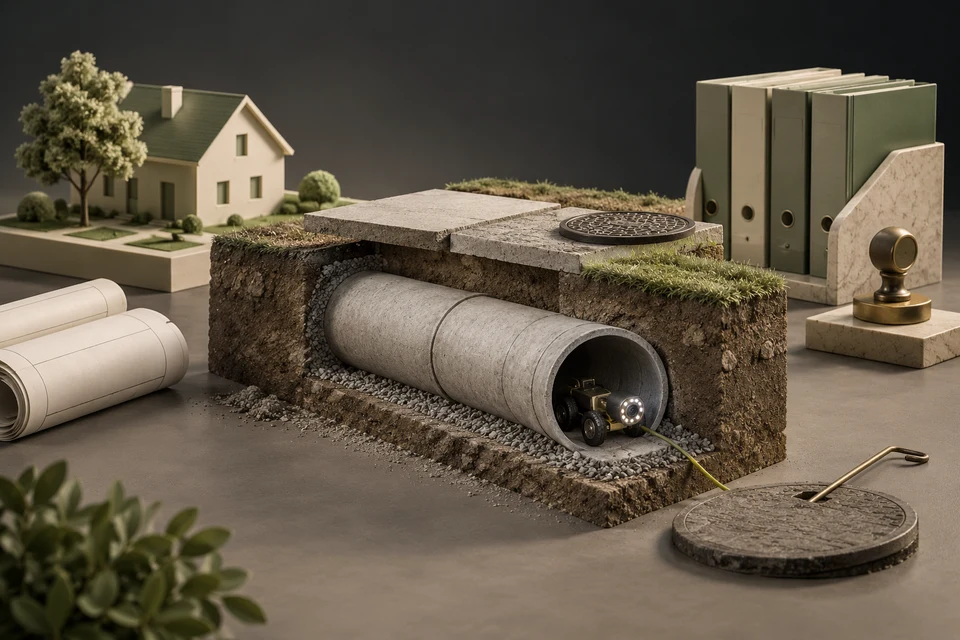
Find out before digging, because slow drains, gurgling and backups look the same whichever part has failed. A camera run from the house cleanout to the tank shows the pipe; a septic service provider opening the tank shows its levels and the inlet; and the condition of the disposal area, including wet ground or odours over the field, points to the field.
| What you find | Likely location | First step |
|---|---|---|
| Liquid level in the tank at or below the outlet, camera shows a break or root mass | The house-to-tank pipe | Plan the pipe repair or replacement |
| Liquid level in the tank above the outlet | Downstream: outlet, effluent filter or field | Have the system serviced and assessed before touching the pipe |
| Camera stops at a sag full of water just before the tank | Settled pipe over the tank excavation | Excavate and re-support that section |
| Tank full of sludge and scum | The tank needs pumping | Pump and inspect, then re-test drainage |
| Wet, spongy ground or odour over the disposal area | The field | Consult an onsite sewage professional |
Ontario's SepticSmart guide suggests having a tank inspected for sludge and scum every three to five years and cleaned out when a third of its depth is taken up by them, and it recommends starting with a system inspection whenever a problem appears, because the tank may simply need cleaning. It also recommends a second opinion before major repairs.
03 /Why do house-to-tank lines fail?
Mostly because of the ground they cross. The tank sits in a large excavation that was backfilled around it, and that fill keeps settling for years. A pipe laid across it without solid support can sink with it, forming a belly just upstream of the tank or cracking at the inlet where the pipe meets a rigid tank wall.
- Settlement near the tank creates sags and breaks at the inlet, as above.
- Roots enter old joints; trees planted too close to the tank or line are a common cause, which is why SepticSmart advises against planting near the tank or distribution system.
- Vehicles crush shallow pipe; the same guide advises never to drive or park over the tank or distribution system.
- Frost affects lines that are shallow because the tank inlet is shallow; the fix is sometimes insulation, sometimes a deeper route, depending on the site.
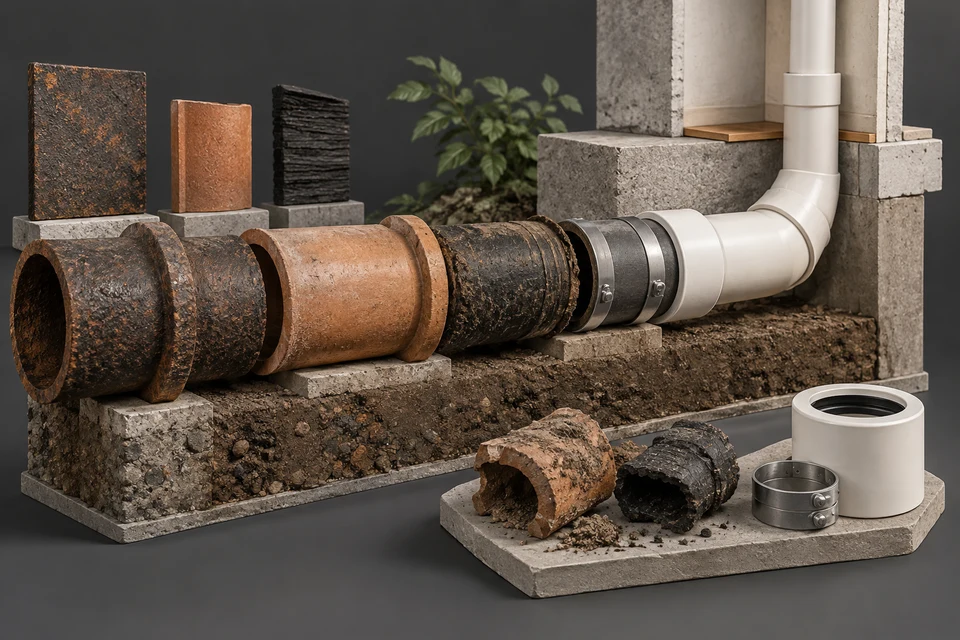
- Old materials such as fibre pipe or clay were used in rural homes too; see replacing cast iron, clay and Orangeburg pipe.
04 /How is the line to a septic tank replaced?
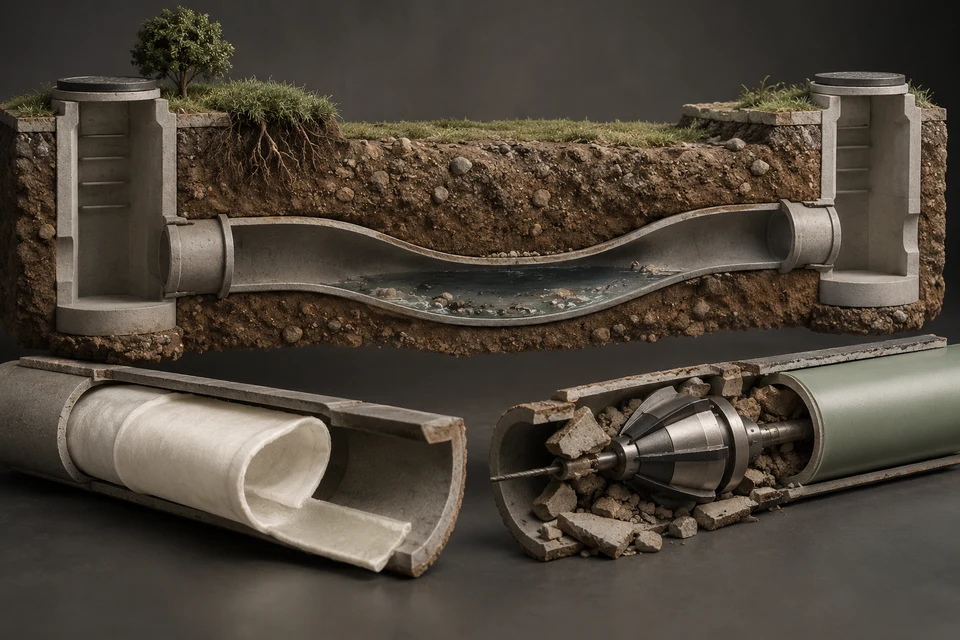
Usually by open cut, because the run is short, often under lawn, and the section that needs fixing is the one near the tank, where grade and support have to be rebuilt. Relining is possible where the pipe is round and on grade, but it cannot fix the settlement that caused most failures. Bursting is uncommon on runs this short.
- Get the permit and locates
Contact the authority that administers private sewage systems where you live, and request public locates. Mark private lines such as the well line and power to outbuildings yourself or with a private locator.
- Have the tank serviced
Pumping the tank before the work lowers the level at the inlet, reduces odour and lets the service provider check the inlet baffle or tee and the effluent filter.
- Expose the line and the inlet
Dig along the line to the tank, taking care not to strike the tank lid, risers or the inlet fitting. Keep machines off the tank and the disposal area.
- Rebuild support over the tank fill
Remove soft material under the pipe where it crosses the tank excavation and replace it with compacted granular bedding so the new pipe cannot settle.
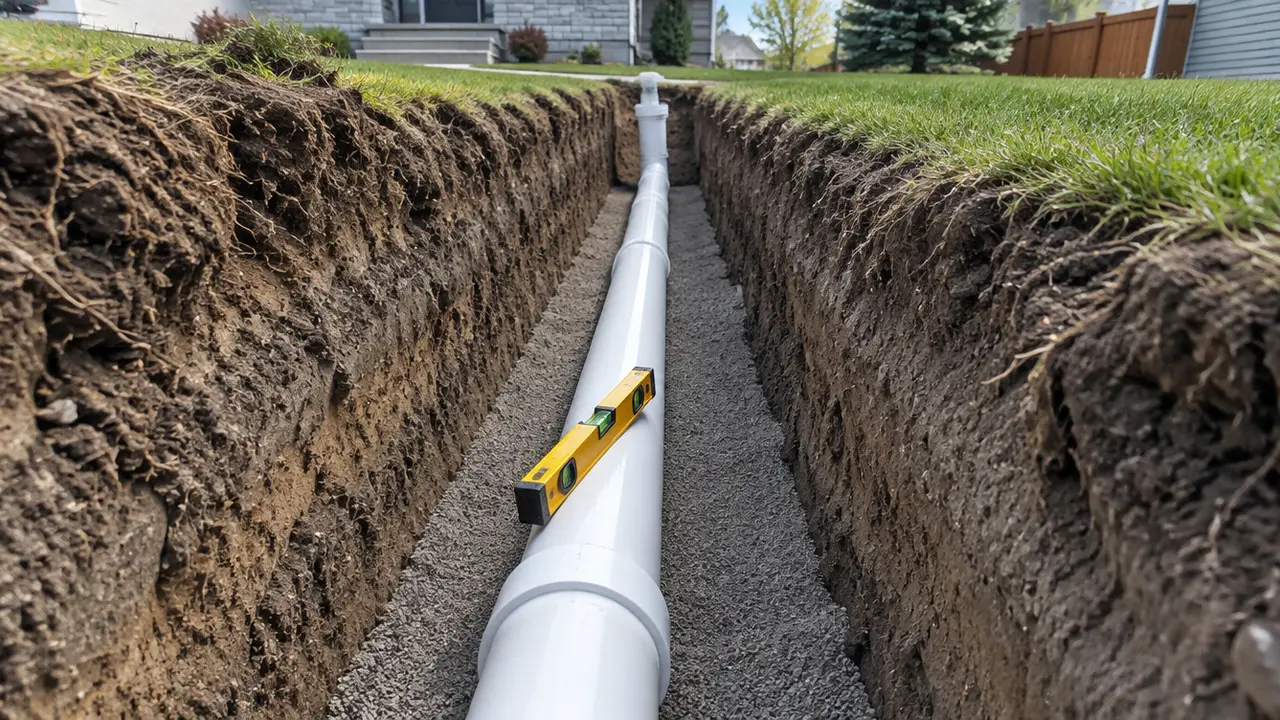
- Lay the pipe at a steady slope
Lay new PVC or ABS at a uniform slope within the code range, with no dips, and a cleanout near the house so the line can be inspected and cleaned without opening the tank.
- Connect at the inlet
Join the new pipe to the tank inlet with a watertight connection that does not disturb the baffle or tee, so incoming flow is still directed down into the tank.
- Inspect, test and backfill
Book the inspection the permit requires, run a camera through the new line, then backfill in compacted layers.
Slope matters here as on any gravity line. Canadian plumbing codes set a minimum fall for building sewers, and the inspector enforces the figure for your pipe size; a line that is too flat lets solids settle before the tank, and a line with a dip will hold them in one place. For the reasoning behind grade, see can trenchless fix a belly.
05 /Should you replace the tank or field at the same time?
Only if they need it, but decide before the trench is closed. If the tank is cracked, the inlet is broken, or the field is failing, a replacement pipe is a partial fix, and the ground will be dug again soon. If the tank and field are sound, renewing only the pipe is reasonable and far less disruptive.
- Ask the septic service provider for a written condition report on the tank and inlet when it is pumped.
- If the field is suspect, have an onsite sewage professional assess it before the pipe work, since a system replacement may move the tank or change the inlet depth.
- Keep the records of pumping, the permit and the inspection together, as SepticSmart recommends keeping approval, construction and maintenance records.
06 /What if you are switching from septic to a municipal sewer?
Then the job is a new lateral to the main, plus decommissioning the tank. Municipalities that extend sewers into septic areas usually set the rules for connecting and for abandoning the old tank, which commonly involves pumping it and then removing, crushing or filling it. The City of Toronto, for example, lists septic-to-sewer conversions among the situations that require a new water and sewer service connection.
Ask the municipality about connection timing, the approved route and any requirement to decommission the tank before planning the private work. The engineering of the private lateral then follows the same logic as any other, covered in sewer lateral replacement. When you know which part has failed, request quotes and include the tank service report with the footage.
FAQQuestions people ask
Do I need a permit to replace the pipe between my house and septic tank?
In many provinces, yes, from whichever authority administers private sewage systems locally: the municipality, a health unit, a conservation authority or a provincial agency. Ask that office before starting, because rules differ between provinces.
Can a full septic tank look like a broken sewer line?
Yes. A tank with its liquid level above the outlet, or a failing disposal field, causes the same slow drains and backups as a broken pipe. Have the tank opened and serviced before paying for pipe replacement.
What pipe is used from a house to a septic tank?
Usually PVC or ABS sewer pipe of a type approved by the code that applies, laid on compacted bedding at a steady slope. The connection at the tank inlet must be watertight and leave the baffle or tee intact.
Should the septic tank be pumped before the sewer line is replaced?
It is usually sensible. Pumping lowers the level at the inlet, reduces odour during the work and gives the service provider a chance to check the inlet, baffle and filter while the ground is open.
Why does the pipe to my septic tank keep sagging near the tank?
Because the soil around the tank was backfilled after the tank went in and continues to settle. A pipe crossing that fill without firm granular support sinks with it. The fix is to rebuild the support under that section.
NETWORKGo deeper across the HAUSE Sewer network
New sewer line cost: new connections, infill services and septic-to-sewer
New sewer line cost in Canada (2026): CAD planning ranges for new house connections, infill services and septic-to-sewer conversions, plus fees to confirm.
DrainAugering.caHow to snake a drain from outside the house
How to snake a drain from outside: using an exterior cleanout, why weeping tile and septic drain fields are different, and what to do when the line is frozen.
SewerJetting.caWhich drain cleaner is safe for toilets, septic systems, RVs and garbage disposals?
What drain cleaner is safe for toilets, septic systems, RVs, garbage disposals and hair clogs, and when a closet auger or hydro jetting is the better fix.