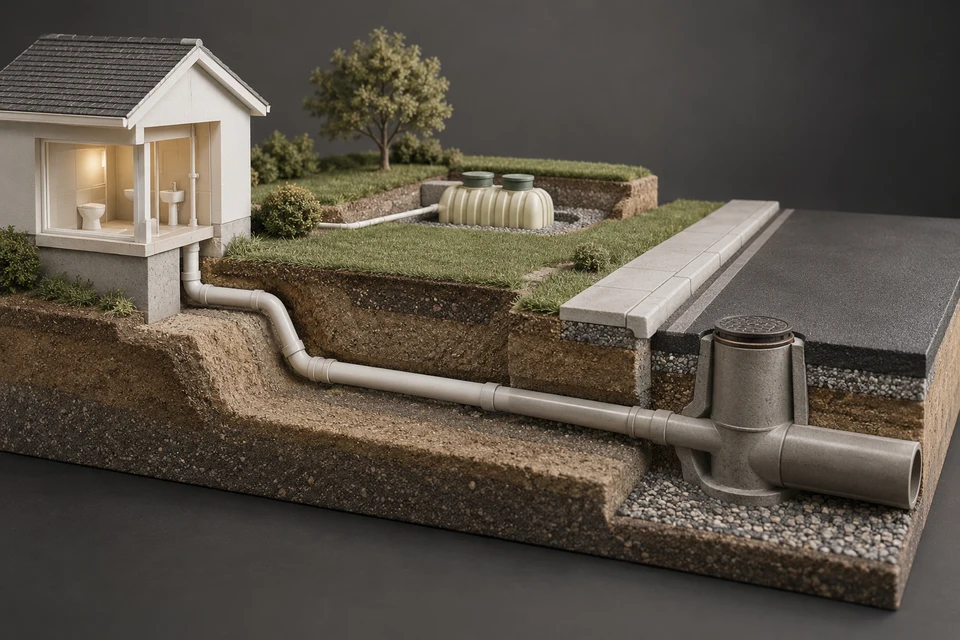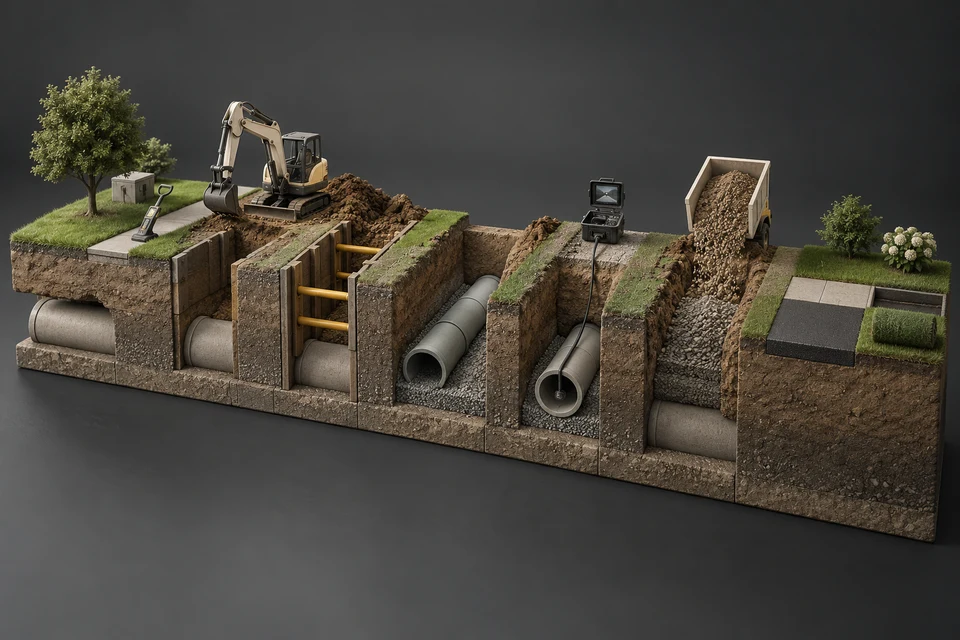
A typical open-cut sewer line replacement takes about one to three days on site once permits and utility locates are in place: set-up and excavation, removing old pipe and laying new pipe to grade, then inspection and backfill. Lining is usually a one-day job and bursting one to two. Restoration of lawn, concrete or boulevard follows, sometimes weeks later.
- Most of the calendar time goes to quotes, permits and locates, not digging.
- Expect to lose drainage for part of each work day, and plan laundry, showers and toilets around it.
- The inspection before backfill is the moment to check the pipe, bedding and slope yourself.
- Backfill placed in compacted layers is what stops the trench line sinking next spring.
- Winter work is possible but slower, and restoration is often temporary until the ground thaws.
01 /How long does sewer line replacement take?
On site, a residential open-cut replacement commonly takes one to three days, full-length lining about a day, pipe bursting one to two days and a spot repair about a day. From first camera run to finished restoration, the whole project usually spans a few weeks for planned work, because permits, locates, inspection booking and restoration each take their own time.
| Method | Days on site | Winter effect | Restoration afterward |
|---|---|---|---|
| Open cut | About 1 to 3 | Adds about 1 to 2 days for frost | Full trench line |
| Full-length lining | About 1 | Cure may need heat | Little or none |
| Pipe bursting | About 1 to 2 | Pits in frozen ground take longer | Pits only |
| Spot repair | About 1 | Adds time for frost | One pit |
These ranges assume the job goes as scoped. Unexpected rock, high groundwater, an unmarked utility or a surprise at the municipal connection can add days. Ask each contractor what they will do, and how they will charge, if any of these happen.
02 /What happens before the first day on site?
Before anyone digs, the line has to be diagnosed, the scope agreed, the paperwork done and every buried utility marked. This preparation is where most delays come from, and where most avoidable mistakes are prevented.
- Final scope in writing
Method, start and end points, length, pipe material and rating, cleanout locations, restoration standard, and who handles permits.
- Permits
A plumbing permit in most municipalities, plus any permission for work on the boulevard or road. Confirm who applies; it is usually the contractor. See permits and inspections for what each approval covers.
- Utility locates
The contractor requests public locates through the provincial one-call service. Paint and flags appear on the lawn; do not remove them.
- Private locates
Irrigation lines, garage power, gas to a barbecue or heater, and the sewer itself are private lines that public locates do not mark.
- Clear the route
Move vehicles, planters, furniture and anything you value from the work zone and the path equipment will take. Tell the crew about sprinkler heads and buried dog fences.
03 /What happens on day one of an open-cut replacement?
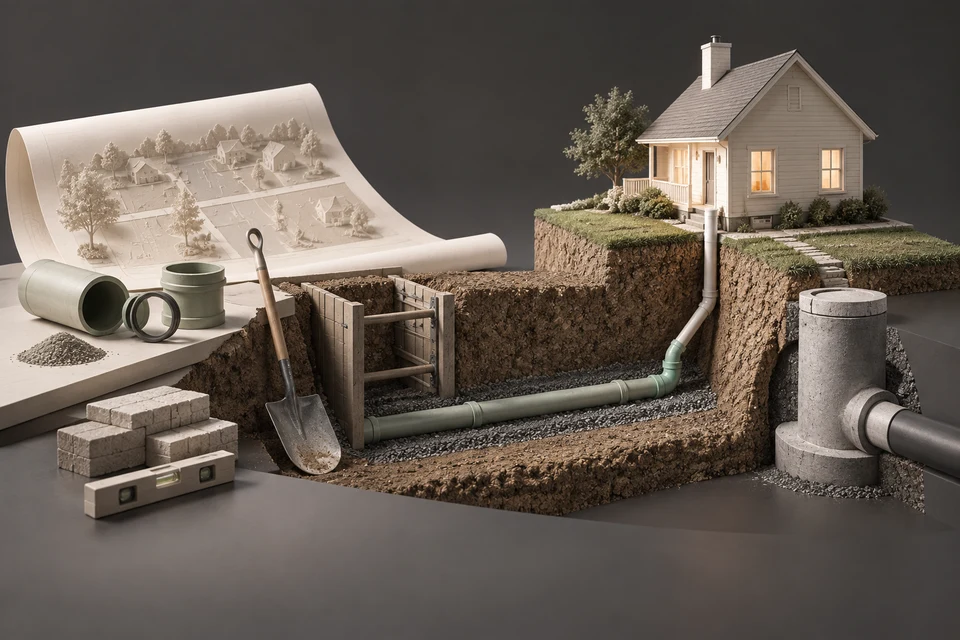
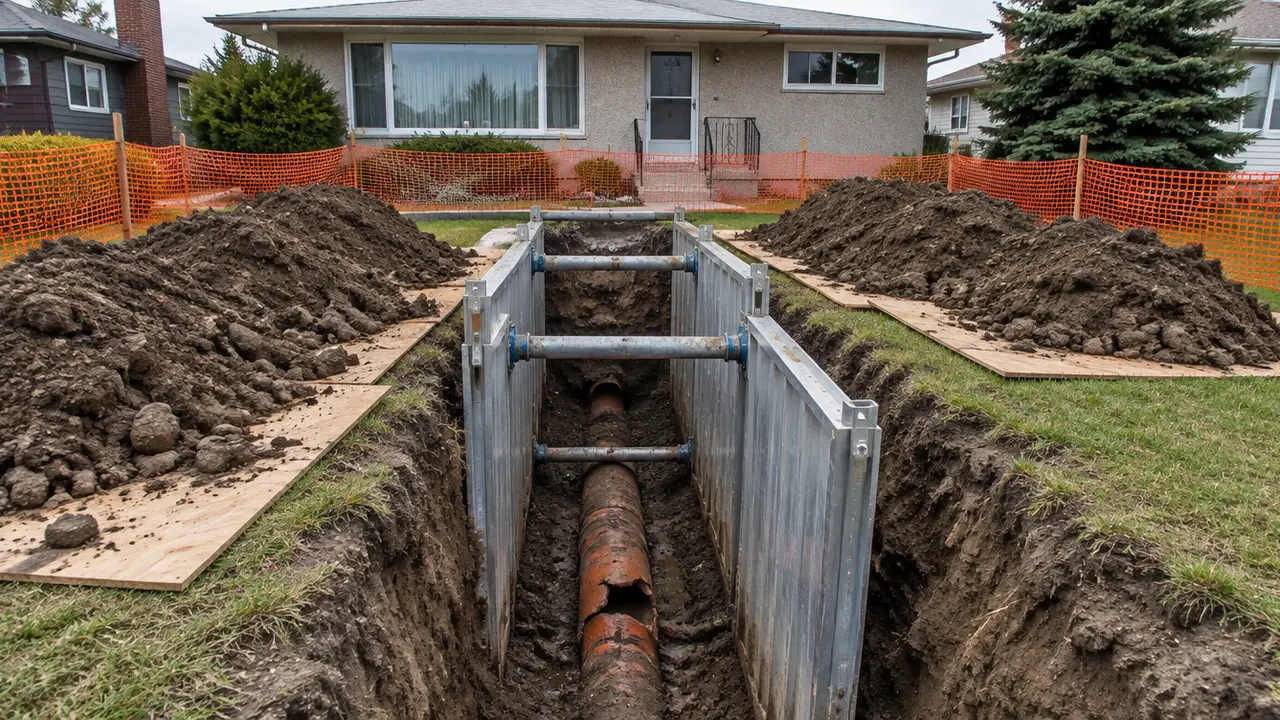
Day one is set-up and excavation. The crew protects the site, confirms the locates, and opens the trench from one end.
- Site protection: plywood or mats over lawn and driveway where the excavator travels, fencing around the trench, and sod cut and rolled if it will be reused.
- Hand exposure of crossings: where locates show a gas, water or electrical line crossing the route, the crew digs by hand or with vacuum excavation to expose it before the machine works near it.
- Excavation: the machine digs along the route toward the pipe, keeping the spoil back from the edge.
- Trench protection: at depths beyond the provincial threshold, commonly around 1.2 to 1.5 m, the walls are sloped, benched or supported with a trench box.
- Water control: if groundwater enters, a pump keeps the trench workable.
Expect noise, vibration from the excavator, and a temporary loss of drainage once the old pipe is cut. The crew should tell you when to stop using water.
04 /What happens on day two?
Day two is usually pipe day. The old pipe is removed, the trench bottom is prepared, and the new pipe is laid and connected. This is the day that decides whether the line drains well for decades.
- Remove the old pipe
The old pipe comes out in pieces and goes to the disposal pile. Cast iron may go for scrap; clay and fibre are hauled away.
- Prepare the bed
Soft or uneven material is removed from the trench bottom and a layer of granular bedding is placed and levelled.
- Lay to grade
The new pipe is laid from the low end upward, with each joint fully seated and the slope checked with a laser or level as the work proceeds.
- Connect both ends
Each end is tied in, to the building drain at the house and to the municipal service or main at the other end, using couplings rated for the two materials, and a cleanout goes in.
- Haunch and cover
Granular material is worked under the sides of the pipe and placed over it to protect it, ready for inspection.
If the scope includes a new backwater valve, a tracer wire or a property-line cleanout, this is when they go in. Ask to see each before it is covered.
05 /What happens at inspection and backfill?
Where a permit applies, the plumbing inspector checks the new pipe, its connections and its slope before it is covered. Some inspections also include a test or a camera run. Once the inspection passes, the trench is backfilled.
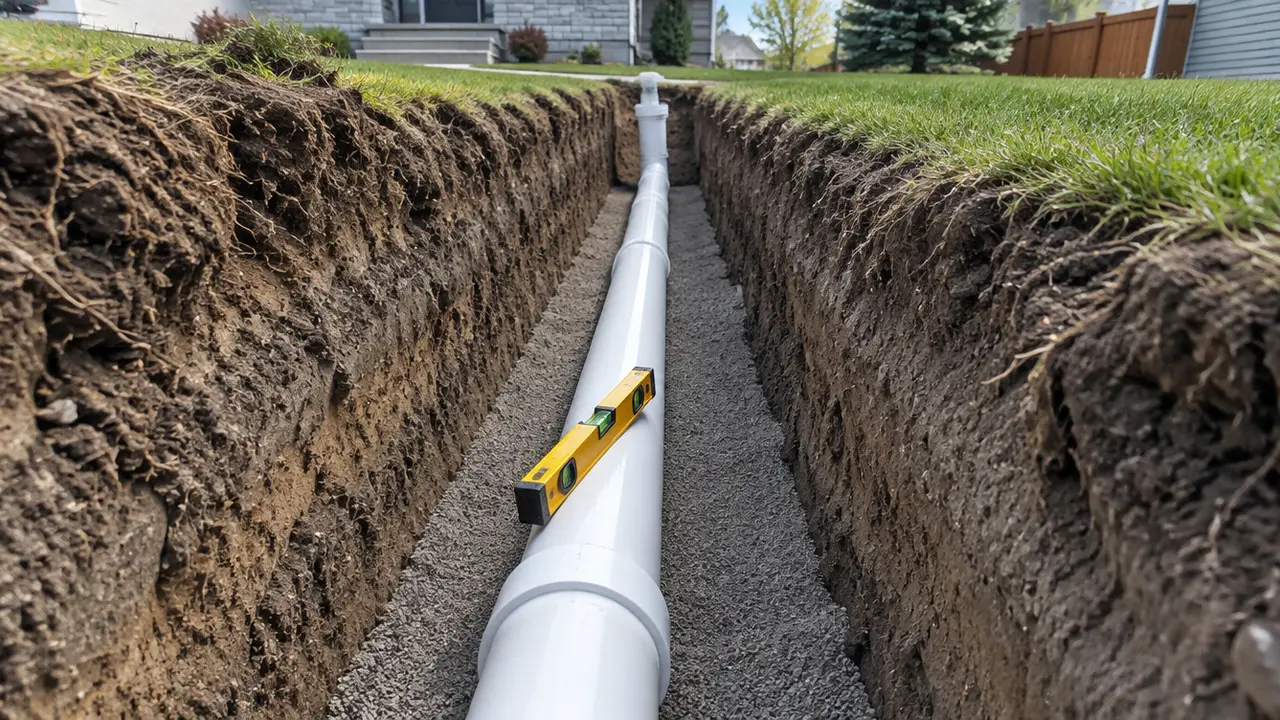
- Your own look: before backfill, check that the pipe markings match the quote, the couplings are the type specified, the cleanout is where you agreed, and the bedding looks even.
- Photos: photograph the open trench with measurements from a fixed point such as the house corner.
- Backfill in lifts: material should go back in layers and be compacted as it goes, not dumped in one pass. Deep trenches that are simply filled and left to settle sink over the following months.
- Final camera run: a recorded video of the new line proves it is continuous and clean. Get a copy before the final payment.
The inspection is the last time anyone will see the new pipe in daylight. Use it.
06 /What does a trenchless replacement day look like?
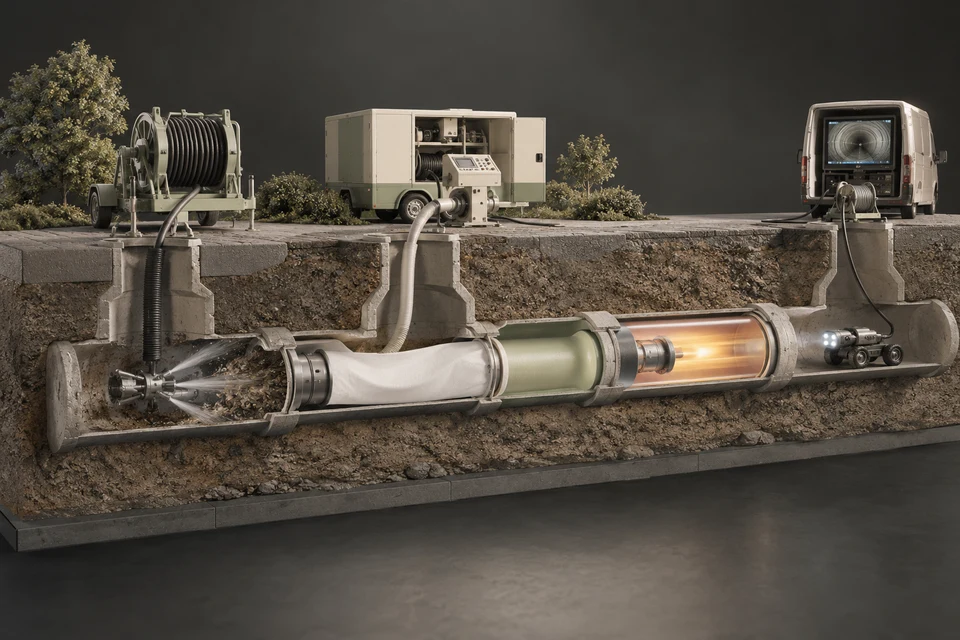
A trenchless day starts the same way, with locates and site protection, but the work concentrates at the access points. Lining crews set up at a cleanout or a single pit; bursting crews open two pits and one at each connection.
| Time of day | Lining | Bursting |
|---|---|---|
| Morning | Set up, clean and descale the host, camera the prepared pipe | Open launch and receiving pits, thread the cable or rods |
| Midday | Wet out and install the liner | Fuse the new HDPE, pull it through behind the bursting head |
| Afternoon | Cure, trim, reinstate connections | Relax the new pipe, make connections at each pit |
| End of day | Final video, water back on once cured | Final video, backfill pits |
Resin odour, compressor noise and a no-water window are the main disruptions. How trenchless sewer replacement works covers each step in detail.
07 /What happens with restoration and in winter?
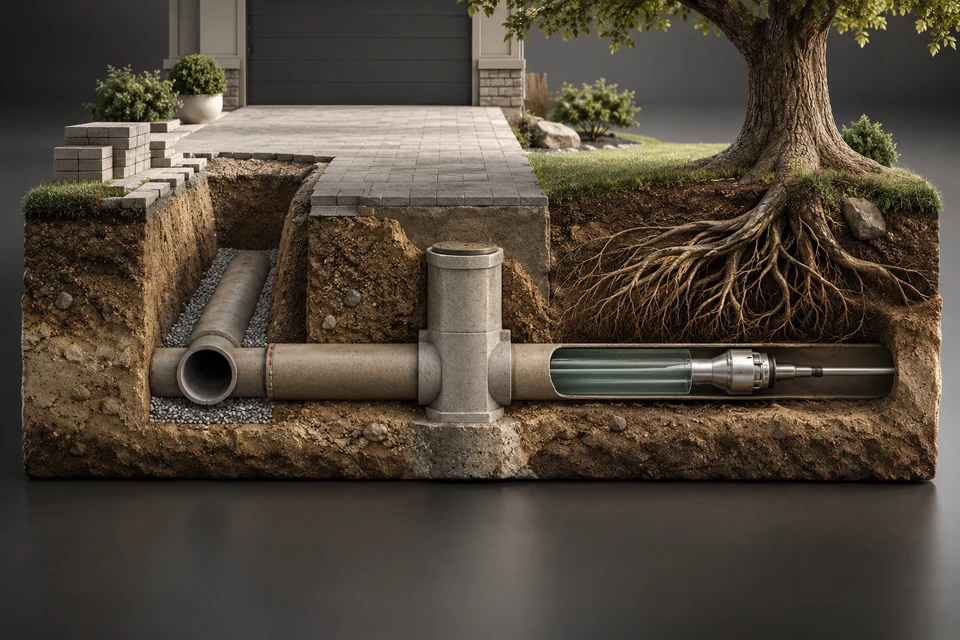
Restoration is the part of the job homeowners live with longest. A lawn trench is usually topsoiled and seeded or sodded, and needs a season to recover fully; lines under driveways and near trees have their own restoration choices, covered in replacing a sewer line under a driveway or near trees. Concrete driveways and walks are formed and poured once the trench has been compacted, then need time to cure before vehicles use them.
- Settlement: even well-compacted trenches can settle slightly after the first freeze and thaw. Ask whether the contractor returns to top up soil.
- Concrete and asphalt: agree the finish, thickness and joints in writing, and whether the contractor or a separate trade does it.
- Boulevard and road: restoration on municipal land follows the municipality's standards and may be done by the municipality or its approved contractors.
- Winter work: frozen ground is slower to dig, may need thawing, and restoration is often temporary, such as compacted gravel or cold patch, until spring.
Planning your own project? Use the Replacement Method Selector to settle the method, read how to choose a sewer replacement contractor, and request quotes that spell out each of these stages.
FAQQuestions people ask
How long does it take to replace a sewer line?
Typically about one to three days on site for open cut, about a day for lining and one to two days for bursting, once permits and locates are in place. The whole project, including planning and restoration, usually takes a few weeks.
Can I use the toilet during sewer line replacement?
Only when the crew says the line is connected again. Crews usually restore drainage at the end of each day where possible. Ask for the no-use window in writing.
Do I need to be home during sewer replacement?
You do not usually need to be present all day, but the crew needs access to the basement cleanout and water shut-off, and you should be available for the inspection and final walkthrough.
Will my lawn recover after sewer replacement?
Yes, with time. A seeded or sodded trench usually looks normal after a growing season. Some settlement after the first winter is common and should be topped up.
Can sewer lines be replaced in winter?
Yes, in most of Canada, but frozen ground adds time, sometimes thawing costs, and restoration is often temporary until spring. Trenchless methods are less affected because they dig less.
NETWORKGo deeper across the HAUSE Sewer network
Sewer scope on a new build: what goes wrong in brand-new sewer lines
Is a sewer line inspection necessary for new construction? What goes wrong in new laterals, when to scope before warranty dates, and what to ask the builder.
SewerCleaners.caSeasonal sewer risks: spring thaw, heavy rain and winter freeze
Seasonal sewer risks in Canada: spring thaw and snowmelt, summer storms and surcharges, fall roots and leaves, and winter freeze, with a checklist for each season.
SewerRoots.caHow to remove tree roots from a sewer line yourself, and when to stop
How to remove tree roots from a sewer line yourself: the tools that work, a step-by-step cut from the cleanout, safety rules and when to call a pro.