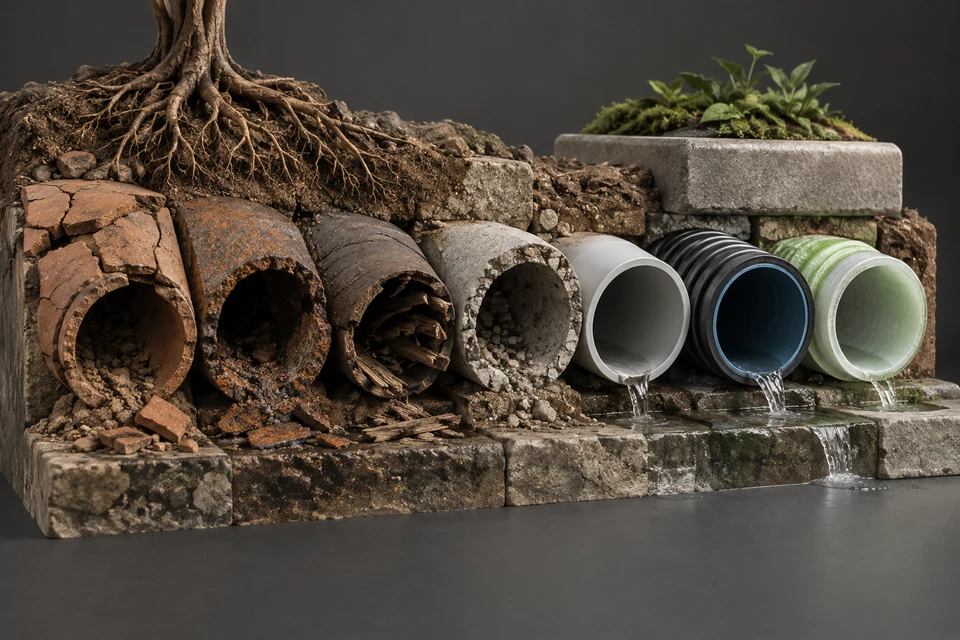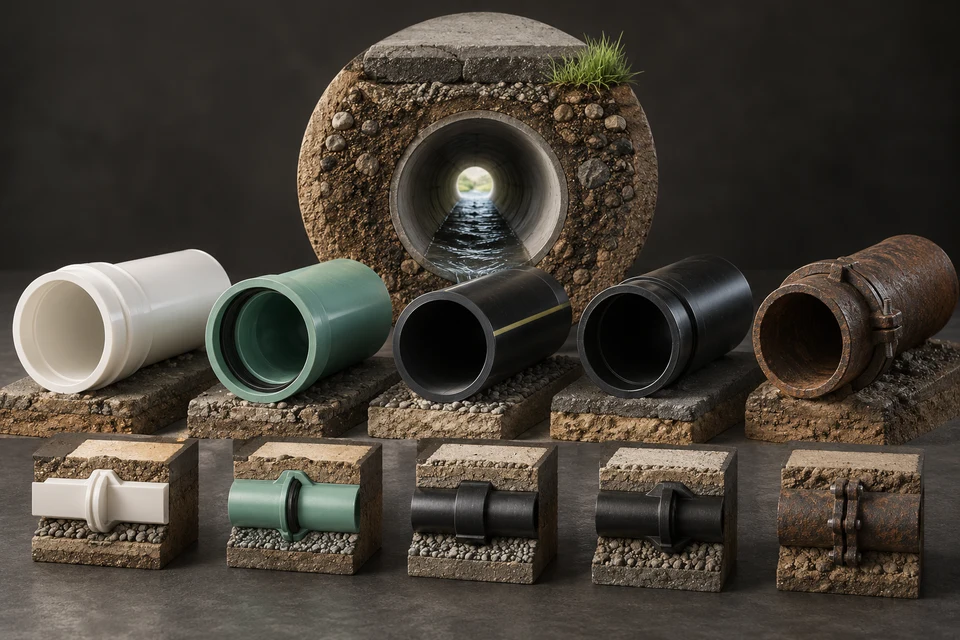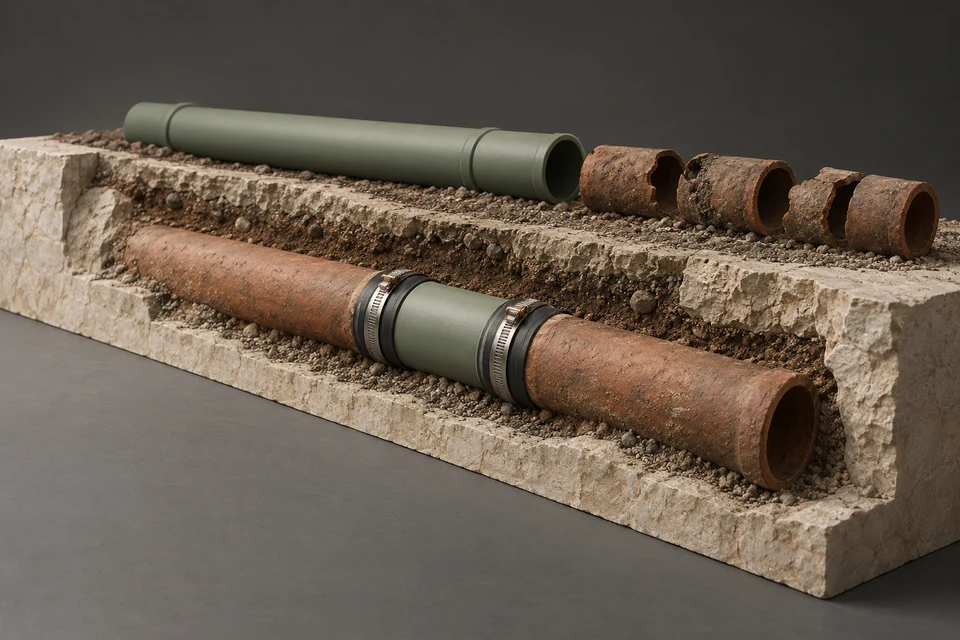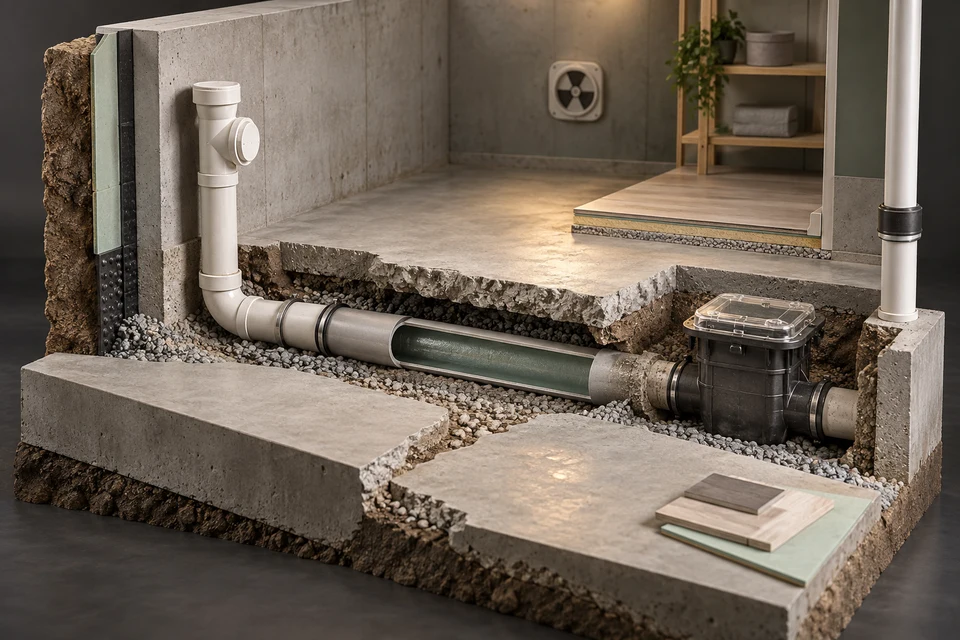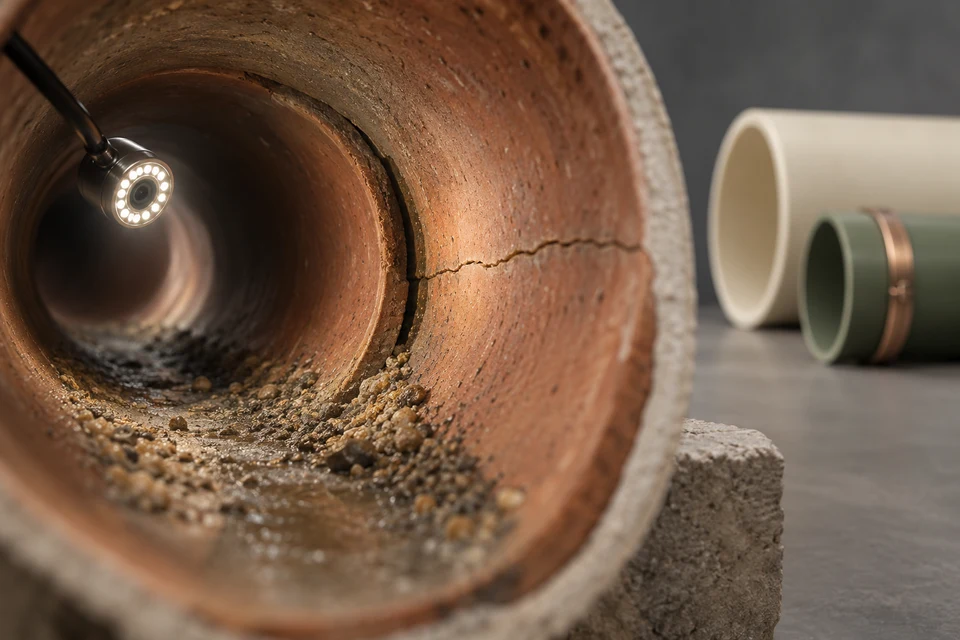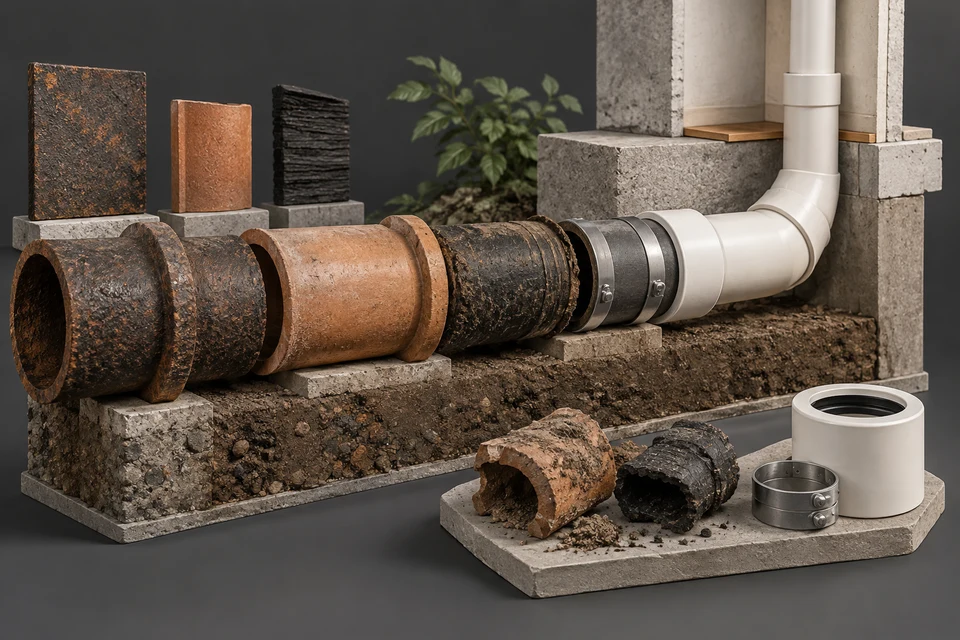
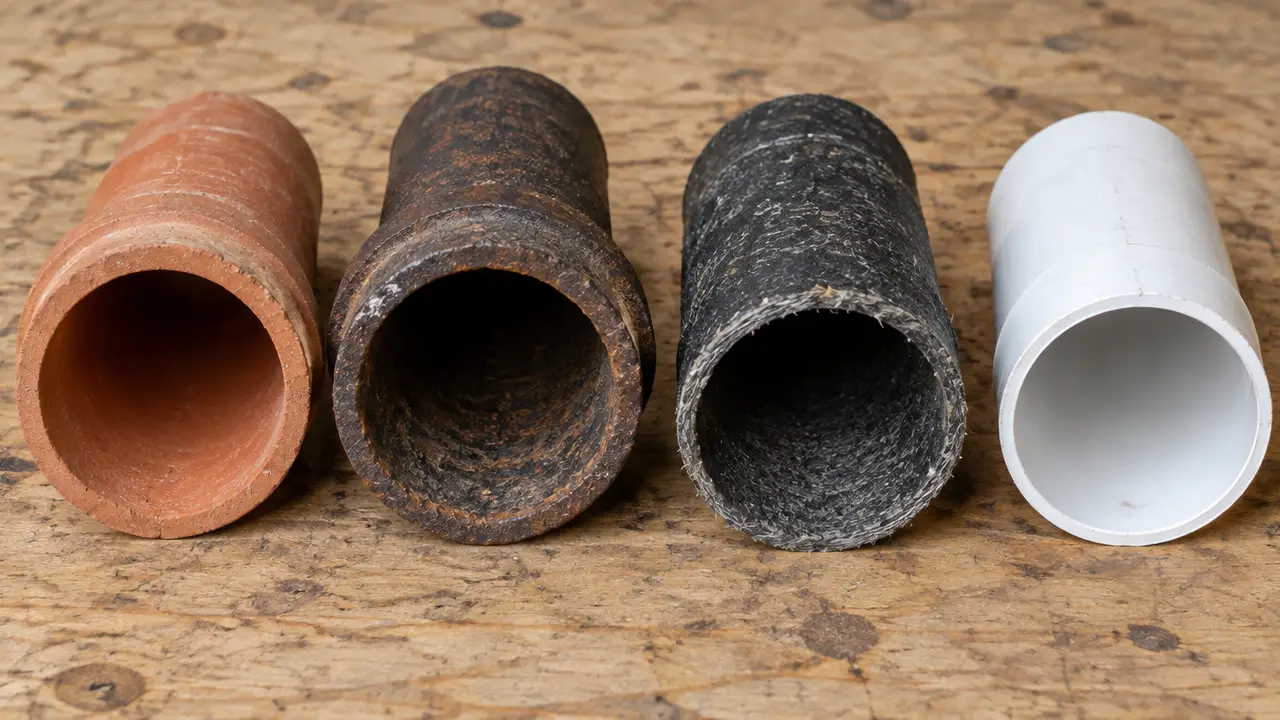
The old material narrows the choice. Clay that is still round usually suits relining, and brittle clay also bursts cleanly. Cast iron can be descaled and relined while its wall is sound, or replaced when it is thin or broken. Orangeburg fibre pipe deforms, so it is replaced by bursting or digging, not lined. The new pipe is typically PVC or ABS, joined to old pipe with approved transition couplings.
- Each old material fails in its own way, and that failure mode rules methods in or out before depth and surface are even considered.
- Clay usually has sound pipe and bad joints, which makes it the best candidate for relining among the old materials.
- Cast iron is judged by its remaining wall: descale and reline while it is round and solid, replace when it is thin, split or holed.
- Orangeburg fibre pipe goes oval and flat with age, so a liner cannot take its shape; bursting or open cut replaces it.
- Older lines are often a patchwork, and every point where one material meets another is a decision and a joint to get right.
01 /Why does the old pipe material change the replacement plan?
Because every renewal method depends on something from the host pipe. Lining needs a continuous, reasonably round pipe to cure against. Bursting needs a pipe that will fracture or split ahead of the bursting head. Open cut needs nothing from the old pipe at all, which is why it remains the fallback. The material tells you which of those conditions your line can meet.
| Old material | Typical failure | Relining | Pipe bursting | Open cut |
|---|---|---|---|---|
| Vitrified clay | Open or offset joints, roots, cracks | Often a good fit if round and on grade | Usually bursts readily | Needed for sags and collapses |
| Cast iron (grey) | Internal scale, thinning, cracks along the bottom | Good fit after descaling if the wall is sound | Usually possible; confirm with the contractor | Common under slabs with branches |
| Bituminous fibre (Orangeburg) | Softening, ovality, blistering, collapse | Generally not suitable once deformed | Commonly used; the fibre crushes and splits | Always possible |
| Concrete | Surface loss from sewer gas above the waterline | Possible if structure remains | Possible; ask about reinforcement | Always possible |
| Asbestos-cement | Softening, cracking | Possible in some cases | Needs special handling rules | Handling and disposal rules apply |
Depth, surface, bends and connections still matter, and the Replacement Method Selector weighs them. The material comes first because it can eliminate a method outright: no amount of convenient access makes a liner suitable for a flattened fibre pipe.
02 /How is an old clay sewer line usually replaced?
Clay's fired body resists sewage chemistry very well, so the typical clay lateral is a string of sound pipe sections joined by weak, root-prone joints. That profile points first toward relining, which seals every joint in one pass without disturbing the surface.
- Reline when: the pipe is round, on grade, and offsets at the joints are small enough for a liner to bridge without wrinkling. Heavy root masses are cut out first, and the joints are sealed by the liner.
- Burst when: sections are cracked or broken but the route is straight, or the line is undersized. Clay is brittle, which suits a bursting head. Keep bursting decisions at this level and see PipeBursting.ca for method depth.
- Dig when: the footage shows a belly holding water, a collapse the camera cannot pass, or offsets too large to line through. Digging is the only way to reset grade.
- Combine when: a single sag sits in an otherwise sound clay run. Excavating the sag and relining the rest often costs less than replacing all of it.
Replacing clay with PVC is the most common answer when the pipe is excavated or burst. The choice of PVC stiffness, or HDPE for bursting, is covered in the best pipe for sewer replacement.
03 /Should cast iron be relined or replaced?
It depends on how much wall is left. Cast iron corrodes from inside, building up scale that narrows the bore and hides the pipe's true condition. A camera run through scaled pipe can make a sound line look terrible or a failing one look passable, so a fair assessment often needs descaling first, followed by a second camera run.
- Descale and re-inspect
Mechanical descaling removes the tuberculation so the camera can show the actual wall. Ask for footage before and after.
- Judge the wall
A round pipe with a smooth, continuous wall after descaling is a relining candidate. Channels worn along the bottom, holes, longitudinal cracks or missing sections point toward replacement.
- Check the branches
Cast iron under a basement slab usually has several fixtures joining it. Each branch must be reopened after lining, or replaced along with the main run.
- Choose the method
Lining avoids breaking the floor. Replacement by trenching the slab lets you add cleanouts and a backwater valve. See replacing a sewer line under a basement slab.
Age tips the balance. The decision engine's rule for heavily scaled cast iron throughout is to descale then reline, unless the pipe is 70 or more years old, in which case it recommends replacement, because relining a pipe near the end of its structural life depends on the liner carrying the full load.
04 /Why is Orangeburg pipe replaced rather than lined?
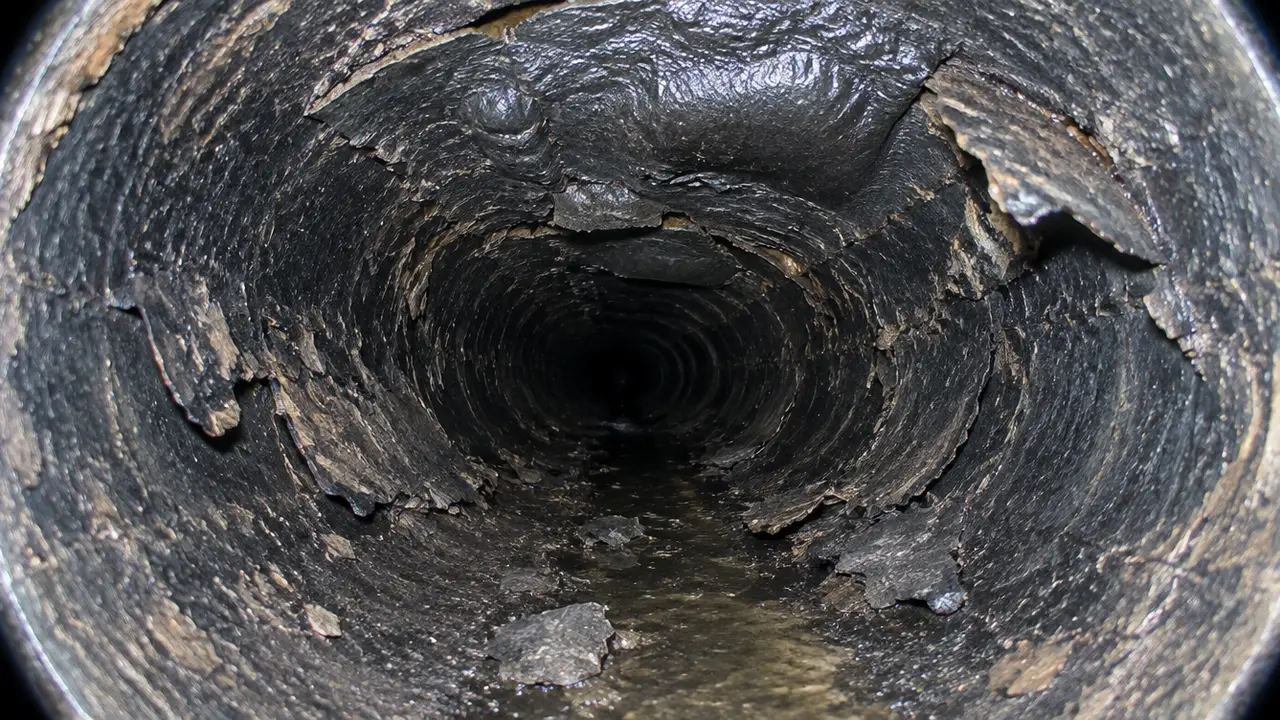
Because Orangeburg, or bituminous fibre pipe, changes shape as it ages. It was made from layers of compressed wood fibre impregnated with coal tar pitch, and it was widely installed for house sewers from the 1940s to the 1970s, according to a history published by a chapter of the American Public Works Association. It was advertised with a 50-year service life, which most surviving lines have now passed.
As moisture works into the fibre, the pipe softens and the soil above presses it oval and eventually flat. Its inner layers can blister and peel, and roots can penetrate the wall. A cured-in-place liner takes the shape of whatever it is cured inside, so lining a deformed fibre pipe produces a deformed liner with a reduced bore, and lining a pipe that is still round leaves a liner inside a host that will keep deforming around it.
- Bursting or splitting is commonly used because the soft fibre crushes and parts easily ahead of the head, and a new pipe follows in the same path.
- Open cut is used where the line sags, where access for bursting is poor, or where the fibre has collapsed and filled with soil.
- Transitions matter: fibre pipe was often joined to a cast iron building drain at the foundation and to clay or concrete near the main, so the replacement usually ends at a coupling on a different material.
05 /How is new pipe joined to the old material?
With couplings made for the purpose. A 100 mm clay, cast iron or fibre pipe does not have the same outside diameter as 100 mm PVC, so the joint must bridge a size difference and still hold the two pipes in line. The CSA standard B602 covers mechanical couplings used to join drain and sewer pipes, including types with a centre stop and an external shield intended for joining different materials or sizes.
- Shielded couplings wrap the rubber sleeve in a stainless steel band that resists shear, so the new and old pipes cannot drop out of line as the trench settles.
- Unshielded rubber couplings flex and can allow an offset to form at the joint, which becomes a new catch point for solids and roots.
- Cutting the old pipe is done with a tool suited to the material; cast iron needs a snap cutter or saw, clay can shatter if cut carelessly, and fibre pipe is soft and may need to be trimmed back to firmer material.
- Bedding at the joint must support both pipes equally, because a coupling cannot hold a heavy old section that has nothing underneath it.
Transitions are where rushed jobs fail first. A finished-line video should show every coupling with no lip, gap or step in the invert. The spot repair guide covers the same joint in detail: spot repair versus full replacement.
06 /Should you replace the whole line or just the worst material?
Plan by segment, then decide whether the segments are worth doing together. Many older homes have a cast iron building drain under the slab, a clay or fibre lateral in the yard, a PVC section left by an earlier repair, and a municipal portion of unknown material beyond the property line. Each segment has its own condition and its own best method.
| Segment | Question to answer | Common outcome |
|---|---|---|
| Cast iron under the slab | How much wall is left after descaling? | Reline if sound; replace by trenching if not |
| Fibre or clay in the yard | Is it round, on grade and passable? | Fibre: burst or dig. Clay: reline or burst |
| Earlier PVC repair | Is it aligned, and are its couplings shielded? | Keep it and join to it, or replace through it |
| Municipal portion | Who owns it, and what is it made of? | Report defects with video; coordinate timing |
Doing everything at once shares the mobilisation, the permit and the restoration, and avoids a new joint between fresh pipe and an old segment that will fail next. Doing only the worst segment makes sense when the others are genuinely sound on camera. The Repair or Replace? Decision Engine treats fibre pipe as a replacement case and adds a note that remaining life is limited for lines 70 or more years old, which is a fair summary of how the materials age.
For how long each old material and its replacement typically last, see how long sewer pipes last. For what happens to the removed pipe, including asbestos-cement and lead joints, see what happens to the old sewer pipe. When the plan is clear, request quotes segment by segment so prices can be compared.
FAQQuestions people ask
Can Orangeburg pipe be relined instead of replaced?
Generally not once it has deformed, because a liner takes the shape of the pipe it cures inside. Bursting or open cut is the usual answer. A still-round fibre pipe is sometimes lined, but the host can keep deforming, so ask about that risk.
Is it worth descaling cast iron before deciding to replace it?
Often, yes. Scale can hide the true wall condition. Descaling followed by a second camera run shows whether the pipe is sound enough to reline or thin enough to replace, and it is required before lining anyway.
What is used to connect new PVC to an old clay or cast iron sewer?
A mechanical transition coupling, ideally a shielded type with a stainless steel band, sized for the two different outside diameters. The joint must be bedded so both pipes are supported equally.
How can I tell what my sewer pipe is made of?
A camera inspection is the reliable way; the operator should name the material at each distance. The age of the house is a clue, not proof, because many older lines have been partly replaced.
Does all of an old clay line need replacing if only one joint is bad?
No. A single defect in otherwise sound clay can be fixed with a spot repair or sectional liner. Full renewal makes sense when defects are spread along the line or keep recurring.
NETWORKGo deeper across the HAUSE Sewer network
Sewer pipe materials by construction era, and what each looks like on camera
Sewer pipe materials by era in Canadian homes: clay, cast iron, Orangeburg, concrete, ABS and PVC, how each one fails and what it looks like on camera.
PipeCleaning.caPipe cleaning methods compared, method by method
Pipe cleaning methods compared: snaking, hydro jetting, descaling, chain knockers, enzymes and chemicals — what each removes, and which pipes each can harm.
SewerJetting.caIs hydro jetting safe for old pipes?
Is hydro jetting safe for old pipes? How jetting affects vitrified clay, cast iron, Orangeburg, concrete and plastic, and why camera-first matters.