For a buried house lateral in Canada, the usual best choice is gasketed PVC sewer pipe, SDR 35 or the thicker SDR 28, laid on proper bedding. For pipe bursting, fused HDPE is the standard. ABS and PVC drain-waste-vent pipe suit building drains inside and under the house. Bedding and joints matter more than small differences between approved pipes.
- SDR is the ratio of outside diameter to wall thickness: the lower the number, the thicker and stiffer the pipe.
- Gasketed PVC sewer pipe is the default for open-cut laterals; fused HDPE is the default for bursting.
- Stiffness helps, but a pipe on poor bedding will still sag, whatever its rating.
- Ask for long sweeps instead of tight bends, a tracer wire on plastic pipe, and a cleanout for future access.
- Your municipality may specify the material and grade for the part of the line it regulates; confirm before buying.
01 /What is the best sewer pipe to use for a replacement?
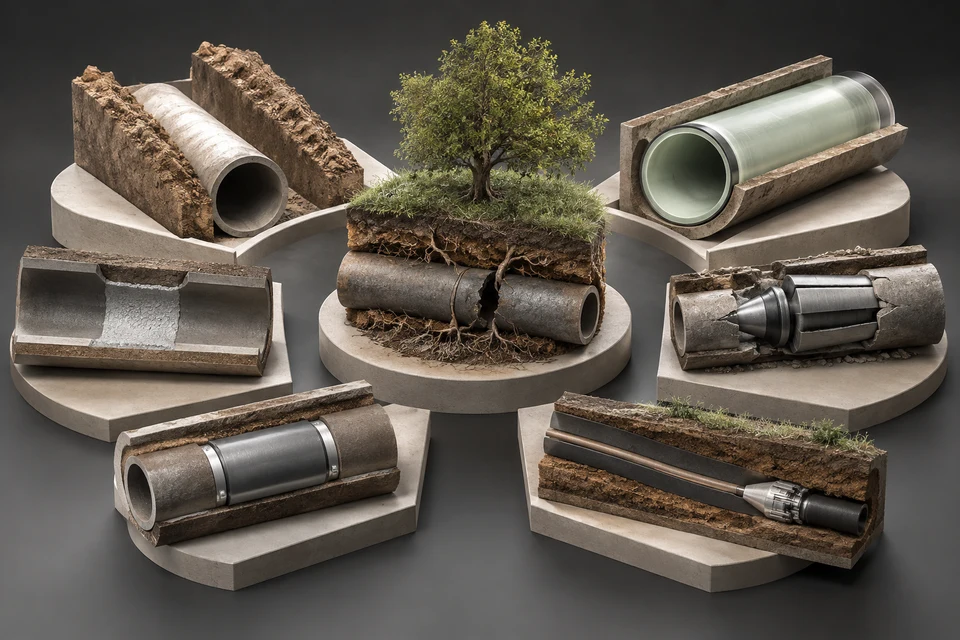
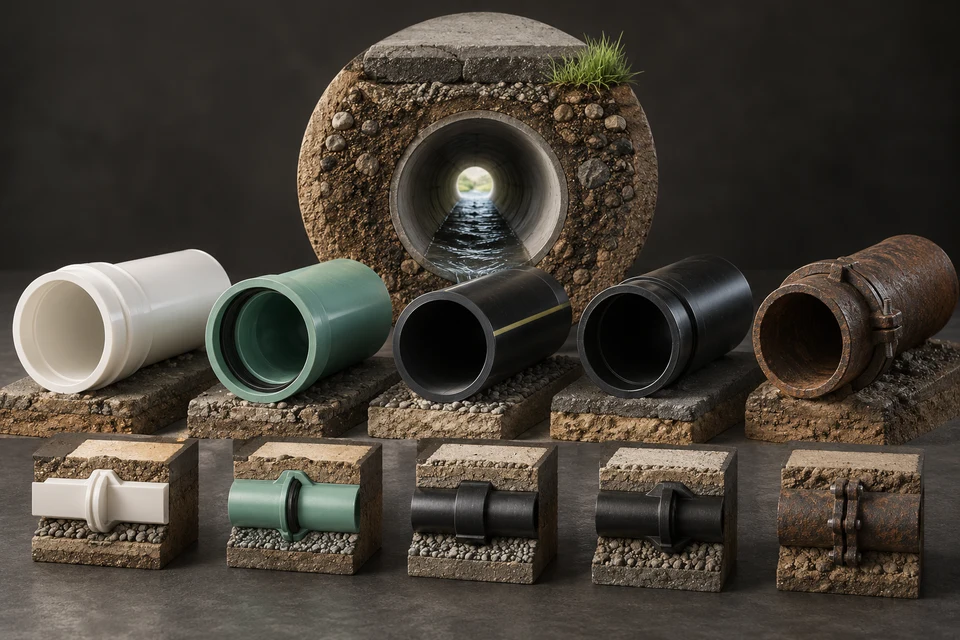
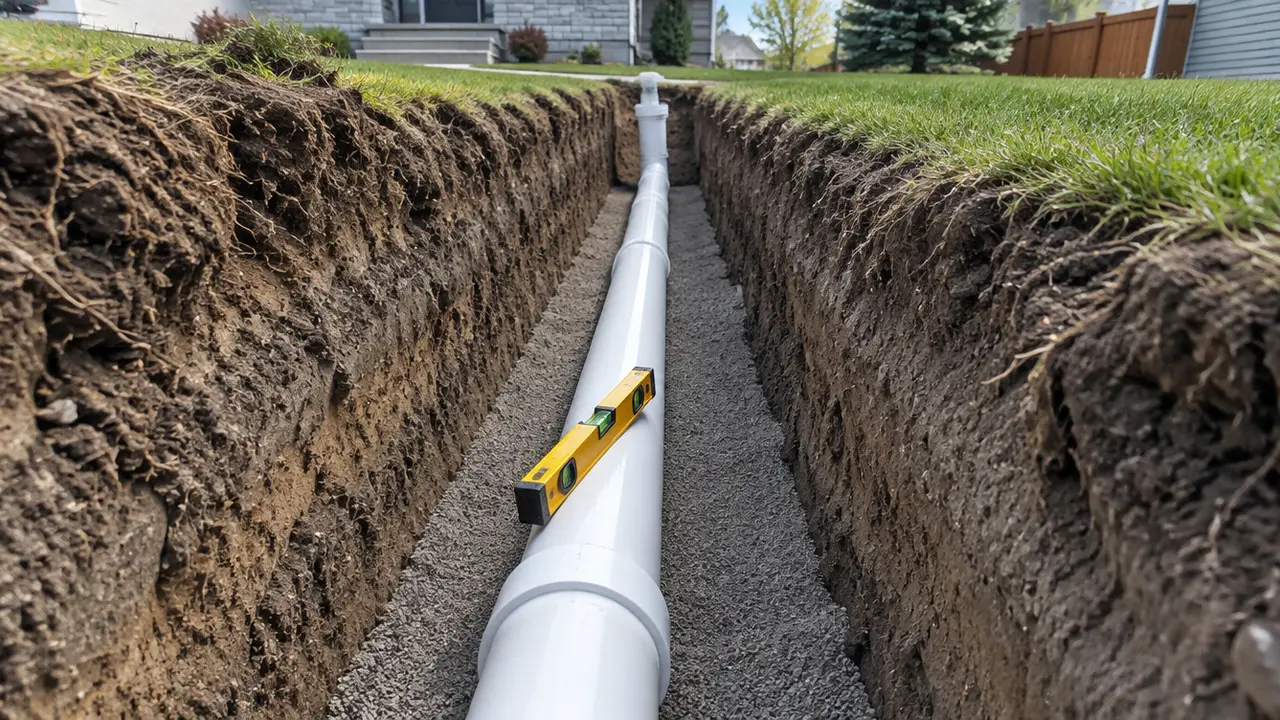
The best pipe is the one approved for the use, matched to the installation method, and installed on a firm, well-compacted bed. For most Canadian house laterals replaced by open cut, that means PVC sewer pipe with gasketed bell-and-spigot joints. Where the line is burst, it means HDPE fused into one continuous length. Where the line is relined, the liner is the new pipe and the old one stays.
| Pipe | Joints | Where it is typically used | Strengths | Watch for |
|---|---|---|---|---|
| PVC sewer pipe, SDR 35 | Gasketed bell and spigot | Buried laterals, open cut | Light, smooth, widely available, chemically resistant | Needs good bedding; thinner wall than SDR 28 |
| PVC sewer pipe, SDR 28 or SDR 26 | Gasketed bell and spigot | Deeper laterals, under driveways | Thicker wall and higher stiffness | Check local standards and fitting availability |
| PVC DWV (solid wall) | Solvent weld | Building drains, some building sewers | Rigid, fully sealed joints | Solvent joints need care in cold weather |
| ABS DWV | Solvent weld | Inside the house and under the slab | Tough, easy to work, common in Canadian homes | Not always permitted for buried laterals; confirm locally |
| HDPE, fused | Butt fusion | Pipe bursting, some directional work | Jointless, flexible, impact resistant | Needs trained fusion; transitions at each end |
| Cast iron (no-hub) | Banded couplings | Inside multi-unit buildings | Quiet, non-combustible | Rarely chosen for a buried residential lateral today |
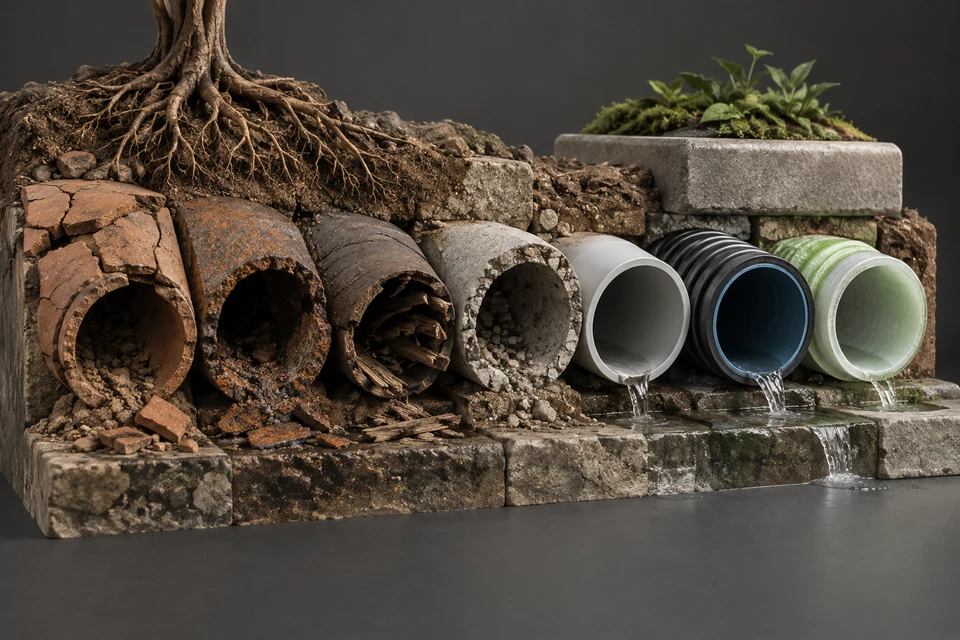
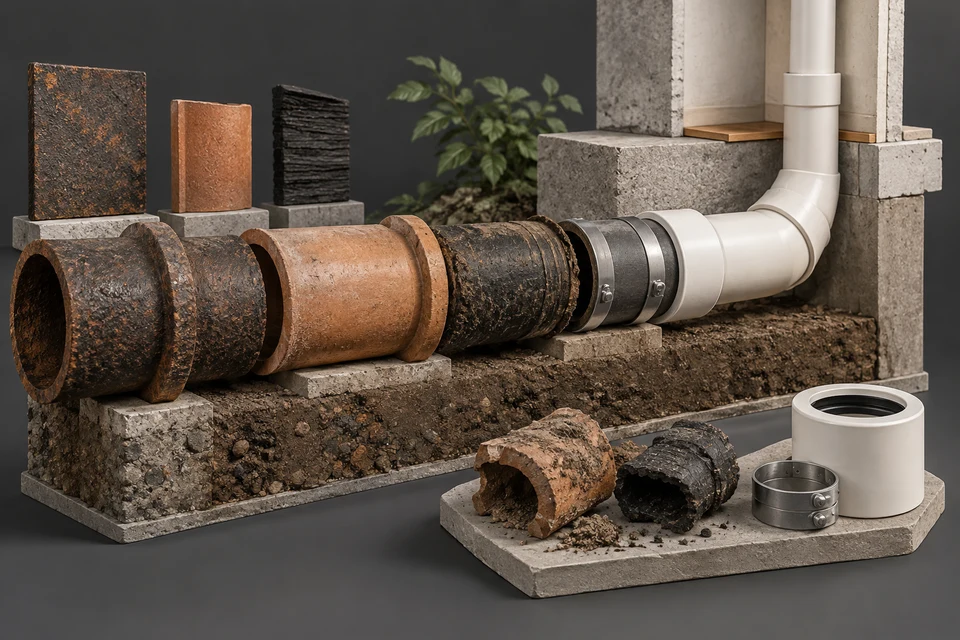
Vitrified clay and concrete are still used for large municipal sewers, but they are seldom chosen to replace a house lateral today. If you find either in a quote for a residential lateral, ask why.
02 /What does SDR 35 mean, and is SDR 28 better?
The rating is a standard dimension ratio (SDR), found by dividing a pipe's outside diameter by its wall thickness. SDR 35 means the wall is one thirty-fifth of the diameter; SDR 28 has a thicker wall for the same diameter, so it is stiffer and resists deflection under soil load better.
| Rating | Approximate wall thickness | Relative stiffness | Typical fit |
|---|---|---|---|
| SDR 35 | About 3.1 mm | Baseline | Standard-depth lawn laterals |
| SDR 28 | About 3.8 mm | Stiffer | Deeper lines, under driveways, where specified |
| SDR 26 | About 4.1 mm | Stiffer again | Deeper or higher-load installations where specified |
Is SDR 28 better? It is stiffer, and on a deep line or under a driveway that margin is worth having. But flexible plastic pipe gets most of its strength from the soil around it. A PVC pipe is designed to deflect slightly and push against well-compacted material at its sides. Put SDR 28 on a lumpy trench bottom with loose backfill and it can still sag; put SDR 35 on proper bedding with compacted haunches and it will perform as designed. Ask what the contractor proposes and why, and check whether your municipality specifies a minimum for the portion it regulates.
In Canada, PVC sewer pipe is certified to CSA Group's B182-series standards, and 100 mm residential sewer pipe is commonly stocked as SDR 28 or SDR 35. The ASTM standard for PSM-type PVC sewer pipe, D3034, is also widely referenced. Look for the certification marking printed along the pipe.
03 /When is HDPE the right replacement pipe?
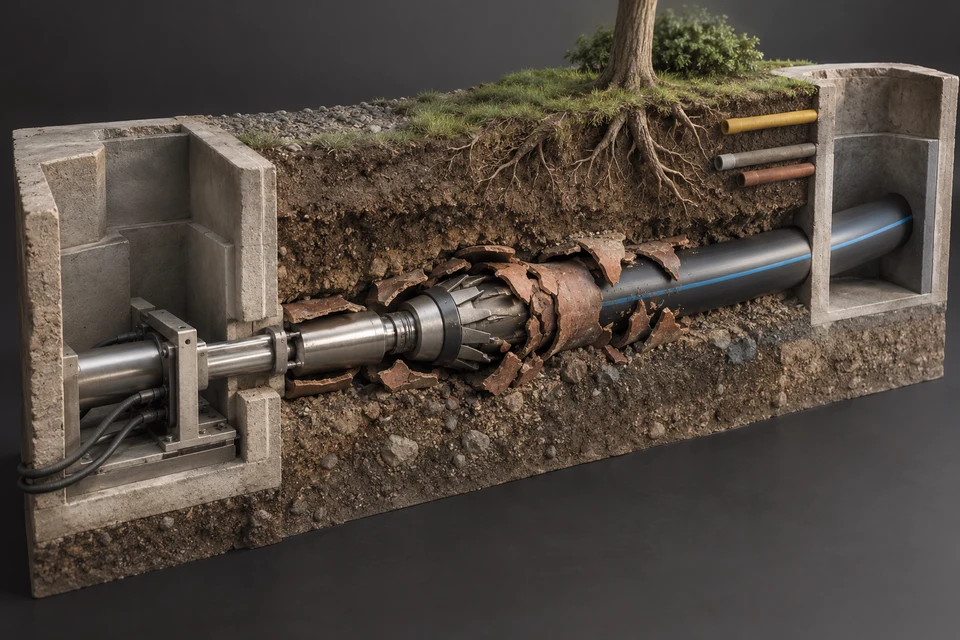
HDPE is the right pipe when the new line is being pulled in rather than laid in a trench, which in residential work mostly means pipe bursting. It is supplied in long lengths or coils, heat-fused into a single string with no gasketed joints, and flexible enough to bend into a launch pit without cracking.
- Jointless: butt-fused joints leave no gasket for roots to find.
- Tough: it tolerates the scraping and point loads of being pulled through fractured pipe fragments.
- Dimension ratio (DR): like SDR, lower means thicker. Ask what DR is proposed and whether it suits the depth.
- Transitions: HDPE cannot be solvent-welded, so each end joins PVC, ABS or cast iron with an approved mechanical coupling or fitting.
- Locating: HDPE is not magnetic, so a tracer wire or marker is needed if you want to find it with a standard locator later.
For the bursting process itself, see pipe bursting explained.
04 /What about ABS and PVC drain-waste-vent pipe under the house?
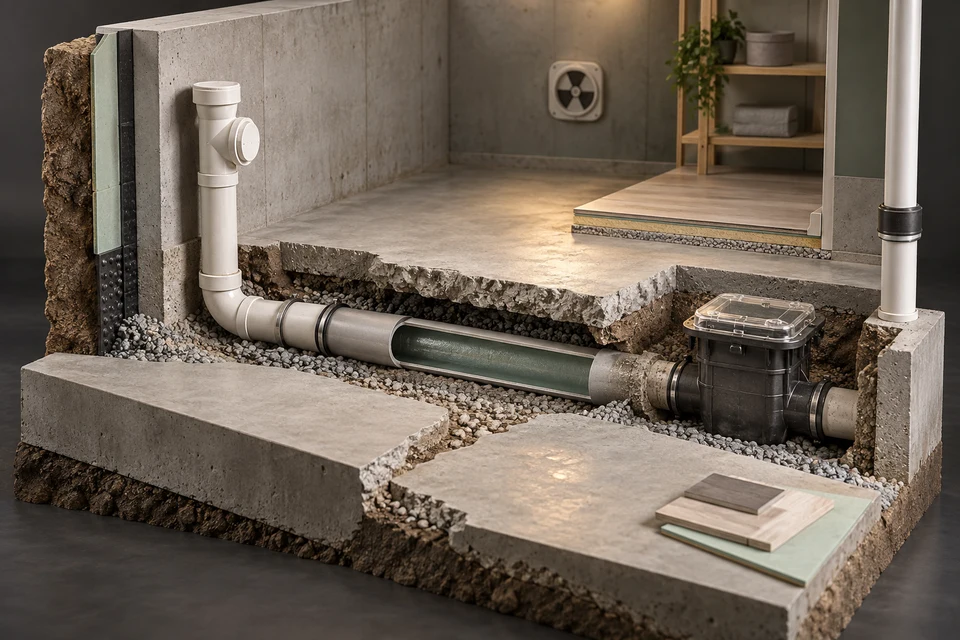
Inside the house and under the basement slab, the building drain is usually replaced with ABS or PVC drain-waste-vent (DWV) pipe with solvent-welded joints. Both are common in Canadian homes; ABS is especially familiar in many western Canadian houses. The choice often comes down to what the rest of the house uses and what the local inspector accepts.
- Match the system. Joining ABS to PVC needs an approved transition method, usually a mechanical coupling, rather than a mixed solvent joint.
- Keep solvent welding warm and clean. Cold, damp conditions slow cement cure; follow the product's temperature guidance.
- Test before cover. New drainage piping is normally tested for leaks before the slab is poured back, when the inspector requires it.
- Think about the backwater valve. A slab replacement is the easiest time to add one where the municipality recommends or requires it.
Replacing a sewer line under a basement slab walks through that job step by step.
05 /Which size of pipe should the replacement be?
Most single-family laterals in Canada are 100 mm (4 in), and a like-for-like replacement is usually right. Larger houses, multi-unit buildings and some older homes use 125 or 150 mm. Upsizing is sensible when fixture load, a new suite, or local standards call for it, not simply because bigger sounds safer.
Oversizing has a cost beyond price. A gravity sewer relies on flow velocity to carry solids along. In a bigger pipe, the same household flow spreads out into a shallower, slower stream, which can leave more solids behind on flat grades. That is why sizing and slope are set together, and why the plumbing code, not preference, governs them. If a contractor proposes a change in size, ask what the code or the municipality requires and how the slope will be set.
06 /What details separate a good replacement from an average one?
The pipe is the smallest part of the specification. The details around it decide whether the line drains well for decades and can be found, cleaned and inspected when it needs to be.
| Detail | Why it matters | What to ask |
|---|---|---|
| Granular bedding and compacted haunches | Prevents sags and deflection | What bedding material, and how is it compacted? |
| Long-radius bends or two 45-degree fittings | Easier for cameras, cables and liners to pass | Will any tight 90-degree bends be buried? |
| Cleanout near the foundation | Access for future cleaning and inspection | Where will the cleanout be, and is it two-way? |
| Tracer wire or marker tape | Plastic pipe can be located later | Will a tracer wire be run and brought up at the cleanout? |
| Approved transition couplings | Sound joints to existing pipe | What coupling at each end, and is it shielded? |
| Pipe markings left visible for inspection | Shows material, rating and certification | Can I see the pipe markings before backfill? |
07 /Does the replacement material affect how long the line lasts?
Yes, but installation quality usually matters more. Modern plastics do not corrode, and fused or gasketed joints resist roots far better than old mortar or packed joints. Industry groups quote design lives measured in many decades for PVC and HDPE sewer pipe. The failures seen in plastic lines are almost always installation or ground problems: sags from poor bedding, joints that were not fully seated, or damage from later digging.
For lifespans of both the old and new materials, see how long sewer pipes last. To see which methods, and therefore which pipes, fit your site, try the Replacement Method Selector, then request quotes that state the pipe, rating and bedding in writing.
FAQQuestions people ask
What is the best pipe for a sewer line?
For an open-cut house lateral, gasketed PVC sewer pipe such as SDR 35 or SDR 28, properly bedded. For pipe bursting, fused HDPE. Inside the house, ABS or PVC DWV to match the existing system and local code.
Is SDR 35 strong enough for a sewer lateral?
SDR 35 is widely used for residential sewer laterals and is strong enough when installed on proper bedding with compacted haunches. Deeper lines or lines under driveways may justify SDR 28 or what the municipality specifies.
Is ABS or PVC better for a sewer line?
Both are approved plastics. PVC sewer pipe is the more common choice for buried laterals; ABS is common inside Canadian homes. Match the existing system and confirm what your inspector accepts.
Why is HDPE used for pipe bursting?
Because it can be fused into one continuous, jointless length, it is tough enough to be pulled through fractured pipe, and it is flexible enough to bend into the launch pit.
Should I upsize my sewer line when replacing it?
Only if the fixture load, a new suite, or local rules require it. A larger pipe carries household flow more slowly and shallowly, which does not always help. Size and slope should be set together under the code.
NETWORKGo deeper across the HAUSE Sewer network
Sewer pipe materials by construction era, and what each looks like on camera
Sewer pipe materials by era in Canadian homes: clay, cast iron, Orangeburg, concrete, ABS and PVC, how each one fails and what it looks like on camera.
PipeCleaning.caWhat pipe do I have? Identify your drain pipe material
What pipe do I have? Identify a drain pipe from its look, joints, markings and house age, with a confidence rating, safe cleaning methods and camera advice.
SewerJetting.caIs hydro jetting safe for PVC and ABS drain pipe?
Can hydro jetting damage PVC or ABS pipe? What plastic lines tolerate, where they are weak (joints, fittings, bellies, heat) and how to jet them safely.