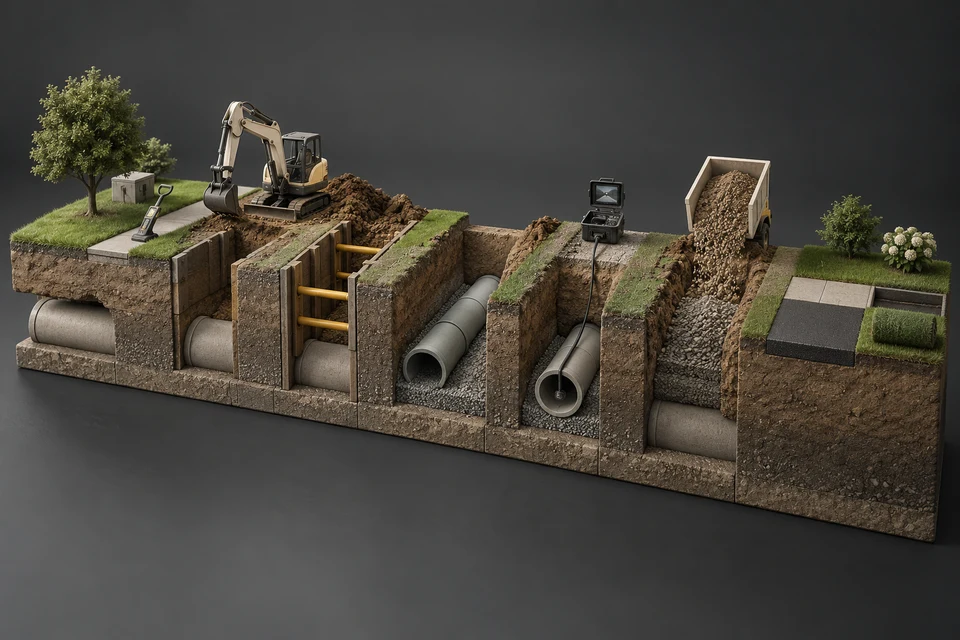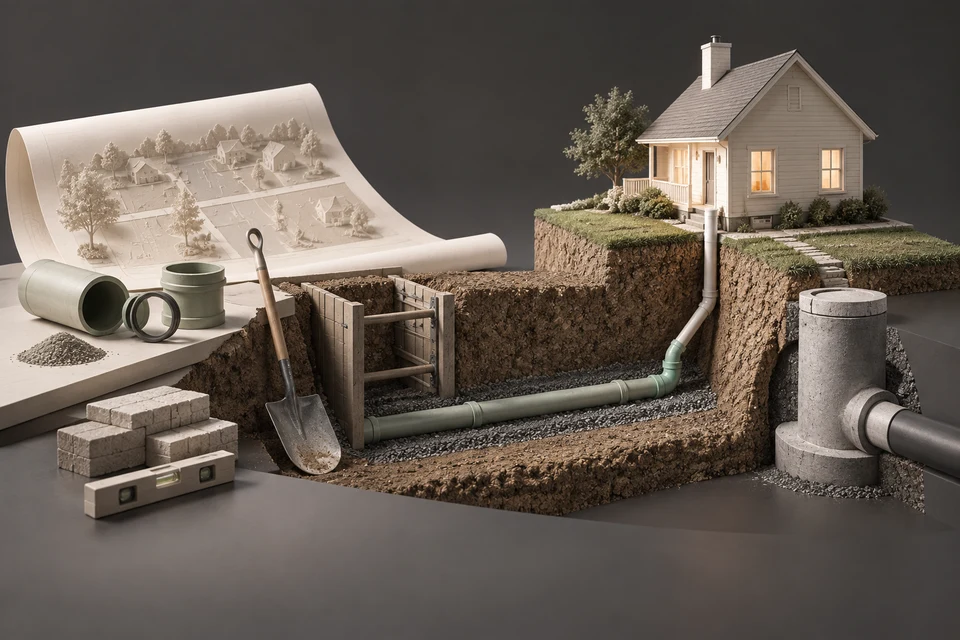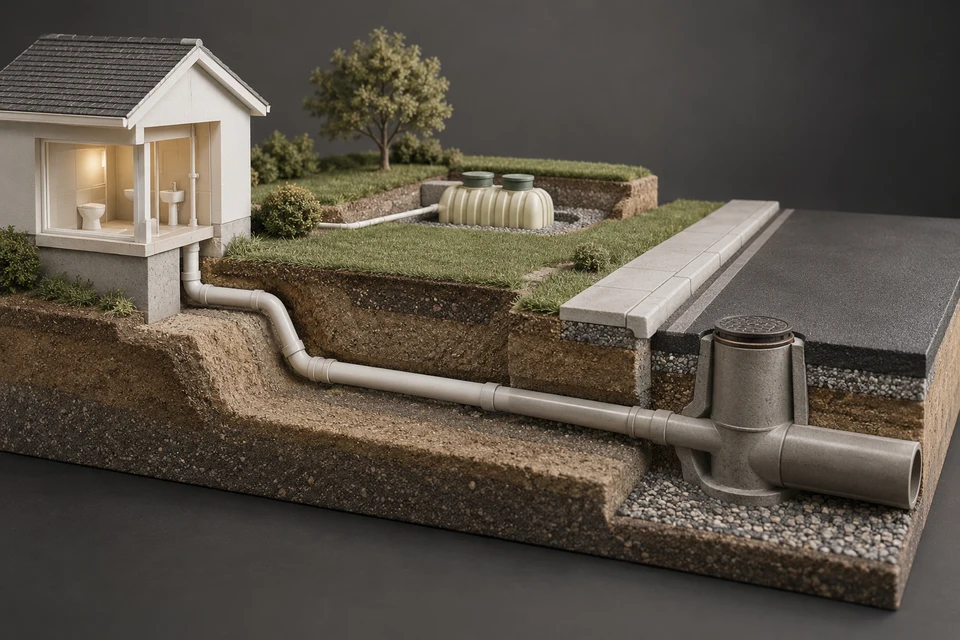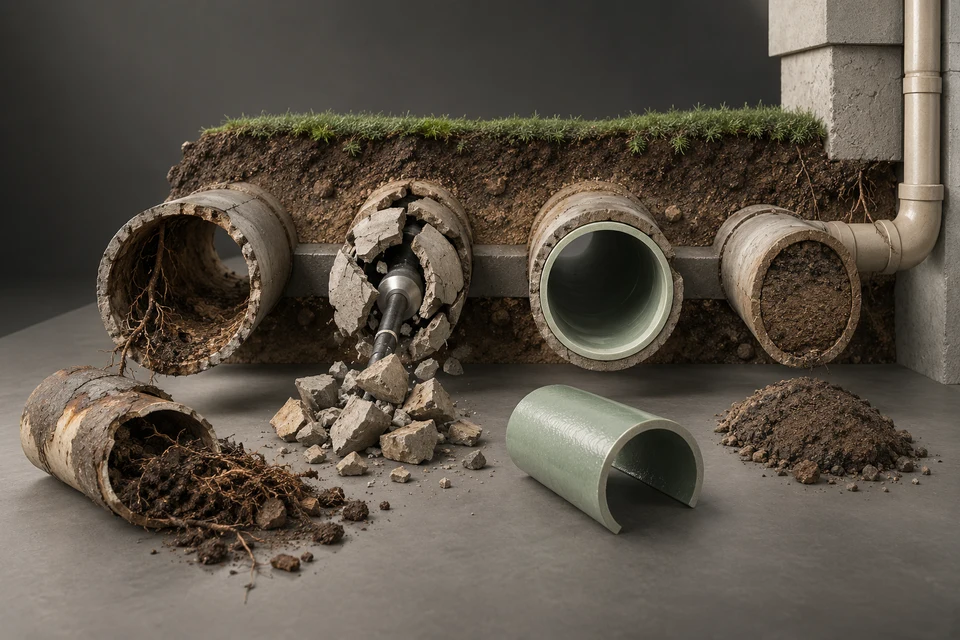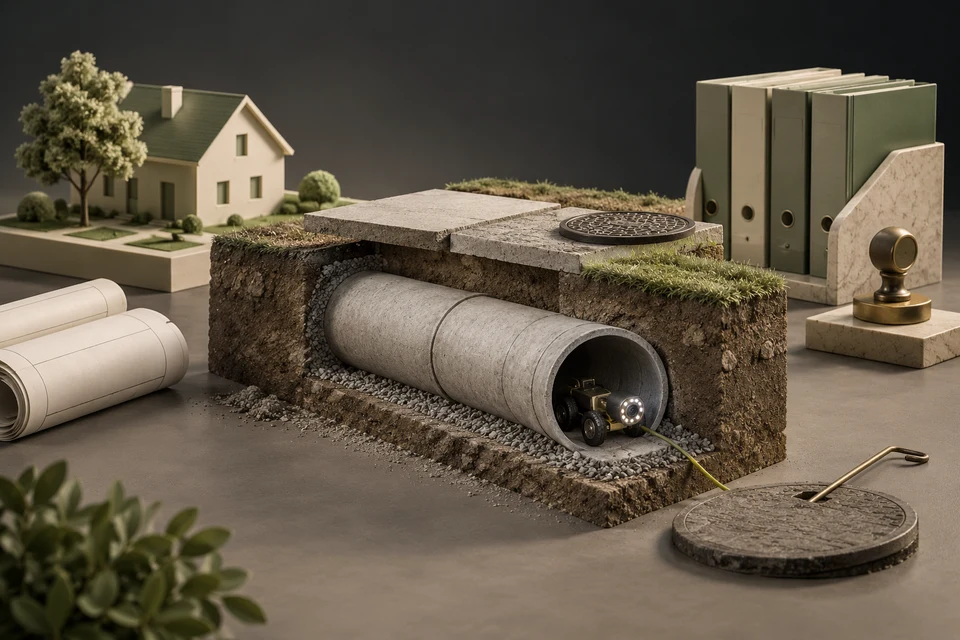
Most Canadian municipalities require a plumbing permit and an inspection before a replaced sewer line is buried, and work on a boulevard, sidewalk or road needs separate right-of-way approval. Rules come from provincial codes based on the National Plumbing Code, but the municipality or its inspection agency decides what your job needs, so confirm with it before work starts.
- Plumbing is regulated provincially, permits are usually issued locally, and the local answer is the one that governs your job.
- A replacement can involve several approvals: plumbing, right-of-way, the municipal connection, trees and, off the sewer grid, private sewage.
- The contractor normally applies; homeowner permits exist in many places, but only for owners doing the work themselves.
- The inspection happens before backfill, so the schedule has to leave the pipe exposed until it is passed.
- Keep the permit number, the inspection result and the finished-line video together; they are the proof the work was done properly.
01 /Do you need a permit to replace a sewer line in Canada?
In most places, yes. Building drains and building sewers are part of the plumbing system, and the National Plumbing Code of Canada, published by the National Research Council, sets requirements not only for new plumbing but for the extension, alteration, renewal and repair of existing systems. Provinces and territories adopt an edition of that model code, sometimes with changes, and municipalities or accredited agencies issue permits and inspect under it.
The layers matter because they do not always say the same thing. Alberta's Permit Regulation, for example, lists installing a building sewer outside a building among the situations where a provincial plumbing permit is not required, while the City of Calgary's homeowner permit page lists replacing water and sewer lines in or around the home as work that needs a plumbing permit. Both were on official pages when this guide was written. The lesson is simple: the office that will inspect your job is the one to ask.
Ontario offers another pattern. The City of Toronto issues stand-alone plumbing and drain permits for work not tied to other construction, and states plainly that it does not replace or install sewer service connections on private property, which remain the owner's responsibility. Other municipalities in the same province may organise the same work differently.
02 /Which parts of a replacement need which approval?
A sewer replacement is really several pieces of work, and each may fall under a different approval. Listing them before quotes arrive shows you which contractor has thought about the whole job.
| Work item | Typical approval | Usually issued by | Notes |
|---|---|---|---|
| New or relined building drain and building sewer on private land | Plumbing permit | Municipality or accredited inspection agency | Some places treat lining or small repairs differently; ask |
| Digging in a boulevard, sidewalk or road | Right-of-way, street-use or excavation permit | Municipal roads or engineering department | May require traffic control, a bond or municipal crews |
| New connection or reconnection at the main | Connection approval or municipal work order | Municipal water or wastewater utility | Some cities do this work themselves |
| Excavation near a protected tree | Tree permit or protection plan | Municipal forestry or parks department | Thresholds and zones are set by local bylaw |
| House-to-tank line on a septic system | Private sewage or onsite permit | Municipality, health unit or provincial agency | See replacing the line to a septic tank |
| Public utility locates | Locate request, not a permit | Provincial one-call centre | Private lines need a private locator |
Repairs sometimes sit in a grey zone. The City of Calgary, for instance, lists repairing a leak in a drainage system and removing a blockage as work that does not need a plumbing permit. Whether a particular spot repair or sectional liner counts as a repair or an alteration is a question for your permit office, before the work, not after.
03 /Who should apply for the permit?
In most cases the contractor doing the work applies, in its own name, because the permit ties the work to a qualified person who answers for it at inspection. Ask for the permit number before the start date and write it into your contract; a company that is vague about permits is telling you something about how it will treat the inspection.
Homeowner permits exist in many jurisdictions for owners doing their own plumbing. Alberta's Permit Regulation allows a permit in the plumbing discipline to be issued to an owner who lives, or intends to live, in a single-family dwelling, and Calgary's homeowner permit page adds that the owner must be doing the work personally and that the home cannot be a rental. Those conditions exist because the permit holder is accountable for the work. If you are weighing that route, read replacing your own sewer line first.
04 /What does the inspector check before the trench is closed?
The inspection exists to see what nobody will see again: the pipe, its support and its slope before they are buried. The exact checklist depends on the code edition and local practice, but inspectors of open-cut work commonly look at the same things.
- Material and markings: the pipe and fittings are of a type approved for a building sewer, with the standard printed on the pipe visible.
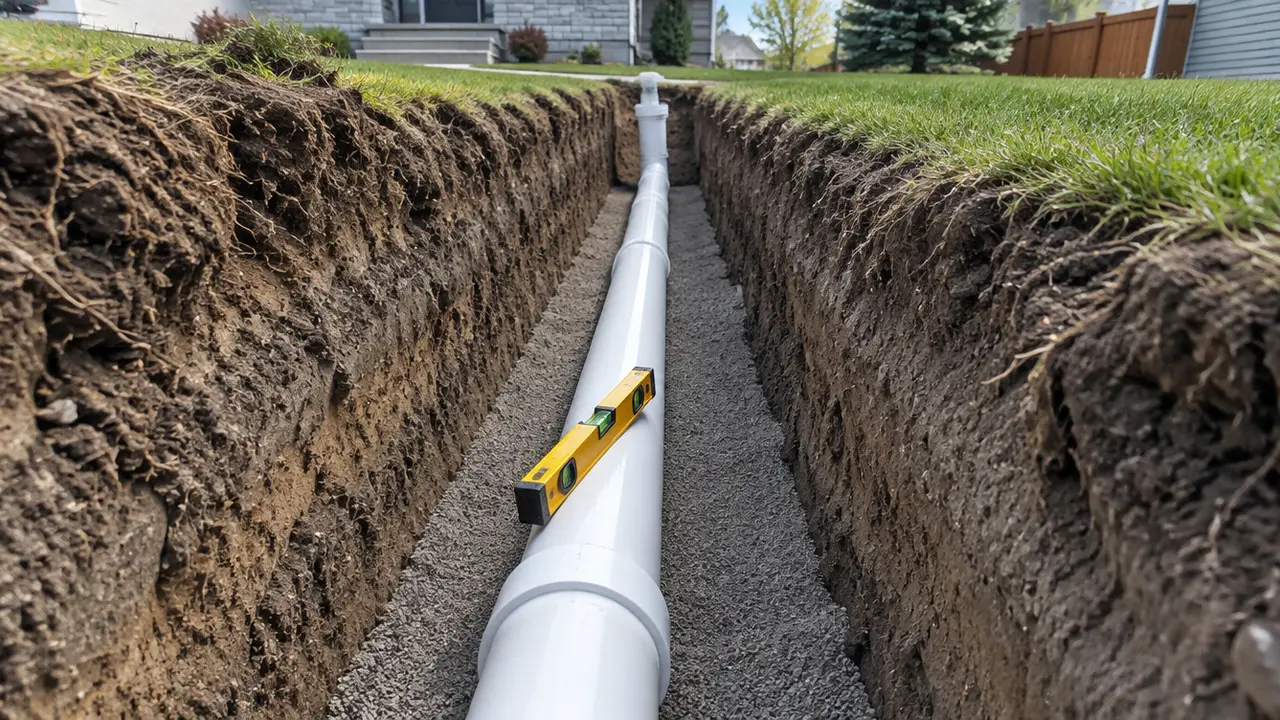
- Bedding and support: the pipe rests on compacted granular bedding along its full length, not on rocks, clods or blocking.
- Slope: the line falls steadily toward the main at no less than the minimum slope that applies to its size, with no dips.
- Joints and transitions: gaskets seated, solvent joints made correctly, and approved couplings where new pipe meets old.
- Cleanouts and valves: access where the code or the municipality requires it, and a backwater valve where one is required or chosen.
- Testing: some jurisdictions ask for a water or air test, or accept a camera video, before cover.
Trenchless work is inspected differently, because there is little to see from the surface. Expect the inspector or the municipality to rely on before and after video, the liner or pipe specification, and the exposed connections at the pits. Ask your contractor in advance how the local inspector handles lining and bursting, and include the answer in the scope.
05 /How do permits and inspections affect the schedule?
They add lead time at the start and a hold point in the middle. Permits for private-side work can be quick; approvals that touch a road or the main can take much longer, and inspection bookings depend on the local office's calendar. The trench has to stay safely open, fenced and shored until the inspector has passed the work.
| Stage | Approval activity | What can hold it up |
|---|---|---|
| Before quotes are final | Confirm what permits apply | Unclear ownership boundary at the property line |
| Before the start date | Permit issued; locates requested | Road or boulevard work; municipal crew scheduling |
| Pipe laid, trench open | Inspection booked and passed | Inspector availability; corrections required |
| After backfill | Final sign-off where required | Restoration standards on municipal land |
Permit fees are a small part of the total. Using the ranges published by our sister site SewerQuotes.com, permits for a residential sewer job run from roughly $150 to $1,000 or more depending on scope and municipality, and work on municipal land can carry its own fees and restoration charges.
06 /What if a sewer line was replaced without a permit?
Unpermitted work tends to surface at inconvenient moments: after a backup claim, during a sale when a buyer's inspector scopes the line, or when the municipality finds the connection during its own work. Depending on local practice, the fix may be a retroactive permit, an inspection based on video, or uncovering parts of the line so an inspector can see them.
- If you are buying a house and the seller says the line was replaced, ask for the permit number and check it with the municipality.
- If you did the work yourself without a permit, call the permit office and ask what it needs to close the gap. Video, photos with measurements and receipts all help.
- If a contractor skipped the permit, raise it with the contractor first; the permit should have been part of the job you paid for.
07 /Which records should you keep after the job?
Keep a single folder, paper or digital, with everything needed to prove what is in the ground and that it was approved. It will be asked for by insurers, buyers and the next contractor who works on the line.
- Permit and inspection result
The permit number, the inspection date and the pass or correction notice.
- Before and after video
The original footage that justified the work and a finished-line run with the distance counter visible.
- As-built sketch
Distances from the foundation to cleanouts, fittings and the property line, with depths where known, and the location of any abandoned pipe.
- Materials
Pipe type and rating, liner specification if lined, and the couplings used at each transition.
- Warranty
The written warranty, with what it covers and for how long. See sewer replacement warranties.
For the full sequence on site, read what happens during replacement, day by day. When you ask for prices, request quotes that name every approval and who is obtaining it. Calgary owners will find the City's process covered in depth on CalgarySewerReplacement.ca.
FAQQuestions people ask
Does relining a sewer pipe need a permit?
It depends on the municipality. Some treat full-length relining as an alteration needing a plumbing permit and video inspection, and others handle it differently. Ask your permit office before work starts and put the answer in the contract.
Who books the sewer inspection, me or the contractor?
Normally the permit holder books it, which is the contractor when the contractor pulled the permit. Ask for the inspection date and a copy of the result, and do not agree to backfill before the inspection is passed.
Can the trench be backfilled before the inspector arrives?
Not where an inspection is required. Covering the pipe early can mean digging it up again so the inspector can see the bedding, slope and joints. Plan the schedule around the booking.
Do I need a separate permit for the part of the lateral under the boulevard?
Often, yes. Work on municipal land such as a boulevard, sidewalk or road usually needs a right-of-way or excavation permit in addition to the plumbing permit, and some municipalities do that work with their own crews.
How can I check whether a previous owner's sewer replacement had a permit?
Ask the municipality's permit or records office for the permit history of the address. Many municipalities can confirm whether a plumbing permit was issued and whether its inspection was passed.
NETWORKGo deeper across the HAUSE Sewer network
Sewer permits, inspections and who pays: owner or city?
Sewer line permits and who pays in Canada: the usual owner vs city split, permit and inspection costs, road cuts, city tree roots and what to confirm.
SewerRoots.caWhose tree, whose pipe: who pays when roots block a sewer line
Who is responsible when a city or neighbour's tree sends roots into your sewer line: the general Canadian pattern, the evidence, and how to raise it.
SewerInspector.caSewer scope on a new build: what goes wrong in brand-new sewer lines
Is a sewer line inspection necessary for new construction? What goes wrong in new laterals, when to scope before warranty dates, and what to ask the builder.