Sometimes, on the private side, where your municipality issues homeowner plumbing permits for a house you own and live in. The connection to the municipal system usually needs an approved contractor, and every job needs locates, an inspection before backfill, and a safe trench. For most people, the realistic DIY role is preparation, restoration and informed supervision.
- Permission comes first: many municipalities allow homeowner permits for some plumbing work, but rules for building sewers and municipal connections are stricter.
- Trench collapse is the main danger, and a single cubic metre of soil weighs well over a tonne.
- Setting and holding a continuous grade over the whole run is the technical skill that separates a working sewer from a new belly.
- Public locates, private locates and an inspection before cover are required whoever does the work.
- You can save real money on site preparation and restoration without taking on the dangerous or regulated parts.
01 /Are Canadian homeowners allowed to replace their own sewer line?
It depends on your municipality and province. Some municipalities issue plumbing permits to homeowners for work on a single-family house they own and occupy, including drainage piping. Others require a certified plumber for any work on the building sewer, and almost all restrict who may connect to, or excavate at, the municipal main or in the public right-of-way.
| Part of the job | Homeowner may be allowed? | Usually required |
|---|---|---|
| Interior drain replacement in an owner-occupied house | Often, with a homeowner permit | Permit and inspection |
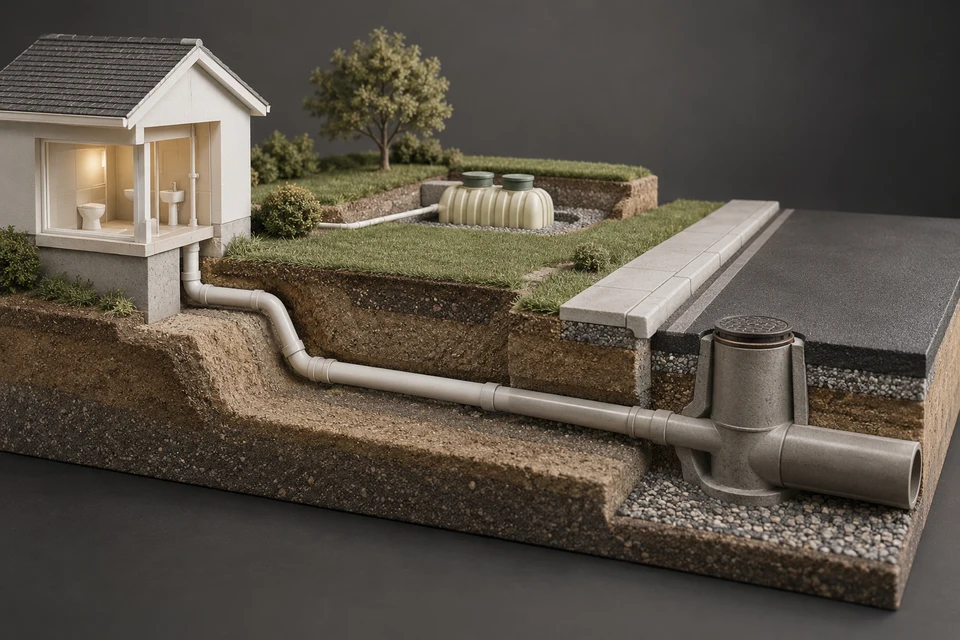
| Private lateral on your own lot | Sometimes, with a homeowner permit | Permit, locates, inspection before backfill |
| Connection at the property line or municipal service | Rarely | Municipal approval; often approved contractors only |
| Work in the boulevard, sidewalk or road | Almost never | Municipal permission, traffic control, approved contractors |
| Rental property or a house you do not live in | Less often | A certified trade in many places |
Call your municipality before you buy a single fitting. Ask whether a homeowner permit is available for the work you intend, what inspections are required, and whether the municipality must make or approve the final connection. In Calgary, 311 is the starting point.
02 /Why is the trench the most dangerous part?
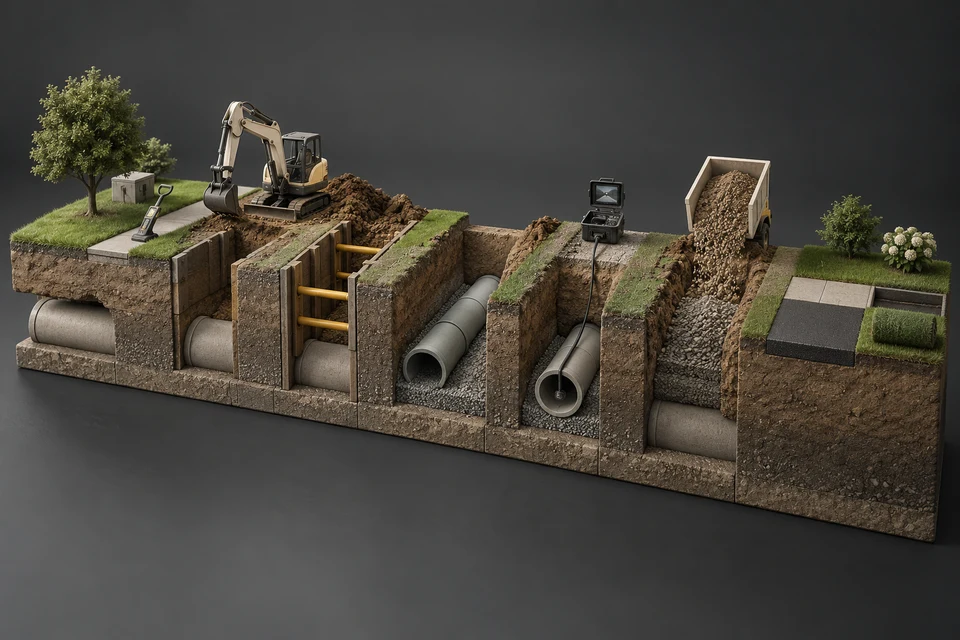
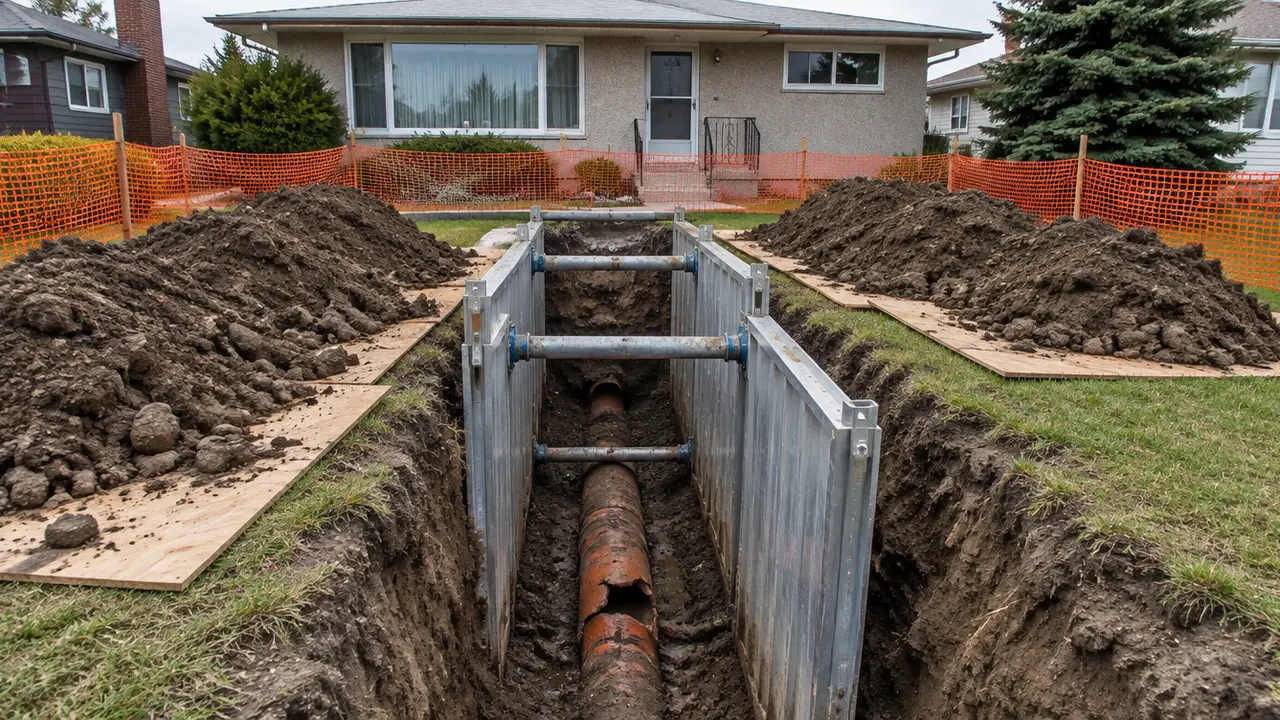
Because trench walls fail without warning, and soil is far heavier than it looks. A single cubic metre of typical soil weighs well over a tonne, and a partial collapse at chest height can pin and crush a person even when their head stays clear. Sewer trenches are often deep enough for this to be fatal.
- Provincial occupational health and safety rules require trench protection beyond set depths, commonly around 1.2 to 1.5 m. Those rules exist because trench deaths happen in shallow, ordinary-looking excavations.
- Spoil piled at the edge adds weight to the wall and can slide back in.
- Wet soil, sandy soil, previously dug ground and vibration from equipment all make collapse more likely.
- Excavations near sewers can collect hydrogen sulphide and low-oxygen air, which a person may not smell at dangerous levels.
- Rented excavators bring their own risks: buried gas and power lines, overhead lines, and tipping on slopes and trench edges.
03 /What technical skills does a sewer replacement demand?
The core skill is setting and holding a continuous grade from the house to the connection. Beyond that, a DIYer needs to prepare a proper bed, join different pipe materials correctly, and backfill so the pipe does not move.
| Run length | Fall at 1 in 100 (1%) | Fall at 1 in 50 (2%) |
|---|---|---|
| 10 m | 0.10 m (100 mm) | 0.20 m (200 mm) |
| 15 m | 0.15 m (150 mm) | 0.30 m (300 mm) |
| 20 m | 0.20 m (200 mm) | 0.40 m (400 mm) |
| 30 m | 0.30 m (300 mm) | 0.60 m (600 mm) |
The arithmetic is simple; holding it in the ground is not. The fall must be continuous, with no local dips, and it has to meet the elevations of the building drain and the municipal service, which are fixed. Professionals use a pipe laser or a builder's level and check every length as it is laid. Confirm the minimum slope your inspector applies for your pipe size before you start.
- Bedding: remove soft material, place granular bedding, and compact it so every length sits evenly.
- Haunching: work bedding under the lower sides of the pipe; plastic pipe relies on that side support.
- Joints: fully seat gasketed joints with the correct lubricant; use approved transition couplings to join old pipe.
- Cleanout: install one where cables and cameras can reach the line later.
- Backfill in lifts: compact in layers; do not drop large rocks onto the pipe.
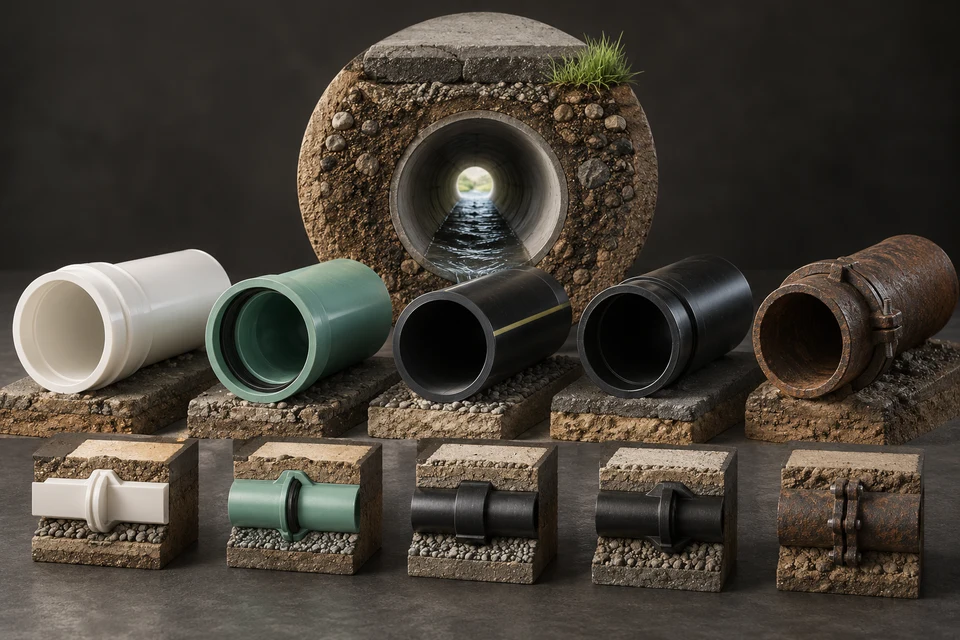
For materials, ratings and fittings, see best pipe for sewer replacement.
04 /What must happen whoever does the work?
A permit, locates and an inspection are not optional just because the owner is doing the work. They protect you, the next owner and your neighbours. How the approvals fit together across provinces and municipalities is set out in sewer line replacement permits and inspections.
- Permit
Obtain the permit the municipality requires before starting, and keep it posted or on hand.
- Public locates
Request locates through your provincial one-call service, such as Utility Safety Partners in Alberta and British Columbia or Ontario One Call, and wait for all utilities to respond.
- Private locates
Find private lines that public locates do not mark: garage power, gas to outdoor appliances, irrigation and the sewer itself.
- Inspection before cover
Book the inspection when the pipe is laid and exposed. Do not backfill before it passes.
- Records
Keep the permit, inspection result, photos with measurements and a camera video of the finished line.
05 /Which parts can a homeowner realistically do?
The parts that do not involve deep excavation, the municipal connection or specialised equipment. These can still take a meaningful share off a professional quote, as long as you agree the split in writing.
| Task | Homeowner? | Notes |
|---|---|---|
| Clearing the route: planters, fences, decking, stored items | Yes | Agree in writing what the crew expects to find |
| Lifting and saving sod, pavers or landscape stone | Yes | Stack pavers well away from the trench |
| Interior demolition of finishes over an under-slab drain | Often | Leave concrete cutting to the crew unless you have the tools and dust control |
| Excavation, trench protection, pipe laying | Rarely advisable | The dangerous and regulated core of the job |
| Connection to the municipal system | Almost never | Usually approved contractors or the municipality |
| Final grading, topsoil, seed, sod, paver relaying | Yes | After the trench has been properly compacted |
Some contractors are happy to exclude restoration; others prefer to control it. If you take restoration on, the settlement of the trench over the first winter becomes your problem, so ask that the backfill be compacted in lifts and discuss who tops up settlement.
06 /What about trenchless DIY?
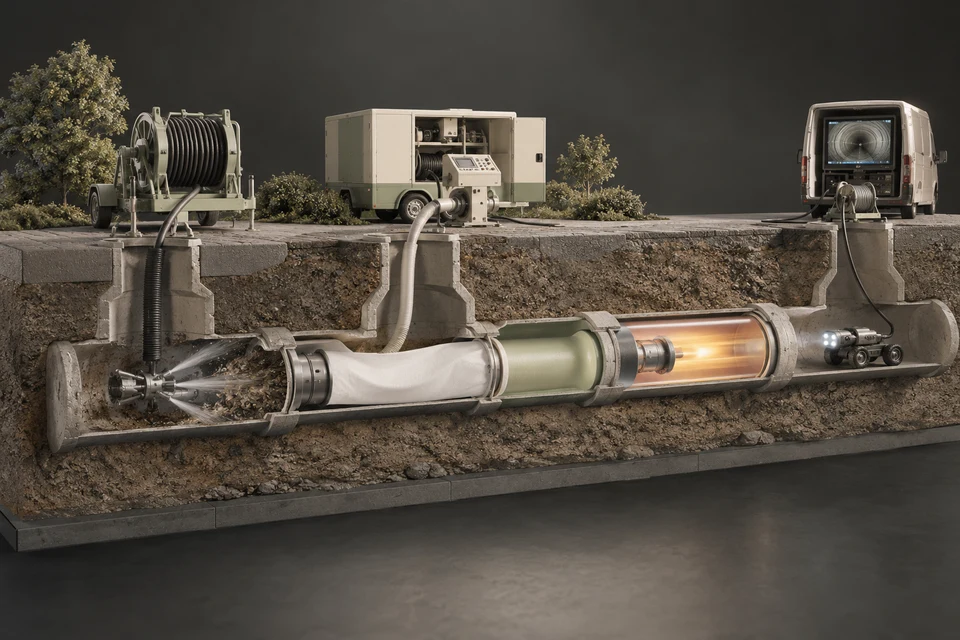
Trenchless replacement is not a realistic DIY job. Lining requires resin systems, inversion equipment, curing control and robotic reinstatement cutters, and bursting requires hydraulic pullers, fusion machines and experience reading how soil will move. The equipment is not generally available for rent to homeowners, and the installation is where quality is made or lost.
What a homeowner can do is make trenchless work go well: find and expose the cleanout, clear access to it, make sure every trap has water in it before a liner cures, and review the before and after videos carefully. How trenchless sewer replacement works explains what to watch for.
07 /Does DIY affect insurance, warranties or resale?
It can. Pipe manufacturers' warranties generally assume installation to their instructions and code. Home insurers may ask whether work was permitted and inspected after a claim, a point covered in does insurance cover sewer line replacement. A future buyer's inspector may scope the line and ask for the permit history.
- Keep the permit, the passed inspection and the video together with the house records.
- Ask your insurer before starting whether owner-performed plumbing affects your coverage.
- Disclose the work honestly when you sell, with its documentation.
If the risk and permission questions point you toward hiring, how to choose a sewer replacement contractor covers what to check, and you can request quotes that exclude the preparation and restoration you plan to do yourself.
FAQQuestions people ask
Can I replace my own sewer line?
Possibly, on the private side, if your municipality issues a homeowner plumbing permit for the work. The municipal connection and any work in the road or boulevard usually require approved contractors. Locates and inspection are always required.
Does a homeowner doing the work still need a permit?
In most Canadian municipalities, yes. Drainage work generally requires a plumbing permit and an inspection before backfill, whether a homeowner or a contractor does it. Check with your municipality first.
How deep can I dig a trench without shoring?
Provincial workplace rules commonly require sloping, benching or shoring beyond about 1.2 to 1.5 m, depending on the province. Collapse can injure or kill at shallower depths, so treat any trench above knee height with caution.
What slope should a sewer line have?
Canadian plumbing codes set minimum slopes for building drains and sewers, commonly expressed as 1 in 50 or 1 in 100 depending on pipe size. Confirm the figure your inspector applies before laying pipe.
Can I do the digging and have a plumber lay the pipe?
Some contractors will agree to split work, but excavation carries the greatest risk and affects their ability to lay pipe to grade. More commonly, owners take on preparation and restoration while the contractor handles the trench and pipe.
NETWORKGo deeper across the HAUSE Sewer network
Whose tree, whose pipe: who pays when roots block a sewer line
Who is responsible when a city or neighbour's tree sends roots into your sewer line: the general Canadian pattern, the evidence, and how to raise it.
SewerQuotes.comSewer permits, inspections and who pays: owner or city?
Sewer line permits and who pays in Canada: the usual owner vs city split, permit and inspection costs, road cuts, city tree roots and what to confirm.
SewerInspector.caSewer camera inspection certification and training: what it proves
Sewer camera inspection certification and training in Canada: NASSCO PACP and LACP, home inspector courses, safety training and what a credential proves.